







Question: The functions you NEED to write (i.e., the filesystem driver) In this assignment, another application (a.k.a., the unit-tests provided to you) will call your code
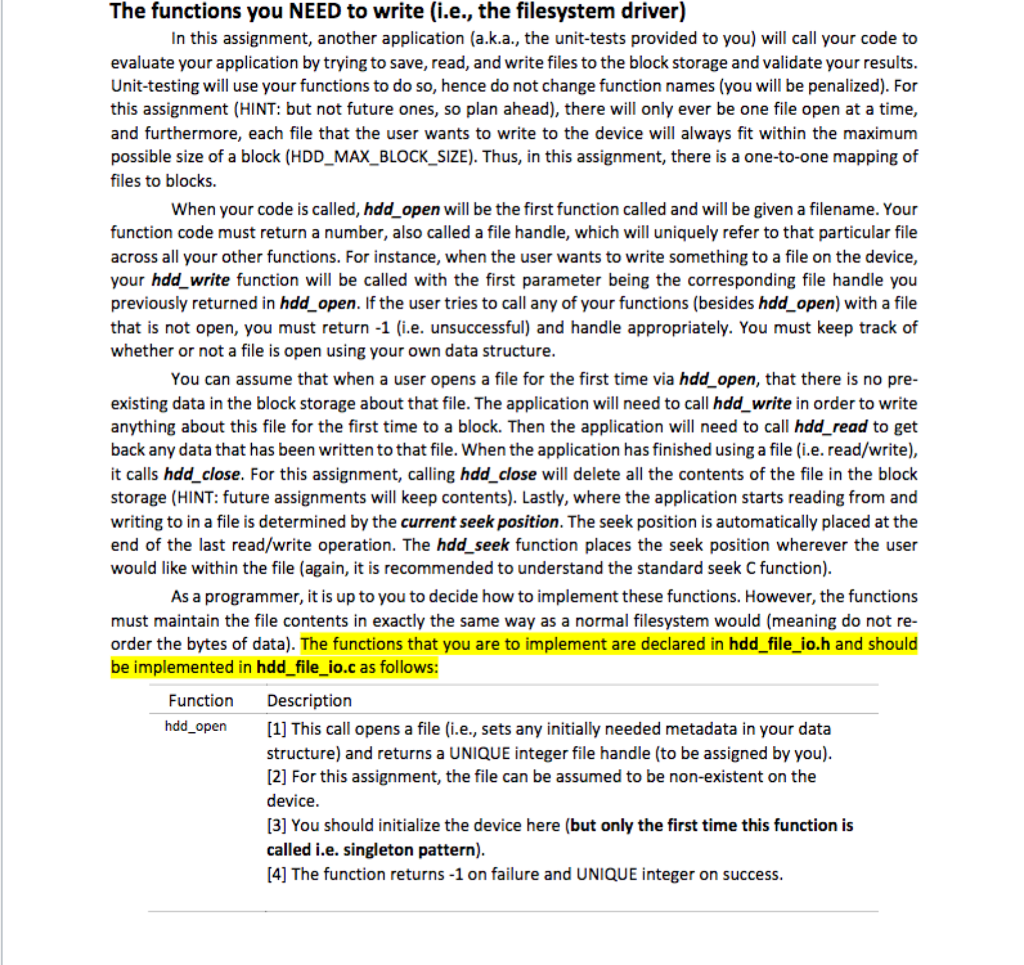
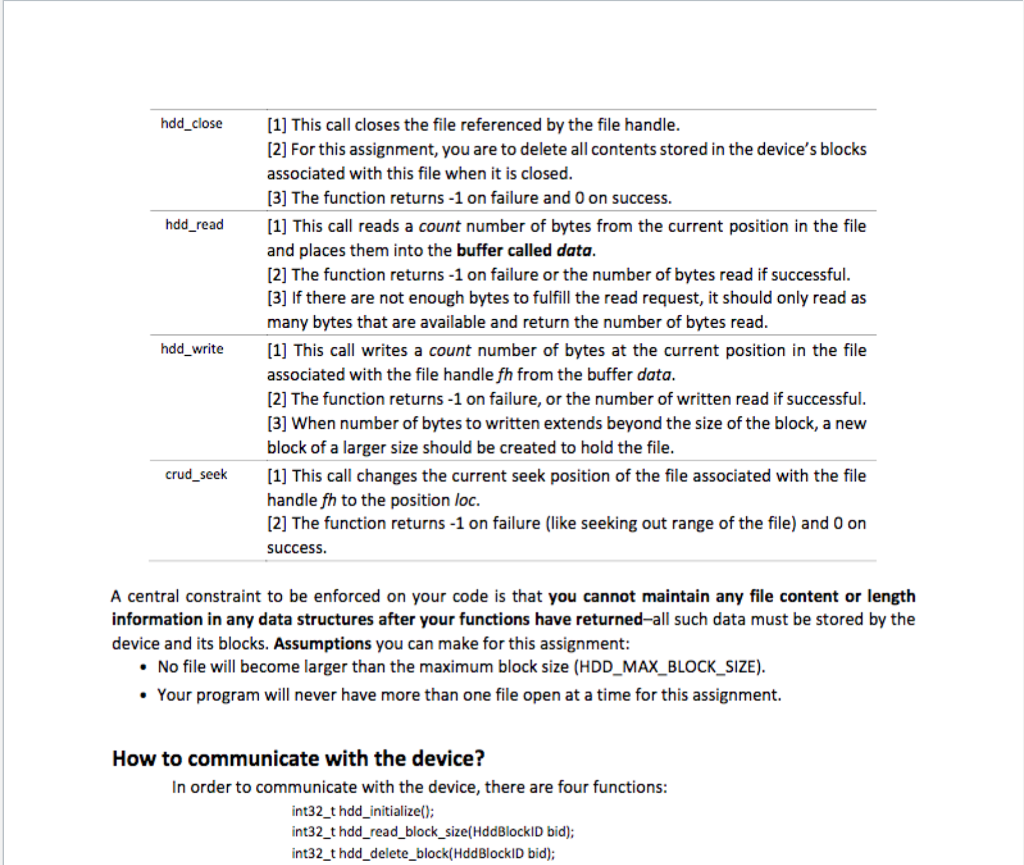
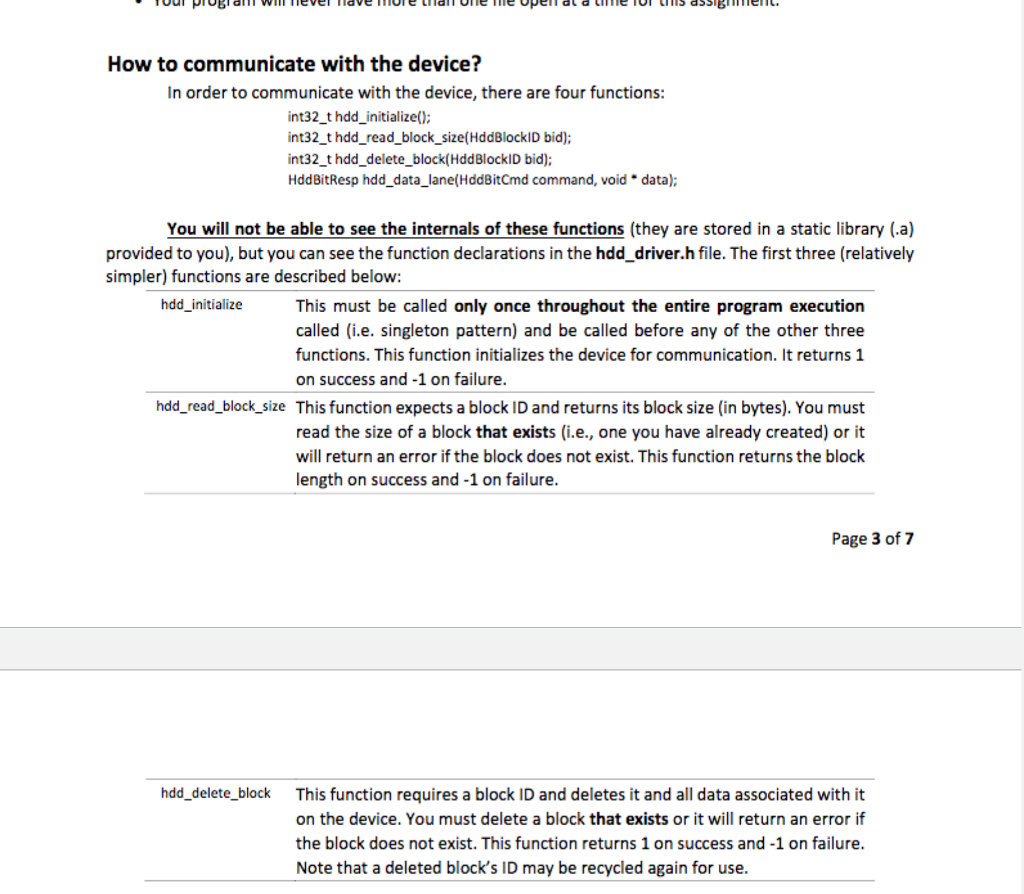
The functions you NEED to write (i.e., the filesystem driver) In this assignment, another application (a.k.a., the unit-tests provided to you) will call your code to evaluate your application by trying to save, read, and write files to the block storage and validate your results. Unit-testing will use your functions to do so, hence do not change function names (you will be penalized). For this assignment (HINT: but not future ones, so plan ahead), there will only ever be one file open at a time, and furthermore, each file that the user wants to write to the device will always fit within the maximum possible size of a block (HDD_MAX_BLOCK_SIZE). Thus, in this assignment, there is a one-to-one mapping of files to blocks. when your code is called, hdd open will be the first function called and will be given a filename. Your function code must return a number, also called a file handle, which will uniquely refer to that particular file across all your other functions. For instance, when the user wants to write something to a file on the device, your hdd write function will be called with the first parameter being the corresponding file handle you previously returned in hdd_open. If the user tries to call any of your functions (besides hdd open) with a file that is not open, you must return -1 (i.e. unsuccessful) and handle appropriately. You must keep track of whether or not a file is open using your own data structure. You can assume that when a user opens a file for the first time via hdd open, that there is no pre- existing data in the block storage about that file. The application will need to call hdd write in order to write anything about this file for the first time to a block. Then the application will need to call hdd read to get back any data that has been written to that file. When the application has finished using a file (i.e. read/write), it calls hdd close. For this assignment, calling hdd close will delete al the contents of the file in the block storage (HINT: future assignments will keep contents). Lastly, where the application starts reading from and writing to in a file is determined by the current seek position. The seek position is automatically placed at the end of the last read/write operation. The hdd seek function places the seek position wherever the user would like within the file (again, it is recommended to understand the standard seek C function) As a programmer, it is up to you to decide how to implement these functions. However, the functions must maintain the file contents in exactly the same way as a normal filesystem would (meaning do not re- order the bytes of data). The functions that you are to implement are declared in hdd file_io.h and should be implemented in hdd _file_io.c as follows: Function Description hdd open1]This call opens a file (i.e., sets any initially needed metadata in your data structure) and returns a UNIQUE integer file handle (to be assigned by you) [2] For this assignment, the file can be assumed to be non-existent on the device [3] You should initialize the device here (but only the first time this function is called i.e. singleton pattern) [4] The function returns -1 on failure and UNIQUE integer on success The functions you NEED to write (i.e., the filesystem driver) In this assignment, another application (a.k.a., the unit-tests provided to you) will call your code to evaluate your application by trying to save, read, and write files to the block storage and validate your results. Unit-testing will use your functions to do so, hence do not change function names (you will be penalized). For this assignment (HINT: but not future ones, so plan ahead), there will only ever be one file open at a time, and furthermore, each file that the user wants to write to the device will always fit within the maximum possible size of a block (HDD_MAX_BLOCK_SIZE). Thus, in this assignment, there is a one-to-one mapping of files to blocks. when your code is called, hdd open will be the first function called and will be given a filename. Your function code must return a number, also called a file handle, which will uniquely refer to that particular file across all your other functions. For instance, when the user wants to write something to a file on the device, your hdd write function will be called with the first parameter being the corresponding file handle you previously returned in hdd_open. If the user tries to call any of your functions (besides hdd open) with a file that is not open, you must return -1 (i.e. unsuccessful) and handle appropriately. You must keep track of whether or not a file is open using your own data structure. You can assume that when a user opens a file for the first time via hdd open, that there is no pre- existing data in the block storage about that file. The application will need to call hdd write in order to write anything about this file for the first time to a block. Then the application will need to call hdd read to get back any data that has been written to that file. When the application has finished using a file (i.e. read/write), it calls hdd close. For this assignment, calling hdd close will delete al the contents of the file in the block storage (HINT: future assignments will keep contents). Lastly, where the application starts reading from and writing to in a file is determined by the current seek position. The seek position is automatically placed at the end of the last read/write operation. The hdd seek function places the seek position wherever the user would like within the file (again, it is recommended to understand the standard seek C function) As a programmer, it is up to you to decide how to implement these functions. However, the functions must maintain the file contents in exactly the same way as a normal filesystem would (meaning do not re- order the bytes of data). The functions that you are to implement are declared in hdd file_io.h and should be implemented in hdd _file_io.c as follows: Function Description hdd open1]This call opens a file (i.e., sets any initially needed metadata in your data structure) and returns a UNIQUE integer file handle (to be assigned by you) [2] For this assignment, the file can be assumed to be non-existent on the device [3] You should initialize the device here (but only the first time this function is called i.e. singleton pattern) [4] The function returns -1 on failure and UNIQUE integer on success
Step by Step Solution
There are 3 Steps involved in it

Get step-by-step solutions from verified subject matter experts
 Study Help