







Question: The hierarchical agglomerative clustering algorithm is to cluster data from bottom to up. Here is the pseudo-code for it. Please implement hierarchical agglomerative clustering algorithm
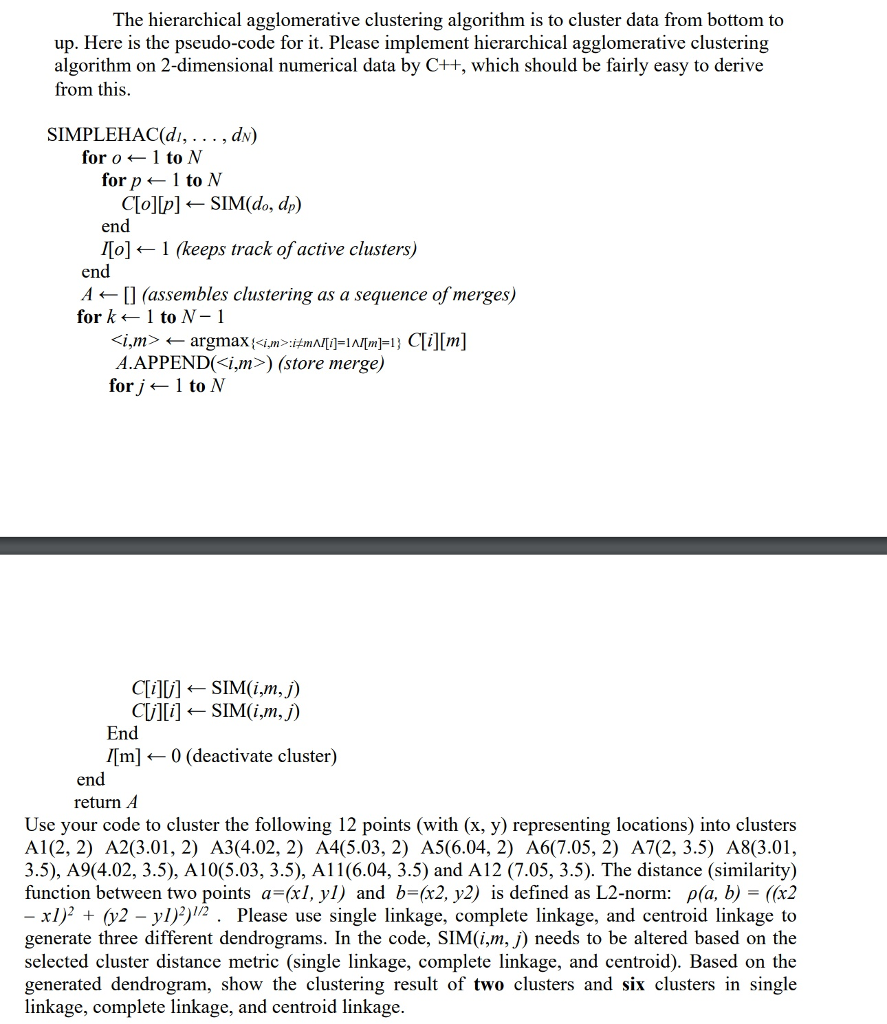
The hierarchical agglomerative clustering algorithm is to cluster data from bottom to up. Here is the pseudo-code for it. Please implement hierarchical agglomerative clustering algorithm on 2-dimensional numerical data by C++, which should be fairly easy to derive from this SIMPLEHAC(d,.. . , dv) for o 1 to N for p 1 to N en I[0] 1 (keeps track of active clusters) en A [] (assembles clustering as a sequence of merges) for k l to N-1 A.APPEND() (store merge) for j 1 to N C[j][i] SI M(i,n,j) [m] 0 (deactivate cluster) en return A Use your code to cluster the following 12 points (with (x, y) representing locations) into clusters Al(2, 2) A2(3.01, 2) A3(4.02, 2) A4(5.03, 2) A5(6.04, 2) A6(7.05, 2) A7(2, 3.5) A8(3.01, 3.5), A9(4.02, 3.5), A10(5.03, 3.5), A11(6.04, 3.5) and A12 (7.05, 3.5). The distance (similarity) function between two points a=(xl, yl) and b=(x2, y2) is defined as L2-norm: (a, b) = (62 x1)? +2-y)2)//2 . Please use single linkage, complete linkage, and centroid linkage to generate three different dendrograms. In the code, SIM(i,m, j) needs to be altered based on the selected cluster distance metric (single linkage, complete linkage, and centroid). Based on the generated dendrogram, show the clustering result of two clusters and six clusters in single linkage, complete linkage, and centroid linkage. The hierarchical agglomerative clustering algorithm is to cluster data from bottom to up. Here is the pseudo-code for it. Please implement hierarchical agglomerative clustering algorithm on 2-dimensional numerical data by C++, which should be fairly easy to derive from this SIMPLEHAC(d,.. . , dv) for o 1 to N for p 1 to N en I[0] 1 (keeps track of active clusters) en A [] (assembles clustering as a sequence of merges) for k l to N-1 A.APPEND() (store merge) for j 1 to N C[j][i] SI M(i,n,j) [m] 0 (deactivate cluster) en return A Use your code to cluster the following 12 points (with (x, y) representing locations) into clusters Al(2, 2) A2(3.01, 2) A3(4.02, 2) A4(5.03, 2) A5(6.04, 2) A6(7.05, 2) A7(2, 3.5) A8(3.01, 3.5), A9(4.02, 3.5), A10(5.03, 3.5), A11(6.04, 3.5) and A12 (7.05, 3.5). The distance (similarity) function between two points a=(xl, yl) and b=(x2, y2) is defined as L2-norm: (a, b) = (62 x1)? +2-y)2)//2 . Please use single linkage, complete linkage, and centroid linkage to generate three different dendrograms. In the code, SIM(i,m, j) needs to be altered based on the selected cluster distance metric (single linkage, complete linkage, and centroid). Based on the generated dendrogram, show the clustering result of two clusters and six clusters in single linkage, complete linkage, and centroid linkage
Step by Step Solution
There are 3 Steps involved in it

Get step-by-step solutions from verified subject matter experts
 Study Help