







Question: The information in DNA is stored as a code made up of four chemical bases which are represented by four upper case letters A ,
The information in DNA is stored as a code made up of four chemical bases which are represented by four
upper case letters A T G C An example DNA sequence could be : ATGAG.
An interesting phenomena here is that when two DNA sequences are attempted to combine, A can only pair
with whereas can only pair with
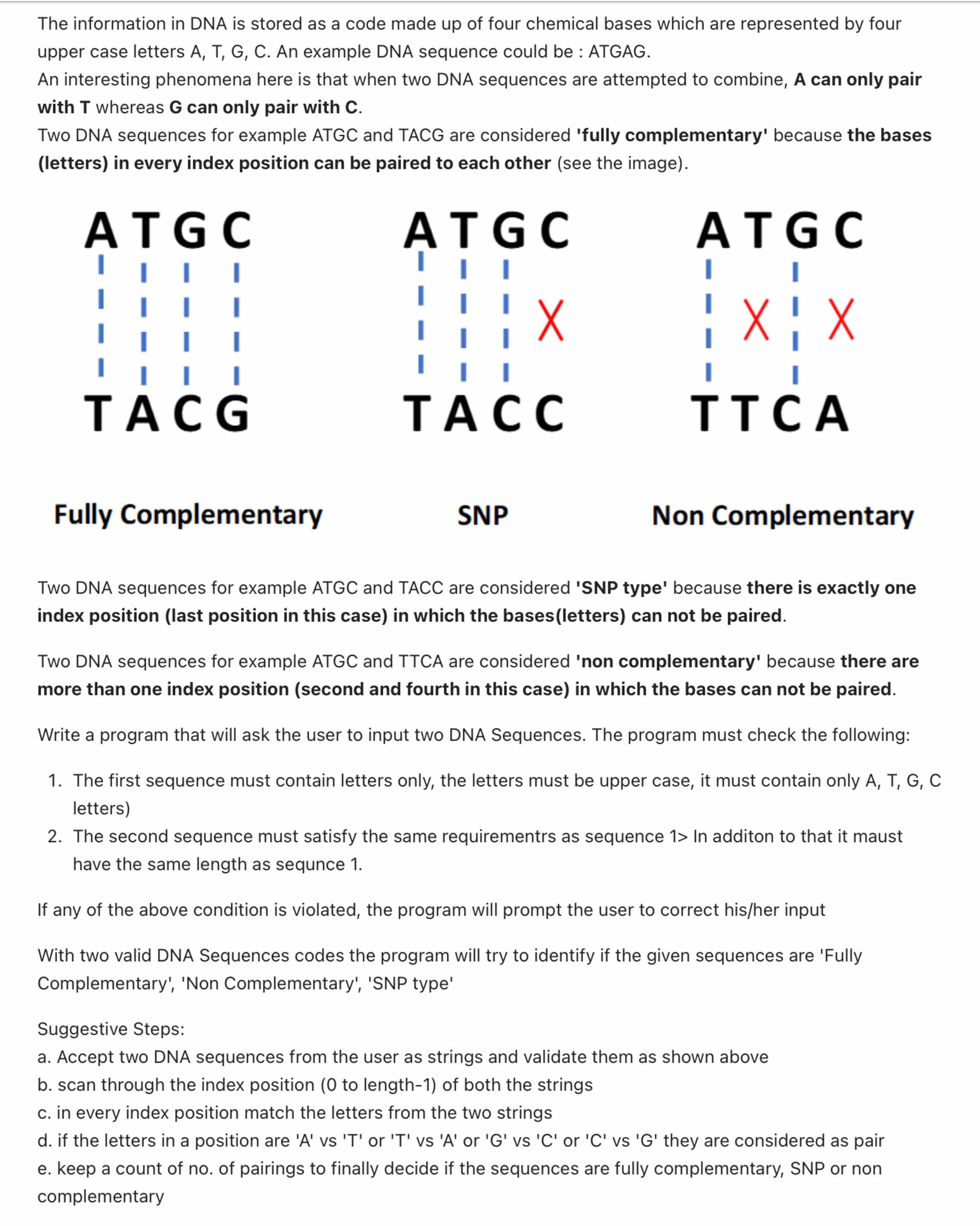
Two DNA sequences for example ATGC and TACG are considered 'fully complementary' because the bases
letters in every index position can be paired to each other see the image
Fully Complementary
SNP
Non Complementary
Two DNA sequences for example ATGC and TACC are considered SNP type' because there is exactly one
index position last position in this case in which the basesletters can not be paired.
Two DNA sequences for example ATGC and TTCA are considered 'non complementary' because there are
more than one index position second and fourth in this case in which the bases can not be paired.
Write a program that will ask the user to input two DNA Sequences. The program must check the following:
The first sequence must contain letters only, the letters must be upper case, it must contain only
letters
The second sequence must satisfy the same requirementrs as sequence In additon to that it maust
have the same length as sequnce
If any of the above condition is violated, the program will prompt the user to correct hisher input
With two valid DNA Sequences codes the program will try to identify if the given sequences are 'Fully
Complementary', 'Non Complementary', SNP type'
Suggestive Steps:
a Accept two DNA sequences from the user as strings and validate them as shown above
b scan through the index position to length of both the strings
c in every index position match the letters from the two strings
d if the letters in a position are A vs or vs A or vs C or C vs G they are considered as pair
e keep a count of no of pairings to finally decide if the sequences are fully complementary, SNP or non
complementary
Step by Step Solution
There are 3 Steps involved in it
1 Expert Approved Answer
Step: 1 Unlock

Question Has Been Solved by an Expert!
Get step-by-step solutions from verified subject matter experts
Step: 2 Unlock
Step: 3 Unlock
 Study Help