Question: The last two paragraphs offer very specific actions and consequences that were happening inside of AP. Translate the 10 specifically outlined into a visual representation
The last two paragraphs offer very specific actions and consequences that were happening inside of AP. Translate the 10 specifically outlined into a visual representation of what is occurring. Very simply draw me a picture of what is happening Feel free to use boxes, arrows, path diagrams, circles, etc The point is that I want to be able to see those actions and consequences in picture form. You might also refer to the optional reading posted in the assignment this week to help you. 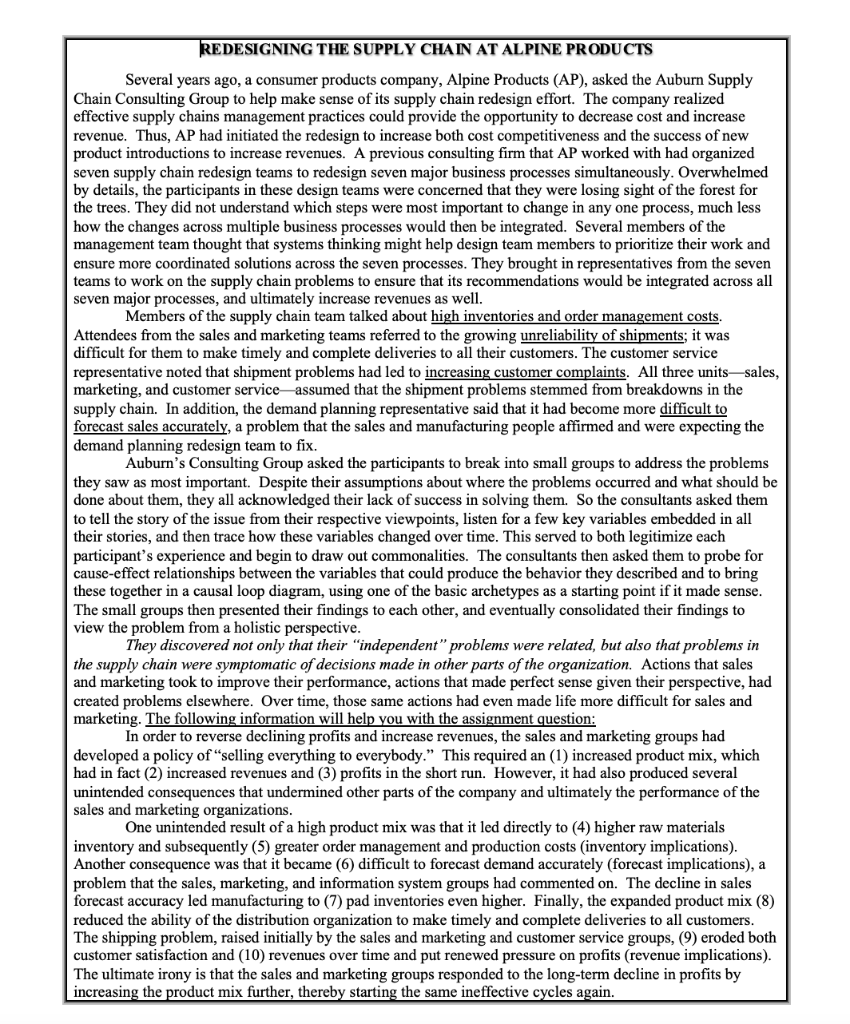
REDESIGNING THE SUPPLY CHAIN AT ALPINE PRODUCTS Several years ago, a consumer products company, Alpine Products (AP), asked the Auburn Supply Chain Consulting Group to help make sense of its supply chain redesign effort. The company realized effective supply chains management practices could provide the opportunity to decrease cost and increase revenue. Thus, AP had initiated the redesign to increase both cost competitiveness and the success of new product introductions to increase revenues. A previous consulting firm that AP worked with had organized seven supply chain redesign teams to redesign seven major business processes simultaneously. Overwhelmed by details, the participants in these design teams were concerned that they were losing sight of the forest for the trees. They did not understand which steps were most important to change in any one process, much less how the changes across multiple business processes would then be integrated. Several members of the management team thought that systems thinking might help design team members to prioritize their work and ensure more coordinated solutions across the seven processes. They brought in representatives from the seven teams to work on the supply chain problems to ensure that its recommendations would be integrated across all seven major processes, and ultimately increase revenues as well. Members of the supply chain team talked about high inventories and order management costs. Attendees from the sales and marketing teams referred to the growing unreliability of shipments; it was difficult for them to make timely and complete deliveries to all their customers. The customer service representative noted that shipment problems had led to increasing customer complaints. All three unitssales, marketing, and customer service assumed that the shipment problems stemmed from breakdowns in the supply chain. In addition, the demand planning representative said that it had become more difficult to forecast sales accurately, a problem that the sales and manufacturing people affirmed and were expecting the demand planning redesign team to fix. Auburn's Consulting Group asked the participants to break into small groups to address the problems they saw as most important. Despite their assumptions about where the problems occurred and what should be done about them, they all acknowledged their lack of success in solving them. So the consultants asked them to tell the story of the issue from their respective viewpoints, listen for a few key variables embedded in all their stories, and then trace how these variables changed over time. This served to both legitimize each participant's experience and begin to draw out commonalities. The consultants then asked them to probe for cause-effect relationships between the variables that could produce the behavior they described and to bring these together in a causal loop diagram, using one of the basic archetypes as a starting point if it made sense. The small groups then presented their findings to each other, and eventually consolidated their findings to view the problem from a holistic perspective. They discovered not only that their "independent" problems were related, but also that problems in the supply chain were symptomatic of decisions made in other parts of the organization. Actions that sales and marketing took to improve their performance, actions that made perfect sense given their perspective, had created problems elsewhere. Over time, those same actions had even made life more difficult for sales and marketing. The following information will help you with the assignment question: In order to reverse declining profits and increase revenues, the sales and marketing groups had developed a policy of "selling everything to everybody. This required an (1) increased product mix, which had in fact (2) increased revenues and (3) profits in the short run. However, it had also produced several unintended consequences that undermined other parts of the company and ultimately the performance of the sales and marketing organizations. One unintended result of a high product mix was that it led directly to (4) higher raw materials inventory and subsequently (5) greater order management and production costs inventory implications). Another consequence was that it became (6) difficult to forecast demand accurately (forecast implications), a problem that the sales, marketing, and information system groups had commented on. The decline in sales forecast accuracy led manufacturing to (7) pad inventories even higher. Finally, the expanded product mix (8) reduced the ability of the distribution organization to make timely and complete deliveries to all customers. The shipping problem, raised initially by the sales and marketing and customer service groups, (9) eroded both customer satisfaction and (10) revenues over time and put renewed pressure on profits (revenue implications). The ultimate irony is that the sales and marketing groups responded to the long-term decline in profits by increasing the product mix further, thereby starting the same ineffective cycles again









 Study Help