







Question: The MAD for Method 1=______thousands gallons (round your response to three decimal places) The mean squared error (MSE) for Method 1=______thousands gallons^2(round your response to
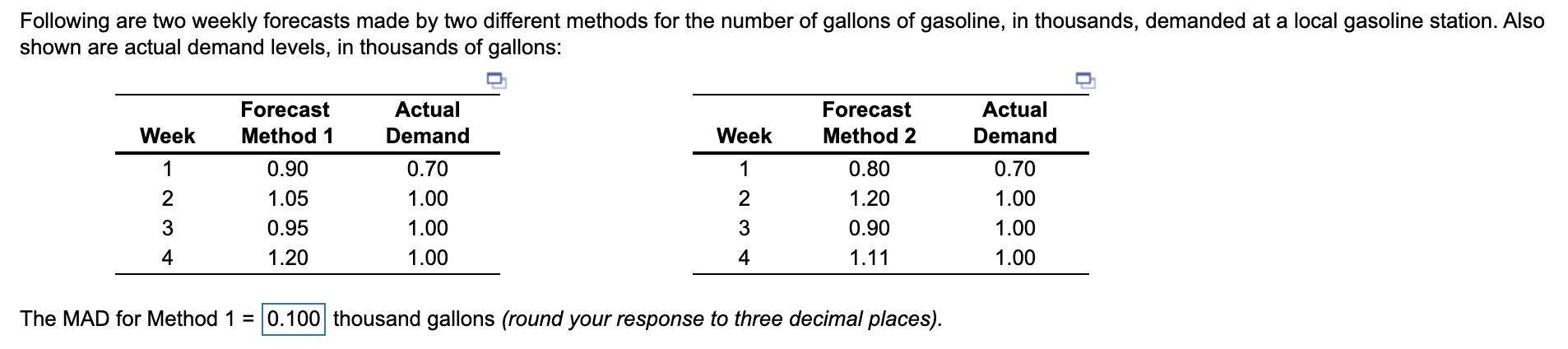
The MAD for Method 1=______thousands gallons (round your response to three decimal places)
The mean squared error (MSE) for Method 1=______thousands gallons^2(round your response to three decimal places)
The MAD for method 2=____thousands gallons (round your response to three decimal places)
The mean squared error (MSE) for Method 2=____thousands gallons^2 (round your response to three decimal places)
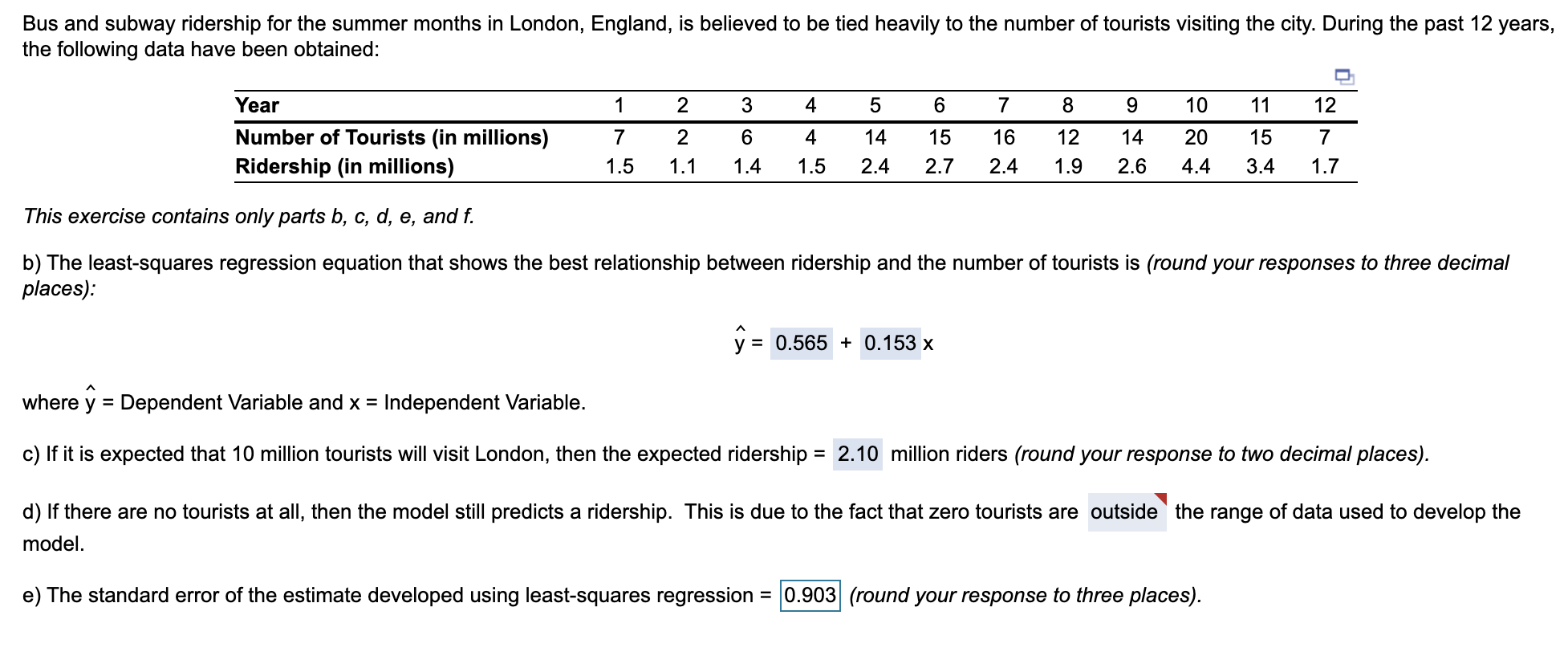
(please solve e and f)
f) The coefficient of correlation for the least squares regression model = _____ (round your response to three decimal places)
The coefficient of determination for the least squares regression model = _____ (round your response to three decimal places)
Following are two weekly forecasts made by two different methods for the number of gallons of gasoline, in thousands, demanded at a local gasoline station. Also shown are actual demand levels, in thousands of gallons: Forecast Method 1 Forecast Method 2 Actual Demand Week Week 1 Actual Demand 0.70 1.00 1.00 1.00 0.90 1.05 0.95 1.20 2 1 2 3 4 0.80 1.20 0.90 1.11 0.70 1.00 1.00 1.00 3 4 The MAD for Method 1 = 0.100 thousand gallons (round your response to three decimal places). Bus and subway ridership for the summer months in London, England, is believed to be tied heavily to the number of tourists visiting the city. During the past 12 years, the following data have been obtained: 1 2 3 4 5 6 7 8 9 10 11 12 Year Number of Tourists (in millions) Ridership (in millions) 6 14 7 1.5 2 1.1 4 1.5 14 2.4 15 2.7 16 2.4 12 1.9 20 4.4 15 3.4 7 1.7 1.4 2.6 This exercise contains only parts b, c, d, e, and f. b) The least-squares regression equation that shows the best relationship between ridership and the number of tourists is (round your responses to three decimal places): y = 0.565 + 0.153 x where y = Dependent Variable and x = Independent Variable. c) If it is expected that 10 million tourists will visit London, then the expected ridership = 2.10 million riders (round your response to two decimal places). d) If there are no tourists at all, then the model still predicts a ridership. This is due to the fact that zero tourists are outside the range of data used to develop the model. e) The standard error of the estimate developed using least-squares regression = 0.903 (round your response to three places)Step by Step Solution
There are 3 Steps involved in it

Get step-by-step solutions from verified subject matter experts
 Study Help