



Question: The MOSFET model you will use in this experiment, the SPICE directive to define the model first. Click on the icon A 4-phase stepper motor,
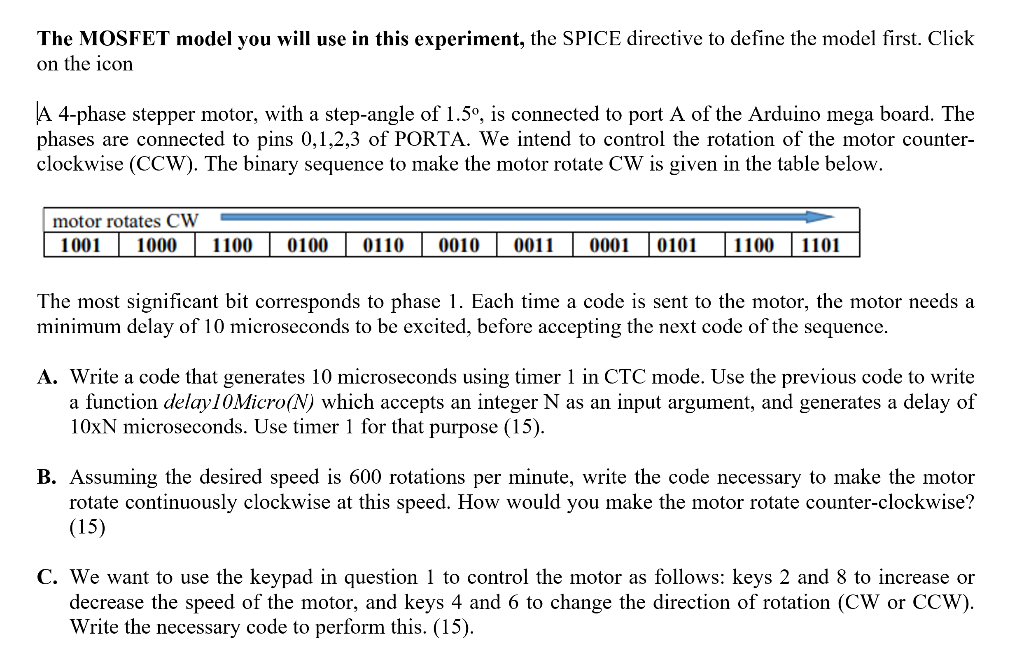
The MOSFET model you will use in this experiment, the SPICE directive to define the model first. Click on the icon A 4-phase stepper motor, with a step-angle of 1.50, is connected to port A of the Arduino mega board. The phases are connected to pins 0,1,2,3 of PORTA. We intend to control the rotation of the motor counter- clockwise (CCW). The binary sequence to make the motor rotate CW is given in the table below. motor rotates CW 1001 10001100 0100 011000100011 0001 0101 1100 1101 The most significant bit corresponds to phase 1. Each time a code is sent to the motor, the motor needs a minimum delay of 10 microseconds to be excited, before accepting the next code of the sequence. A. Write a code that generates 10 microseconds using timer 1 in CTC mode. Use the previous code to write a function delay10Micro(N) which accepts an integer N as an input argument, and generates a delay of 10xN microseconds. Use timer 1 for that purpose (15). B. Assuming the desired speed is 600 rotations per minute, write the code necessary to make the motor rotate continuously clockwise at this speed. How would you make the motor rotate counter-clockwise? (15) C. We want to use the keypad in question 1 to control the motor as follows: keys 2 and 8 to increase or decrease the speed of the motor, and keys 4 and 6 to change the direction of rotation (CW or CCW). Write the necessary code to perform this. (15). The MOSFET model you will use in this experiment, the SPICE directive to define the model first. Click on the icon A 4-phase stepper motor, with a step-angle of 1.50, is connected to port A of the Arduino mega board. The phases are connected to pins 0,1,2,3 of PORTA. We intend to control the rotation of the motor counter- clockwise (CCW). The binary sequence to make the motor rotate CW is given in the table below. motor rotates CW 1001 10001100 0100 011000100011 0001 0101 1100 1101 The most significant bit corresponds to phase 1. Each time a code is sent to the motor, the motor needs a minimum delay of 10 microseconds to be excited, before accepting the next code of the sequence. A. Write a code that generates 10 microseconds using timer 1 in CTC mode. Use the previous code to write a function delay10Micro(N) which accepts an integer N as an input argument, and generates a delay of 10xN microseconds. Use timer 1 for that purpose (15). B. Assuming the desired speed is 600 rotations per minute, write the code necessary to make the motor rotate continuously clockwise at this speed. How would you make the motor rotate counter-clockwise? (15) C. We want to use the keypad in question 1 to control the motor as follows: keys 2 and 8 to increase or decrease the speed of the motor, and keys 4 and 6 to change the direction of rotation (CW or CCW). Write the necessary code to perform this. (15)
Step by Step Solution
There are 3 Steps involved in it

Get step-by-step solutions from verified subject matter experts