







Question: The Optimization Case Study corresponds to concepts taught in Module 2 (Optimization - Part 1) and Module 3 (Optimization - Part 2). This is a

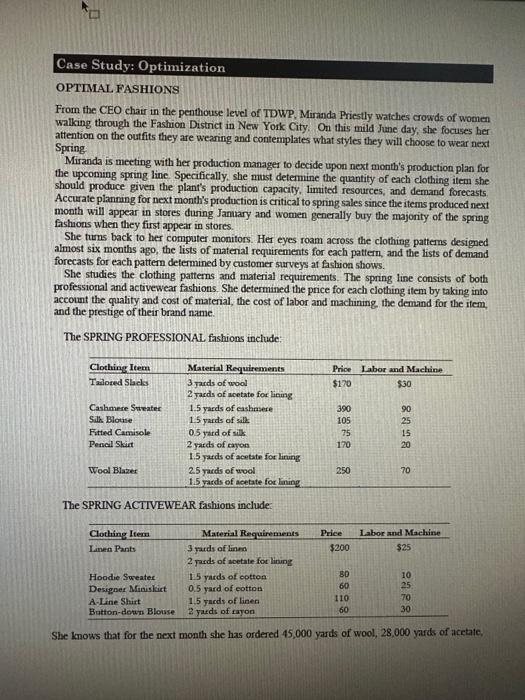
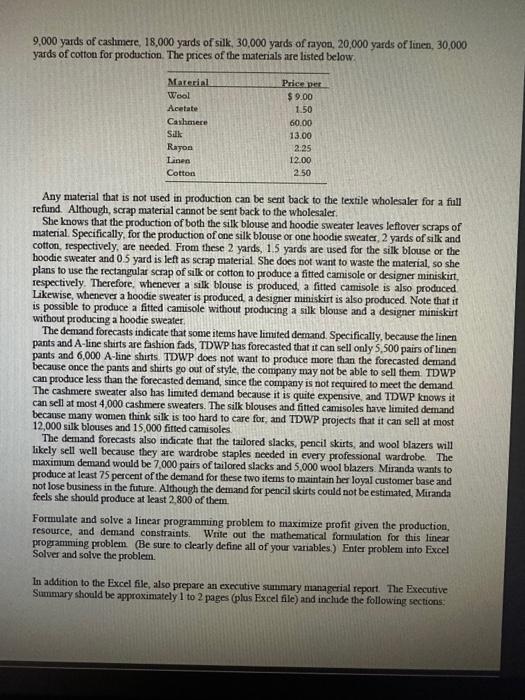
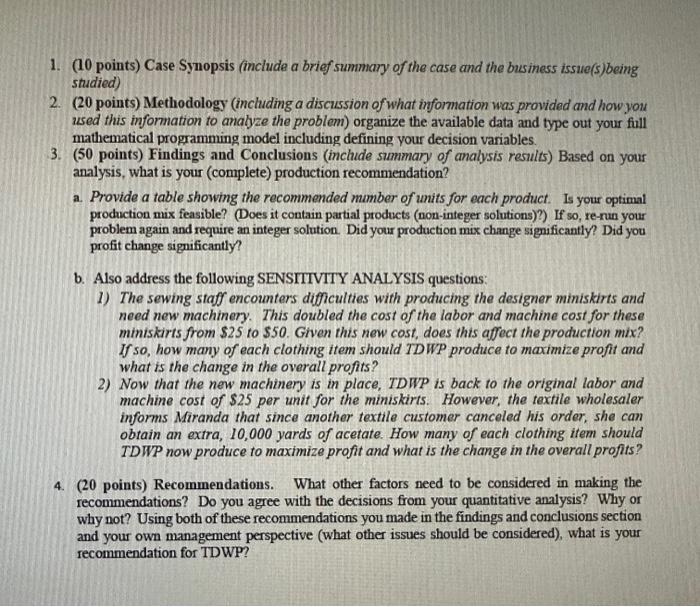
The Optimization Case Study corresponds to concepts taught in Module 2 (Optimization - Part 1) and Module 3 (Optimization - Part 2). This is a team assignment. The instructions require you to complete an Excel analysis and write up an Executive Summary for this Case Study. Please submit the assignment using the assignment feature - only one member from each team needs to submit the case (both Word document and Excel file). Here is the Optimization Case Study Assignment - M3-CaseStudy-Optimization-SU23, pdff Case Study: Optimization OPTIMAL FASHIONS From the CEO chair in the penthouse level of TDWP, Miranda Priestly watches crowds of women walking through the Fashion District in New York City. On this mild June day, she focuses her attention on the outfits they are wearing and contemplates what styles they will choose to wear next Spring Miranda is meeting with her production manager to decide upon next month's production plan for the upcoming spring line. Specifically, she must determine the quantity of each clothing item she should produce given the plant's production capacity, limited resources, and dernand forecasts Accurate planning for next month's production is critical to spring sales since the items produced next month will appear in stores during January and women generally buy the majority of the spring fashions when they first appear in stores. She turns back to her computer monitors. Her eyes roam across the clothing patterns designed almost six months ago, the lists of materal requirements for each pattern, and the lists of demand forecasts for each pattem determined by customer surveys at fachion shows. She studies the clothing patterns and material requirements. The spring line consists of both professional and activewear fashions. She determined the price for each clothing item by taking into account the quality and cost of material, the cost of labor and machining the demand for the item, and the prestige of their brand name. The SPRING PROFESSIONAL fashions include: The SPRING ACTIVEWEAR fashions include: She knows that for the next month she has ordered 45,000 yards of wool, 28,000 yards of acetate. 9,000 yards of cashmere, 18,000 yards of silk, 30,000 yards of rayon, 20,000 yards of linen, 30,000 yards of cotton for production. The prices of the materials are listed below. Any material that is not used in production can be sent back to the textile wholesaler for a full refund. Although, scrap material cannot be sent back to the wholesaler. She knows that the production of both the silk blouse and hoodie sweater leaves leftover scraps of material. Specifically, for the production of one silk blouse or one hoodie sweater, 2 yards of silk and cotton, respectively, are needed. From these 2 yards, 1.5 yards are used for the silk blouse or the boodie sweater and 0.5 yard is left as serap material. She does not want to waste the material, so she plans to use the rectangular scrap of silk or cotton to produce a fitted camisole or designer miniskirt, respectively. Therefore, whenever a silk blouse is produced, a fitted camisole is also produced Likewise, whenever a hoodie sweater is produced a designer miniskirt is also produced. Note that it is possible to produce a fitted camisole without producing a silk blouse and a designer miniskirt without producing a hoodie sweater. The demand forecasts indicate that some items have limited demand. Specifically, because the linen pants and A-line shirts are fishion fads, TDWP has forecasted that it can sell only 5,500 pairs of linen pants and 6,000 A-line shirts. TDWP does not want to produce more than the forecasted demand becatse once the pants and shirts go out of style, the company may not be able to sell them. TDWP can produce less than the forecasted demand, since the company is not required to meet the demand The cashmere sweater also has limited demand because it is quite expensive, and TDWP knows it can sell at most 4,000 cashmere sweaters. The silk blouses and fitted camisoles have limited demand becanse many women think silk is too hard to care for, and TDWP projects that it can sell at most 12,000 silk blouses and 15,000 fitted camisoles The demand forecasts also indicate that the tailored slacks, pencil skirts, and wool blazers will likely sell weil because they are wardrobe staples needed in every professional wardrobe. The maximum demand would be 7,000 pairs of tailored slacks and 5.000 wool blazers. Miranda wants to produce at least 75 percent of the demand for these two items to maintain her loyal customer base and not lose business in the future. Although the demand for pencil skirts could not be estimated, Miranda feels she should produce at least 2,800 of them. Formulate and solve a linear programming problem to maximize profit given the production, resource, and demand constraints. Write out the mathematical formulation for this linex programming problem. (Be sure to clearly define all of your variables.) Enter problem into Excel Solver and solve the problem. In addition to the Excel file, also prepare an executive summary managerial report. The Executive Summary should be approximately 1 to 2 pages (plus Excel file) and include the following sections: 1. (10 points) Case Synopsis (include a brief summary of the case and the business issue(s)being studied) 2. (20 points) Methodology (including a discussion of what information was provided and how you used this information to analyze the problem) organize the available data and type out your full mathematical programming model including defining your decision variables. 3. (50 points) Findings and Conclusions (include summary of analysis resilts) Based on your analysis, what is your (complete) production recommendation? a. Provide a table showing the recommended mumber of units for each product. Is your optimal production mix feasible? (Does it contain partial products (non-integer solutions)?) If so, re-run your problem again and require an integer solution. Did your production mix change significantly? Did you profit change significantly? b. Also address the following SENSIIIVITY ANALYSIS questions: 1) The sewing staff encounters difficulties with producing the designer miniskirts and need new machinery. This doubled the cost of the labor and machine cost for these miniskirts from $25 to $50. Given this new cost, does this affect the production mix? If so, how many of each clothing item should TDWP produce to maximize profit and what is the change in the overall profits? 2) Now that the new machinery is in place, TDWP is back to the original labor and machine cost of $25 per unit for the miniskirts. However, the textile wholesaler informs Miranda that since another textile customer canceled his order, she can obtain an extra, 10,000 yards of acetate. How many of each clothing item should TDWP now produce to maximize profit and what is the change in the overall profits? 4. (20 points) Recommendations. What other factors need to be considered in making the recommendations? Do you agree with the decisions from your quantitative analysis? Why or why not? Using both of these recommendations you made in the findings and conclusions section and your own management perspective (what other issues should be considered), what is your recommendation for TDWP
Step by Step Solution
There are 3 Steps involved in it

Get step-by-step solutions from verified subject matter experts
 Study Help