







Question: The paralle - axis theorem can be used to find an area's moment of inertia about any axis that is parallel to an axis that
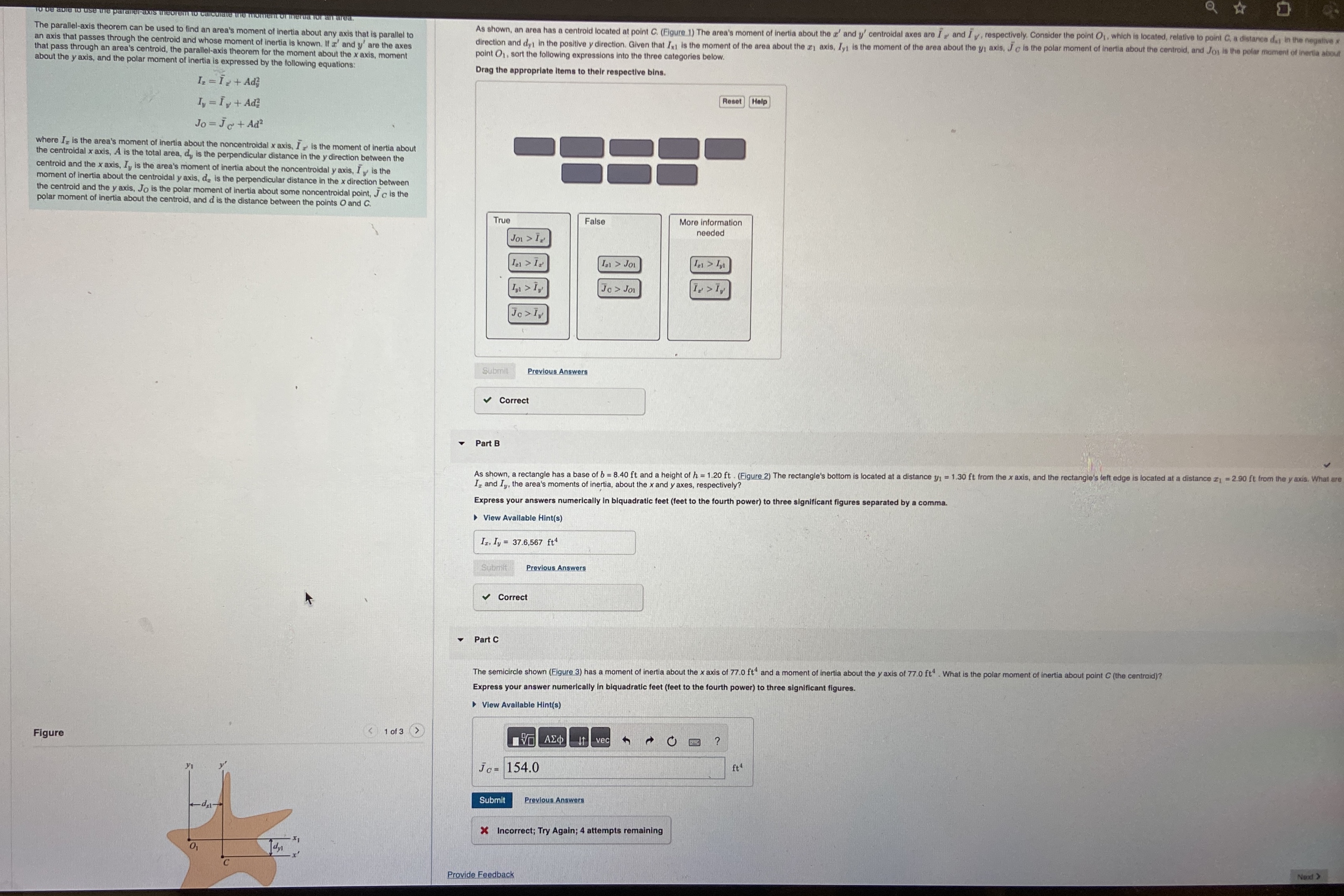
The paralleaxis theorem can be used to find an area's moment of inertia about any axis that is parallel to an axis that passes through the centroid and whose moment of inertia is known. It and are the axes
that pass through an area's centroid, the paralleaxis the about the axis, and the polar moment of inertia is expressed tor the moment about the axis, moment
where is the area's moment of ineria about the noncentroidal axis, is the moment of inertia about the centroidal axis, is the total area, is the perpendicular distance in the direction between the centroid and the axis, is the area's moment of ineria about the noncentroidal axis, is the moment of inertia about the centroidal axis, is the perpendicular distance in the direction between the centroid and the axis, is the polar moment of inertia about some noncentroidal point, is the polar moment of inertia about the centroid, and is the distance between the points and
As shown, an area has a centroid located at point Elgure The area's moment of inertia about the and centroidal axes are tilde and respectively, Consider the point which is located, relative to point a distance dat in the nepative direction and in the positive direction. Given that is the moment of the area about the axis, is the moment of the area about the axis, is the polar moment of inertia about the centroid, and is the polar moment of inertia aison point sort the following expressions into the three categories below.
Drag the appropriate items to their respective bins.
Submil
Provious Answers
Correct
Part B
As shown, a rectangle has a base of and a height of Figure The rectangle's bottom is located at a distance from the axis, and the rectangle's left edge is located at a distance trom the axis. What are and the area's moments of inertia, about the and axes, respectively?
Express your answers numerically in biquadratic feet feet to the fourth power to three significant figures separated by a comma.
View Avallable Hints
Previous Answers
Correct
Part C
The semicircle shown Eigure has a moment of inertia about the axis of and a moment of inertia about the axis of What is the polar moment of inertia about point the centroid Express your answer numerically in biquadratic feet feet to the fourth power to three significant figures.
View Available Hints
Previous Answers
Incorrect; Try Again; attempts remaining
Provide Feedback
Answer part C
Step by Step Solution
There are 3 Steps involved in it
1 Expert Approved Answer
Step: 1 Unlock

Question Has Been Solved by an Expert!
Get step-by-step solutions from verified subject matter experts
Step: 2 Unlock
Step: 3 Unlock
 Study Help