







Question: The probability density evolution in a one-dimensional harmonic trapping potential is governed by the partial differential equation: 2m where is the probability density and V(x)-kr2/2
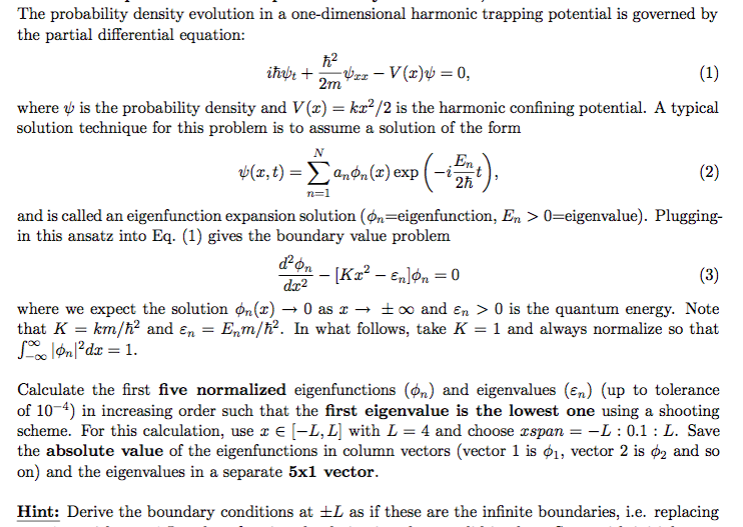
The probability density evolution in a one-dimensional harmonic trapping potential is governed by the partial differential equation: 2m where is the probability density and V(x)-kr2/2 is the harmonic confining potential. A typical solution technique for this problem is to assume a solution of the form t(x, t) = 4A(z) exp (-12nt), and is called an eigen function expansion solution (On-eigen function. En > 0 in this ansatz into Eq. (1) gives the boundary value problem eigenvalue). Plugging dr2 where we expect the solution (z) 0 as z oo and En > 0 is the quantum energy. Note that K-km/2 and En-E,m. In what follows, take K = 1 and always normalize so that Calculate the first five normalized eigenfunctions (dn) and eigenvalues (En) (up to tolerance of 10-4) in increasing order such that the first eigenvalue is the lowest one using a shooting scheme. For this calculation, use z E [-L,L] with L = 4 and choose xspan =-L : 0.1 : L. Save the absolute value of the eigenfunctions in column vectors (vector 1 is , vector 2 is P2 and so on) and the eigenvalues in a separate 5x1 vector. Hint: Derive the boundary conditions at L as if these are the infinite boundaries. i.e. replacing The probability density evolution in a one-dimensional harmonic trapping potential is governed by the partial differential equation: 2m where is the probability density and V(x)-kr2/2 is the harmonic confining potential. A typical solution technique for this problem is to assume a solution of the form t(x, t) = 4A(z) exp (-12nt), and is called an eigen function expansion solution (On-eigen function. En > 0 in this ansatz into Eq. (1) gives the boundary value problem eigenvalue). Plugging dr2 where we expect the solution (z) 0 as z oo and En > 0 is the quantum energy. Note that K-km/2 and En-E,m. In what follows, take K = 1 and always normalize so that Calculate the first five normalized eigenfunctions (dn) and eigenvalues (En) (up to tolerance of 10-4) in increasing order such that the first eigenvalue is the lowest one using a shooting scheme. For this calculation, use z E [-L,L] with L = 4 and choose xspan =-L : 0.1 : L. Save the absolute value of the eigenfunctions in column vectors (vector 1 is , vector 2 is P2 and so on) and the eigenvalues in a separate 5x1 vector. Hint: Derive the boundary conditions at L as if these are the infinite boundaries. i.e. replacing
Step by Step Solution
There are 3 Steps involved in it

Get step-by-step solutions from verified subject matter experts
 Study Help