







Question: The problems are in the picture below Problems 1. A particle of mass m moves in a one-dimensional box of length L, with boundaries at
The problems are in the picture below
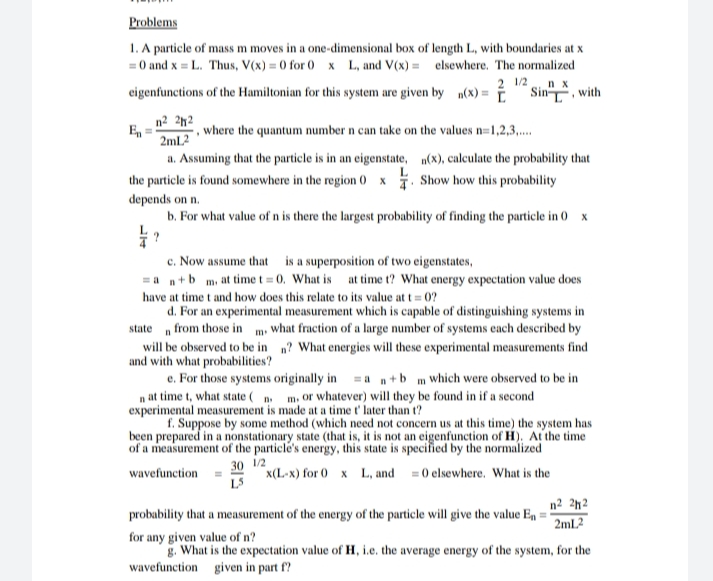
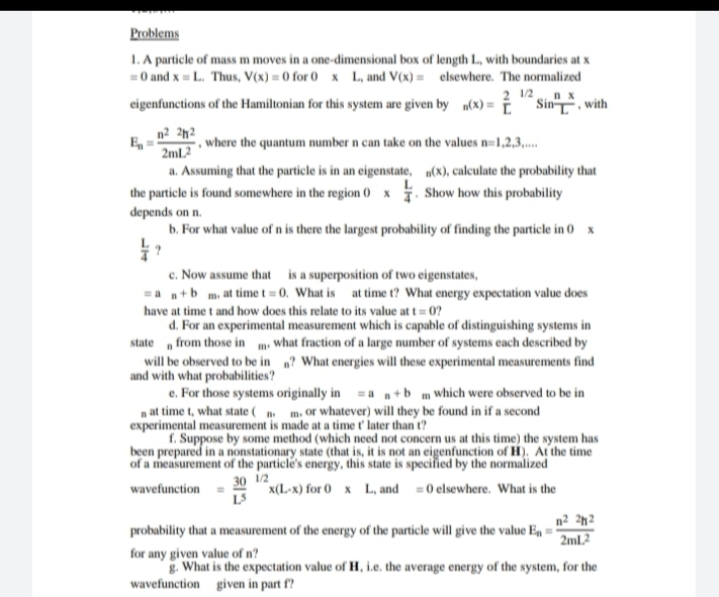
Problems 1. A particle of mass m moves in a one-dimensional box of length L, with boundaries at x = 0 and x = L. Thus, V(x) = 0for 0 x L, and V(x) = elsewhere. The normalized eigenfunctions of the Hamiltonian for this system are given by (x)= [ Sin , with 2 1/2 n x En _ 12 212 2mL 2 . where the quantum number n can take on the values n=1,2,3,.. a. Assuming that the particle is in an eigenstate, (x), calculate the probability that the particle is found somewhere in the region 0 x 7. Show how this probability depends on n. b. For what value of n is there the largest probability of finding the particle in 0 x c. Now assume that is a superposition of two eigenstates, n+b m. at time t = 0. What is at time t? What energy expectation value does have at time t and how does this relate to its value at t = 0? d. For an experimental measurement which is capable of distinguishing systems in state , from those in m. what fraction of a large number of systems each described by will be observed to be in n? What energies will these experimental measurements find and with what probabilities? e. For those systems originally in =a a + b m which were observed to be in a at time t, what state ( n. m. or whatever) will they be found in if a second experimental measurement is made at a time t' later than t? f. Suppose by some method (which need not concern us at this time) the system has been prepared in a nonstationary state (that is, it is not an eigenfunction of H). At the time of a measurement of the particle's energy, this state is specified by the normalized 30 1/2 wavefunction LS x(L-x) for 0 x L, and =0 elsewhere. What is the probability that a measurement of the energy of the particle will give the value En = n2 212 2mL2 for any given value of n? g. What is the expectation value of H. i.e. the average energy of the system, for the wavefunction given in part fProblems 1. A particle of mass m moves in a one-dimensional box of length L, with boundaries at x = 0 and x = L. Thus, V(x) = 0for 0 x L, and V(x) = elsewhere. The normalized eigenfunctions of the Hamiltonian for this system are given by (x)= - Sin , with En2 212 2ml.2 . where the quantum number n can take on the values n=1,23,.. a. Assuming that the particle is in an eigenstate, s(x), calculate the probability that the particle is found somewhere in the region 0 x 7. Show how this probability depends on n. b. For what value of n is there the largest probability of finding the particle in O x c. Now assume that is a superposition of two eigenstates, = n+ b m. at time t = 0. What is at time t? What energy expectation value does have at time t and how does this relate to its value at t = 0? d. For an experimental measurement which is capable of distinguishing systems in state from those in m. what fraction of a large number of systems each described by will be observed to be in ? What energies will these experimental measurements find and with what probabilities? e. For those systems originally in = a n + b m which were observed to be in a at time t, what state ( n. m. or whatever) will they be found in if a second experimental measurement is made at a time t' later than (? f. Suppose by some method (which need not concern us at this time) the system has been prepared in a nonstationary state (that is, it is not an eigenfunction of H), At the time of a measurement of the particle's energy, this state is specified by the normalized 1/2 wavefunction LS x(L-x) for 0 x L, and =0 elsewhere. What is the probability that a measurement of the energy of the particle will give the value . _ s h- 2ml.2 for any given value of n? g. What is the expectation value of H. i.e. the average energy of the system, for the wavefunction given in part
Step by Step Solution
There are 3 Steps involved in it

Get step-by-step solutions from verified subject matter experts
 Study Help