







Question: The pseudo-code below, behaves like a simple shell for interpreting simple bash scripts, that consist of a few lines. Each line is made of a
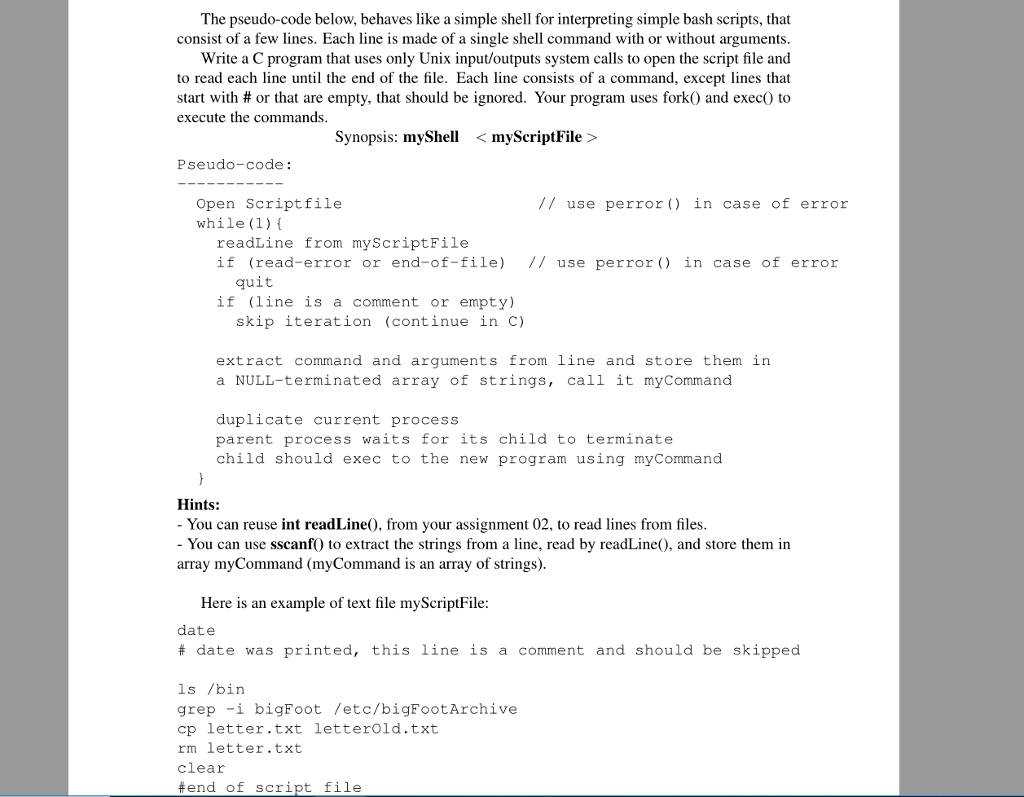
The pseudo-code below, behaves like a simple shell for interpreting simple bash scripts, that consist of a few lines. Each line is made of a single shell command with or without arguments Write a C program that uses only Unix input/outputs system calls to open the script file and to read each line until the end of the file. Each line consists of a command, except lines that start with # or that are empty, that should be ignored. Your program uses fork() and exec() to execute the commands Synopsis: myShell Pseudo-code: // use perror ) in case of error Open Scriptfile while (1) readLine from myScriptFile if (read-error or end-of-file) I/ use perror in case of error quit if (line is a comment or empty) skip iteration (continue in C) extract command and arguments from line and store them irn a NULL-terminated array of strings, call it myCommand duplicate current process parent process waits for its child to terminate chila shoula exec to the new program using myCommand Hints: - You can reuse int readLine), from your assignment 02, to read lines from files - You can use sscanfO to extract the strings from a line, read by readLine), and store them in array myCommand (myCommand is an array of strings) Here is an example of text file myScriptFile date # date was printed, this line is a comment and should be skipped ls /bin grep -i bigFoot /etc/bigFootArchive cp letter.txt letterold.txt rm letter.txt clear #end of script file
Step by Step Solution
There are 3 Steps involved in it

Get step-by-step solutions from verified subject matter experts
 Study Help