







Question: The purpose of this assignment is to evaluate a database management system (DBMS), construct a logical data model, and apply rules of normalization to the
The purpose of this assignment is to evaluate a database management system (DBMS), construct a logical data model, and apply rules of normalization to the model.
For this assignment, refer to "Chapter 10Exercises C and D" in Systems Analysis and Design.
Complete "Exercise C." Summarize your findings. State any assumptions you have made.
Exercise C:
Using the Web, review the product, 'Relational DBMS'. What are the main features and functions of the software? In what companies has the database management system (DBMS) been implemented, and for what purposes? According to the information that you found, what are three strengths and weaknesses of the product? Explain.
For "Exercise D," construct a logical data model using a program such as Excel, Visio, or Microsoft Word. Apply the rules of normalization to the model to check the model for processing efficiency as directed. Summarize your findings. State any assumptions you have made.
Exercise D:
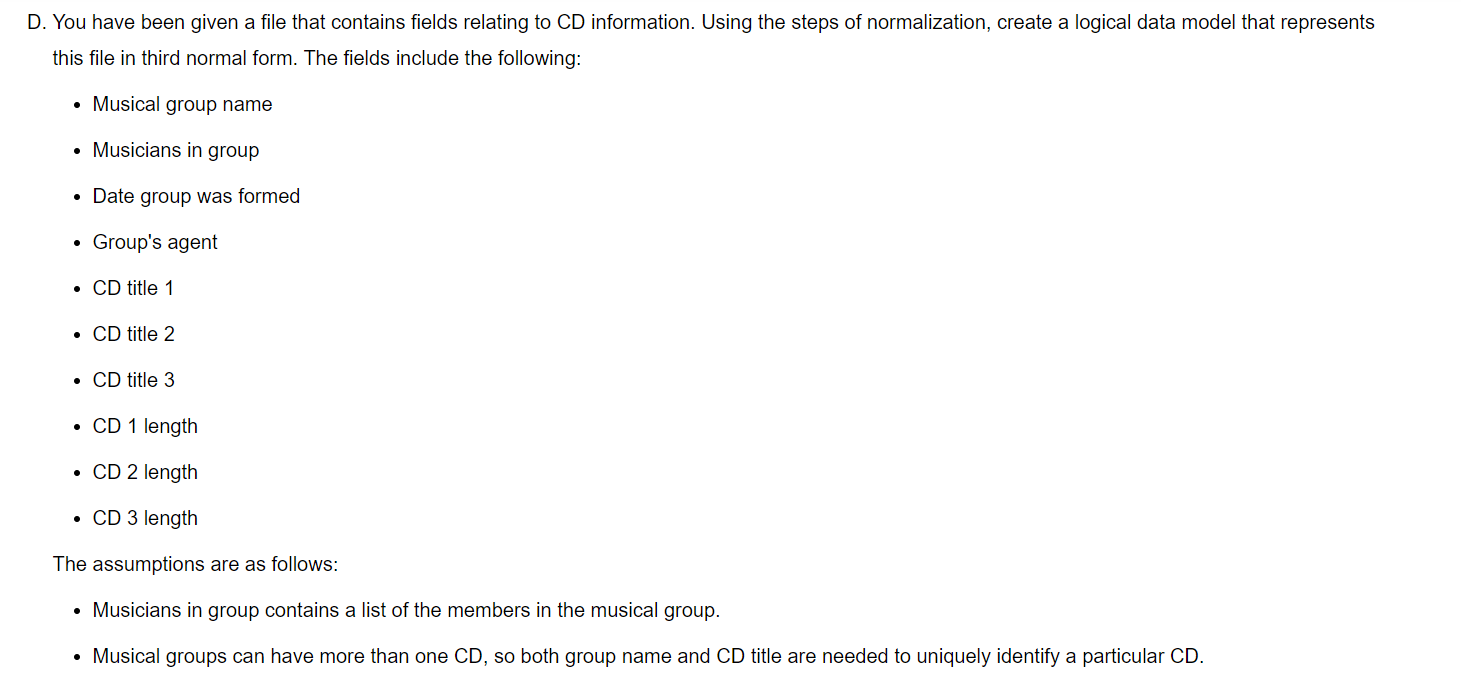
D. You have been given a file that contains fields relating to CD information. Using the steps of normalization, create a logical data model that represents this file in third normal form. The fields include the following: . Musical group name . Musicians in group . Date group was formed . Group's agent . CD title 1 . CD title 2 . CD title 3 . CD 1 length . CD 2 length . CD 3 length The assumptions are as follows: . Musicians in group contains a list of the members in the musical group. . Musical groups can have more than one CD, so both group name and CD title are needed to uniquely identify a particular CD
Step by Step Solution
There are 3 Steps involved in it

Get step-by-step solutions from verified subject matter experts
 Study Help