







Question: The question is completed, all information has been provided. No any material is missing. Please provide me with detailed solutions, thanks. Do not waste my
The question is completed, all information has been provided. No any material is missing. Please provide me with detailed solutions, thanks. Do not waste my time by simply saying incomplete question.
Question 4. [25 points] Consider a variant of the sealed-bid auctions with imperfect information considered in class in which the players are risk-averse. Specifically, assume that the payoff of a player with valuation v who wins the object and pays the price p is (v ? p)1/m, where m > 1. (In class we considered the case m = 1, in which the bidders are "risk neutral". For m > 1, the bidders are "risk averse".)
- [7 points] Find an equilibrium of the second-price auction.
- [12points]Suppose that there are two players and each player's valuation is drawn independently from a uniform distribution on [0, 1] (as we assumed in class). Find an equilibrium of the first- price auction. (Hint: Assume that the player strategy is a linear function of their evaluation, i.e. when player 2's valuation is v2 she bids ?v2, where ? is a constant. Find the best response of player 1 to this strategy of player 2 when player 1's valuation is v1.)
- [6points]Following the environment of part (2) (two players , uniform distribution of valuations), compare the expected value of the price paid by a winner with valuation v in the equilibrium of a second-price and a first-price auction. How does the auctioneer's revenue differ between the two auctions?.
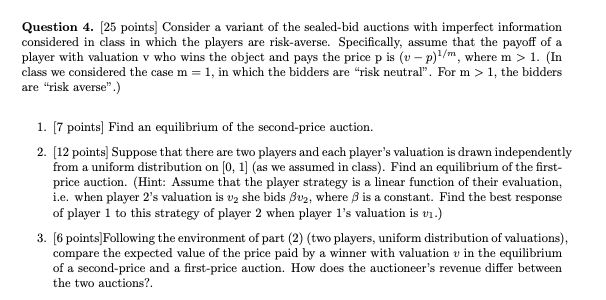
Question 4. [25 points] Consider a variant of the sealed-bid auctions with imperfect information considered in class in which the players are risk-averse. Specifically, assume that the payoff of a player with valuation v who wins the object and pays the price p is (v -p) /", where m > 1. (In class we considered the case m = 1, in which the bidders are "risk neutral". For m > 1, the bidders are "risk averse".) 1. [7 points] Find an equilibrium of the second-price auction. 2. [12 points] Suppose that there are two players and each player's valuation is drawn independently from a uniform distribution on [0, 1] (as we assumed in class). Find an equilibrium of the first- price auction. (Hint: Assume that the player strategy is a linear function of their evaluation, i.e. when player 2's valuation is vz she bids Buz, where / is a constant. Find the best response of player 1 to this strategy of player 2 when player 1's valuation is v1.) 3. [6 points]Following the environment of part (2) (two players, uniform distribution of valuations), compare the expected value of the price paid by a winner with valuation v in the equilibrium of a second-price and a first-price auction. How does the auctioneer's revenue differ between the two auctions
Step by Step Solution
There are 3 Steps involved in it

Get step-by-step solutions from verified subject matter experts
 Study Help