







Question: The random wait time after collision in CSMA/CD is generated following certain rules. In Ethernet, which is the predominant protocol where CSMA/CD is used,
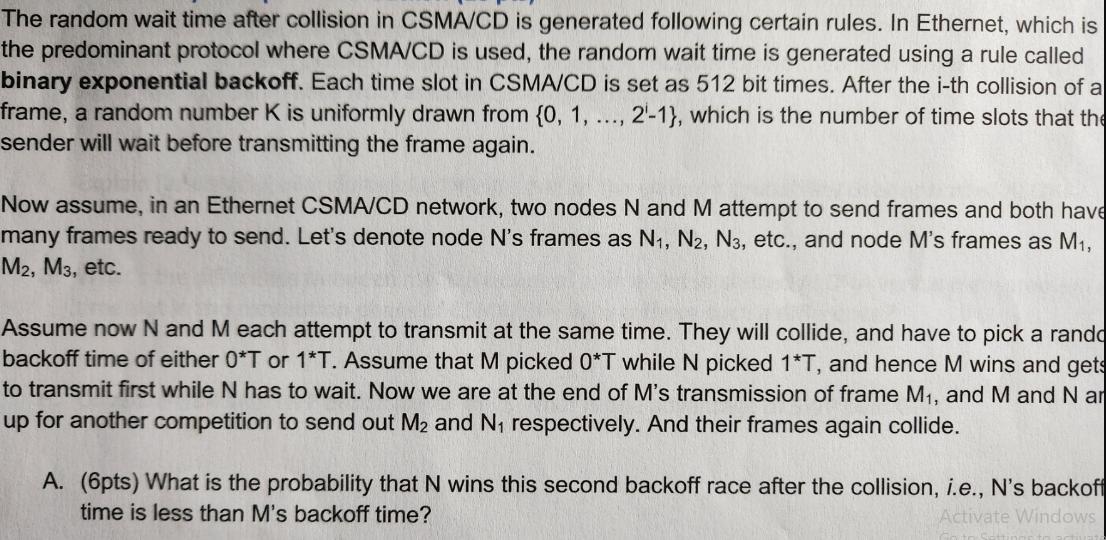
The random wait time after collision in CSMA/CD is generated following certain rules. In Ethernet, which is the predominant protocol where CSMA/CD is used, the random wait time is generated using a rule called binary exponential backoff. Each time slot in CSMA/CD is set as 512 bit times. After the i-th collision of a frame, a random number K is uniformly drawn from {0, 1, ..., 2-1}, which is the number of time slots that the sender will wait before transmitting the frame again. Now assume, in an Ethernet CSMA/CD network, two nodes N and M attempt to send frames and both have many frames ready to send. Let's denote node N's frames as N, N2, N3, etc., and node M's frames as M, M2, M3, etc. Assume now N and M each attempt to transmit at the same time. They will collide, and have to pick a rando backoff time of either 0*T or 1*T. Assume that M picked 0*T while N picked 1*T, and hence M wins and gets to transmit first while N has to wait. Now we are at the end of M's transmission of frame M, and M and N ar up for another competition to send out M and N respectively. And their frames again collide. A. (6pts) What is the probability that N wins this second backoff race after the collision, i.e., N's backoff time is less than M's backoff time? Activate Windows The random wait time after collision in CSMA/CD is generated following certain rules. In Ethernet, which is the predominant protocol where CSMA/CD is used, the random wait time is generated using a rule called binary exponential backoff. Each time slot in CSMA/CD is set as 512 bit times. After the i-th collision of a frame, a random number K is uniformly drawn from {0, 1, ..., 2-1}, which is the number of time slots that the sender will wait before transmitting the frame again. Now assume, in an Ethernet CSMA/CD network, two nodes N and M attempt to send frames and both have many frames ready to send. Let's denote node N's frames as N, N2, N3, etc., and node M's frames as M, M2, M3, etc. Assume now N and M each attempt to transmit at the same time. They will collide, and have to pick a rando backoff time of either 0*T or 1*T. Assume that M picked 0*T while N picked 1*T, and hence M wins and gets to transmit first while N has to wait. Now we are at the end of M's transmission of frame M, and M and N ar up for another competition to send out M and N respectively. And their frames again collide. A. (6pts) What is the probability that N wins this second backoff race after the collision, i.e., N's backoff time is less than M's backoff time? Activate Windows
Step by Step Solution
3.32 Rating (155 Votes )
There are 3 Steps involved in it
A To calculate the probability that node N wins the second backoff race after a c... View full answer

Get step-by-step solutions from verified subject matter experts
 Study Help