







Question: The representative U.S. consumer optimizes decisions for consumption in period 1 and period 2 (denoted, respectively, as c and ) and labor supply in
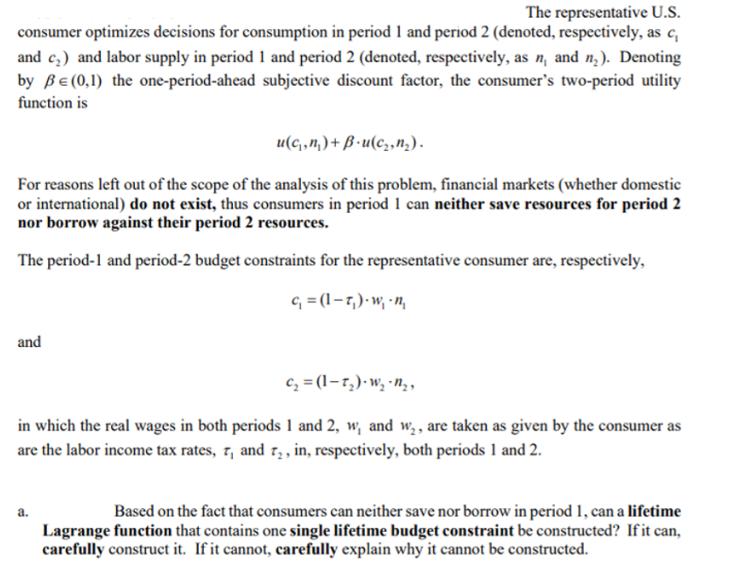
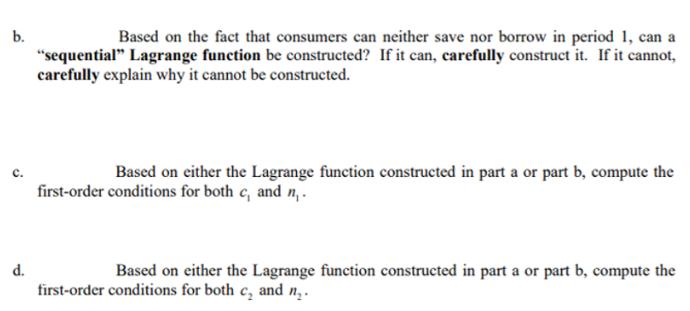
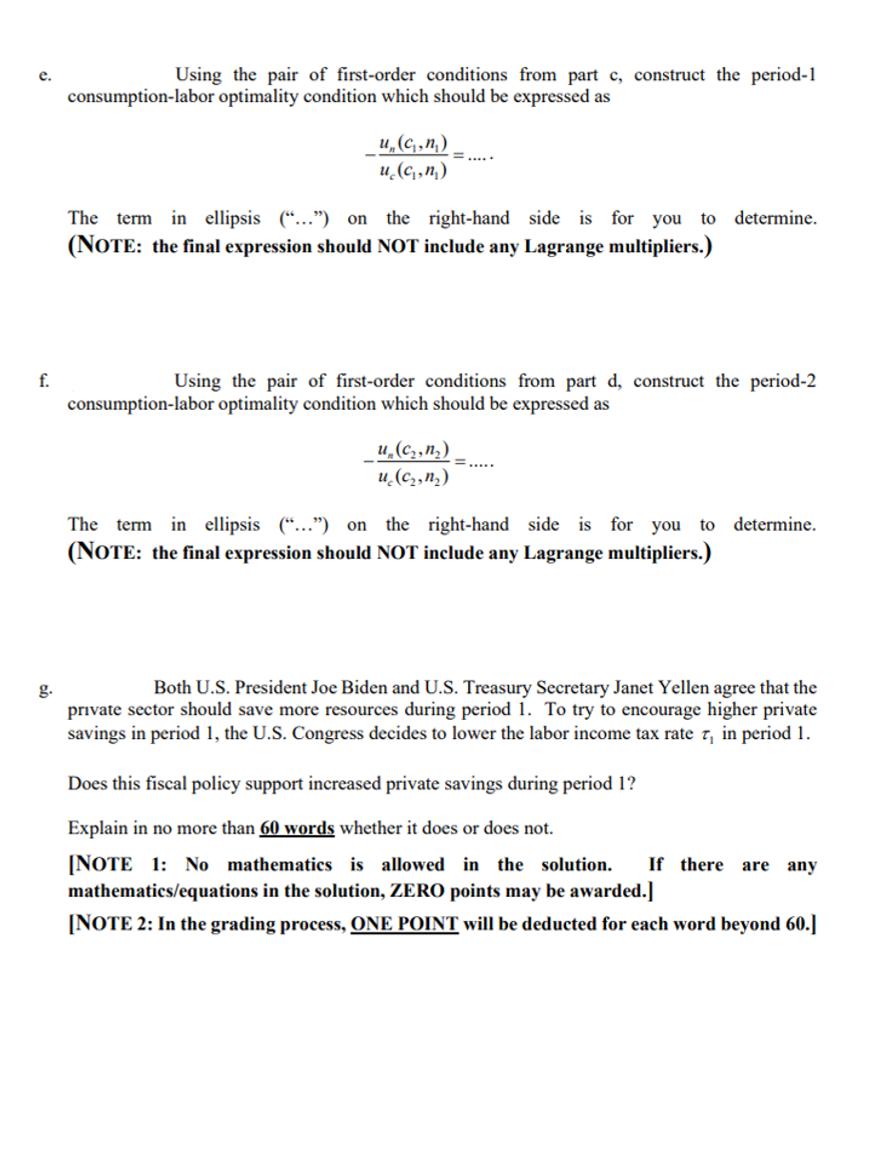
The representative U.S. consumer optimizes decisions for consumption in period 1 and period 2 (denoted, respectively, as c and ) and labor supply in period 1 and period 2 (denoted, respectively, as n, and n). Denoting by Be(0,1) the one-period-ahead subjective discount factor, the consumer's two-period utility function is u(c, n) + -u(c,n). For reasons left out of the scope of the analysis of this problem, financial markets (whether domestic or international) do not exist, thus consumers in period 1 can neither save resources for period 2 nor borrow against their period 2 resources. The period-1 and period-2 budget constraints for the representative consumer are, respectively, c = (1-7).w, -n and C = (1-T)-W -n, in which the real wages in both periods 1 and 2, w, and w, are taken as given by the consumer as are the labor income tax rates, r, and 7, in, respectively, both periods 1 and 2. Based on the fact that consumers can neither save nor borrow in period 1, can a lifetime Lagrange function that contains one single lifetime budget constraint be constructed? If it can, carefully construct it. If it cannot, carefully explain why it cannot be constructed. b. d. Based on the fact that consumers can neither save nor borrow in period 1, can a "sequential" Lagrange function be constructed? If it can, carefully construct it. If it cannot, carefully explain why it cannot be constructed. Based on either the Lagrange function constructed in part a or part b, compute the first-order conditions for both c, and n. Based on either the Lagrange function constructed in part a or part b, compute the first-order conditions for both c, and n. e. f. g. Using the pair of first-order conditions from part c, construct the period-1 consumption-labor optimality condition which should be expressed as u, (c,n). u. (c, n.) The term in ellipsis ("...") on the right-hand side is for you to determine. (NOTE: the final expression should NOT include any Lagrange multipliers.) Using the pair of first-order conditions from part d, construct the period-2 consumption-labor optimality condition which should be expressed as u (c,n) u. (C, M) =..... The term in ellipsis ("...") on the right-hand side is for you to determine. (NOTE: the final expression should NOT include any Lagrange multipliers.) Both U.S. President Joe Biden and U.S. Treasury Secretary Janet Yellen agree that the private sector should save more resources during period 1. To try to encourage higher private savings in period 1, the U.S. Congress decides to lower the labor income tax rate 7, in period 1. Does this fiscal policy support increased private savings during period 1? Explain in no more than 60 words whether it does or does not. [NOTE 1: No mathematics is allowed in the solution. If there are any mathematics/equations in the solution, ZERO points may be awarded.] [NOTE 2: In the grading process, ONE POINT will be deducted for each word beyond 60.]
Step by Step Solution
3.39 Rating (152 Votes )
There are 3 Steps involved in it

Get step-by-step solutions from verified subject matter experts
 Study Help