







Question: The Setup Note: The companion spreadsheet automates this setup for you, in the sense that it takes your information and returns a table with the
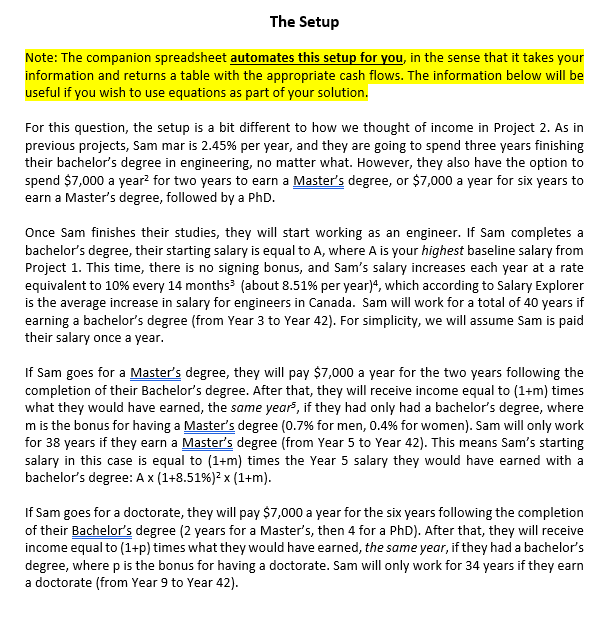
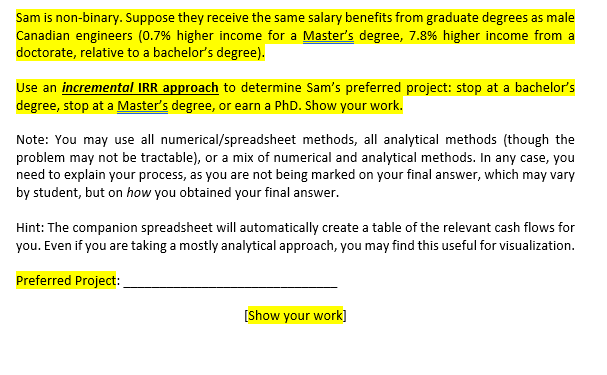
The Setup Note: The companion spreadsheet automates this setup for you, in the sense that it takes your information and returns a table with the appropriate cash flows. The information below will be useful if you wish to use equations as part of your solution. For this question, the setup is a bit different to how we thought of income in Project 2. As in previous projects, Sam mar is 2.45% per year, and they are going to spend three years finishing their bachelor's degree in engineering, no matter what. However, they also have the option to spend $7,000 a year for two years to earn a Master's degree, or $7,000 a year for six years to earn a Master's degree, followed by a PhD. Once Sam finishes their studies, they will start working as an engineer. If Sam completes a bachelor's degree, their starting salary is equal to A, where A is your highest baseline salary from Project 1. This time, there is no signing bonus, and Sam's salary increases each year at a rate equivalent to 10% every 14 months (about 8.51% per year)4, which according to Salary Explorer is the average increase in salary for engineers in Canada. Sam will work for a total of 40 years if earning a bachelor's degree (from Year 3 to Year 42). For simplicity, we will assume Sam is paid their salary once a year. If Sam goes for a Master's degree, they will pay $7,000 a year for the two years following the completion of their Bachelor's degree. After that, they will receive income equal to (1+m) times what they would have earned, the same years, if they had only had a bachelor's degree, where m is the bonus for having a Master's degree (0.7% for men, 0.4% for women). Sam will only work for 38 years if they earn a Master's degree (from Year 5 to Year 42). This means Sam's starting salary in this case is equal to (1+m) times the Year 5 salary they would have earned with a bachelor's degree: A x (1+8.51%)2 x (1+m). If Sam goes for a doctorate, they will pay $7,000 a year for the six years following the completion of their Bachelor's degree (2 years for a Master's, then 4 for a PhD). After that, they will receive income equal to (1+p) times what they would have earned, the same year, if they had a bachelor's degree, where p is the bonus for having a doctorate. Sam will only work for 34 years if they earn a doctorate (from Year 9 to Year 42).Sam is non-binary. Suppose they receive the same salary benefits from graduate degrees as male Canadian engineers (0.7% higher income for a Master's degree, 7.8% higher income from a doctorate, relative to a bachelor's degree). Use an incremental IRR approach to determine Sam's preferred project: stop at a bachelor's degree, stop at a Master's degree, or earn a PhD. Show your work. Note: You may use all numerical/spreadsheet methods, all analytical methods (though the problem may not be tractable), or a mix of numerical and analytical methods. In any case, you need to explain your process, as you are not being marked on your final answer, which may vary by student, but on how you obtained your final answer. Hint: The companion spreadsheet will automatically create a table of the relevant cash flows for you. Even if you are taking a mostly analytical approach, you may find this useful for visualization. Preferred Project: [ Show your work]
Step by Step Solution
There are 3 Steps involved in it

Get step-by-step solutions from verified subject matter experts
 Study Help