



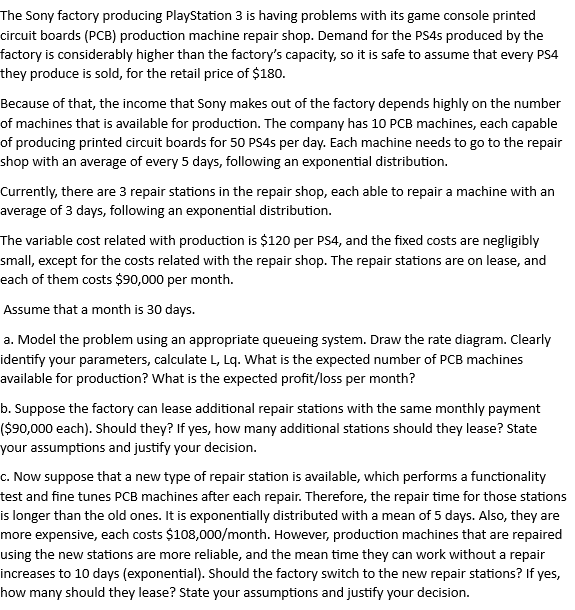
Question: The Sony factory producing PlayStation 3 is having problems with its game console printed circuit boards ( PCB ) production machine repair shop. Demand for
The Sony factory producing PlayStation is having problems with its game console printed
circuit boards PCB production machine repair shop. Demand for the PSs produced by the
factory is considerably higher than the factory's capacity, so it is safe to assume that every PS
they produce is sold, for the retail price of $
Because of that, the income that Sony makes out of the factory depends highly on the number
of machines that is available for production. The company has PCB machines, each capable
of producing printed circuit boards for PSs per day. Each machine needs to go to the repair
shop with an average of every days, following an exponential distribution.
Currently, there are repair stations in the repair shop, each able to repair a machine with an
average of days, following an exponential distribution.
The variable cost related with production is $ per PS and the fixed costs are negligibly
small, except for the costs related with the repair shop. The repair stations are on lease, and
each of them costs $ per month.
Assume that a month is days.
a Model the problem using an appropriate queueing system. Draw the rate diagram. Clearly
identify your parameters, calculate L Lq What is the expected number of PCB machines
available for production? What is the expected profitloss per month?
b Suppose the factory can lease additional repair stations with the same monthly payment
$ each Should they? If yes, how many additional stations should they lease? State
your assumptions and justify your decision.
c Now suppose that a new type of repair station is available, which performs a functionality
test and fine tunes PCB machines after each repair. Therefore, the repair time for those stations
is longer than the old ones. It is exponentially distributed with a mean of days. Also, they are
more expensive, each costs $ month. However, production machines that are repaired
using the new stations are more reliable, and the mean time they can work without a repair
increases to days exponential Should the factory switch to the new repair stations? If yes,
how many should they lease? State your assumptions and justify your decision.
Step by Step Solution
There are 3 Steps involved in it
1 Expert Approved Answer
Step: 1 Unlock

Question Has Been Solved by an Expert!
Get step-by-step solutions from verified subject matter experts
Step: 2 Unlock
Step: 3 Unlock