





Question: the supervisor and Chapter 8: Performance Evaluation and Development effectiveness will be able to Performance Evaluation and 195 win-win relation and de pproach using basic
the supervisor and Chapter 8: Performance

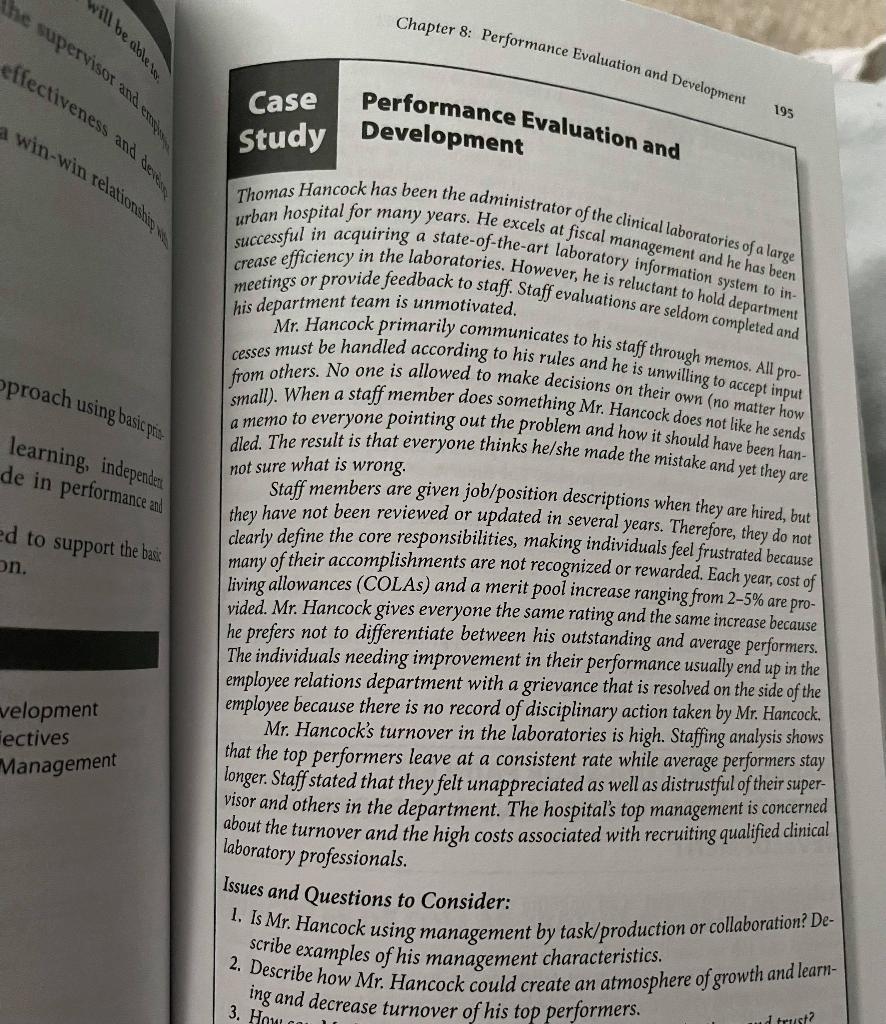
the supervisor and Chapter 8: Performance Evaluation and Development effectiveness will be able to Performance Evaluation and 195 win-win relation and de pproach using basic pris learning, independent de in performance and ed to support the basis on. Case Study Development urban hospital for many years. He excels at fiscal management and he has been Thomas Hancock has been the administrator of the clinical laboratories of a large successful in acquiring a state-of-the-art laboratory information system to in meetings or provide feedback to staff. Staff evaluations are seldom completed and crease efficiency in the laboratories. However, he is reluctant to hold department his department team is unmotivated. Mr. Hancock primarily communicates to his staff through memos. All pro- cesses must be handled according to his rules and he is unwilling to accept input from others. No one is allowed to make decisions on their own (no matter how small). When a staff member does something Mr. Hancock does not like he sends a memo to everyone pointing out the problem and how it should have been han- dled. The result is that everyone thinks he/she made the mistake and yet they are not sure what is wrong. Staff members are given job/position descriptions when they are hired, but they have not been reviewed or updated in several years. Therefore , they do not clearly define the core responsibilities, making individuals feel frustrated because many of their accomplishments are not recognized or rewarded. Each year, cost of living allowances (COLAs) and a merit pool increase ranging from 2-5% are pro- vided. Mr. Hancock gives everyone the same rating and the same increase because he prefers not to differentiate between his outstanding and average performers. The individuals needing improvement in their performance usually end up in the employee relations department with a grievance that is resolved on the side of the employee because there is no record of disciplinary action taken by Mr. Hancock. Mr. Hancock's turnover in the laboratories is high. Staffing analysis shows that the top performers leave at a consistent rate while average performers stay longer . Staff stated that they felt unappreciated as well as distrustful of their super- visor and others in the department. The hospital's top management is concerned about the turnover and the high costs associated with recruiting qualified clinical laboratory professionals. Issues and Questions to Consider: 1. Is Mr. Hancock using management by task/production or collaboration? De- scribe examples of his management characteristics. 2. Describe how Mr. Hancock could create an atmosphere of growth and learn- ing and decrease turnover of his top performers. d trust? velopment lectives Management 3. How can

Step by Step Solution

There are 3 Steps involved in it

1 Expert Approved Answer
Step: 1 Unlock blur-text-image

Question Has Been Solved by an Expert!

Get step-by-step solutions from verified subject matter experts

Step: 2 Unlock
Step: 3 Unlock

Students Have Also Explored These Related General Management Questions!