







Question: The table gives selected values of the continuous function g . Below is Max's attempt to write a formal justification for the fact that the
The table gives selected values of the continuous function
g.\ Below is Max's attempt to write a formal justification for the fact that the\ equation
g(x)=5has a solution where
14.\ Is Max's justification complete? If not, why?\ Max's justification:\ We are given that
g is continuous.\ So, according to the intermediate value theorem,
g(x)=5\ must have a solution at some point between
x=14 and\
x=18.\ Choose 1 answer:\ Yes, Max's justification is complete.\ No, Max didn't establish that 5 is between
g(14) and
g(18).\ No, Max should've mentioned that
g is continuous.
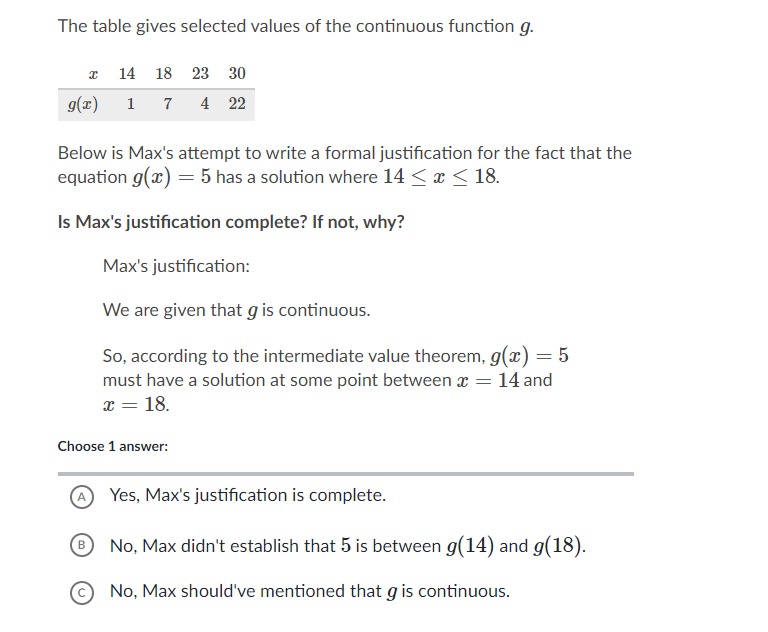
The table gives selected values of the continuous function g. Below is Max's attempt to write a formal justification for the fact that the equation g(x)=5 has a solution where 14x18. Is Max's justification complete? If not, why? Max's justification: We are given that g is continuous. So, according to the intermediate value theorem, g(x)=5 must have a solution at some point between x=14 and x=18. Choose 1 answer: Yes, Max's justification is complete. No, Max didn't establish that 5 is between g(14) and g(18). No, Max should've mentioned that g is continuous. The table gives selected values of the continuous function g. Below is Max's attempt to write a formal justification for the fact that the equation g(x)=5 has a solution where 14x18. Is Max's justification complete? If not, why? Max's justification: We are given that g is continuous. So, according to the intermediate value theorem, g(x)=5 must have a solution at some point between x=14 and x=18. Choose 1 answer: Yes, Max's justification is complete. No, Max didn't establish that 5 is between g(14) and g(18). No, Max should've mentioned that g is continuous
Step by Step Solution
There are 3 Steps involved in it

Get step-by-step solutions from verified subject matter experts
 Study Help