







Question: There 3 short case studies, base on the case study answer the below question. Read the case and description properly. I need the answer ASAP
There 3 short case studies, base on the case study answer the below question. Read the case and description properly. I need the answer ASAP and a professional answer reffering and related to the cases.
Case 1:
Case 2:
Case 3:
QUESTION :

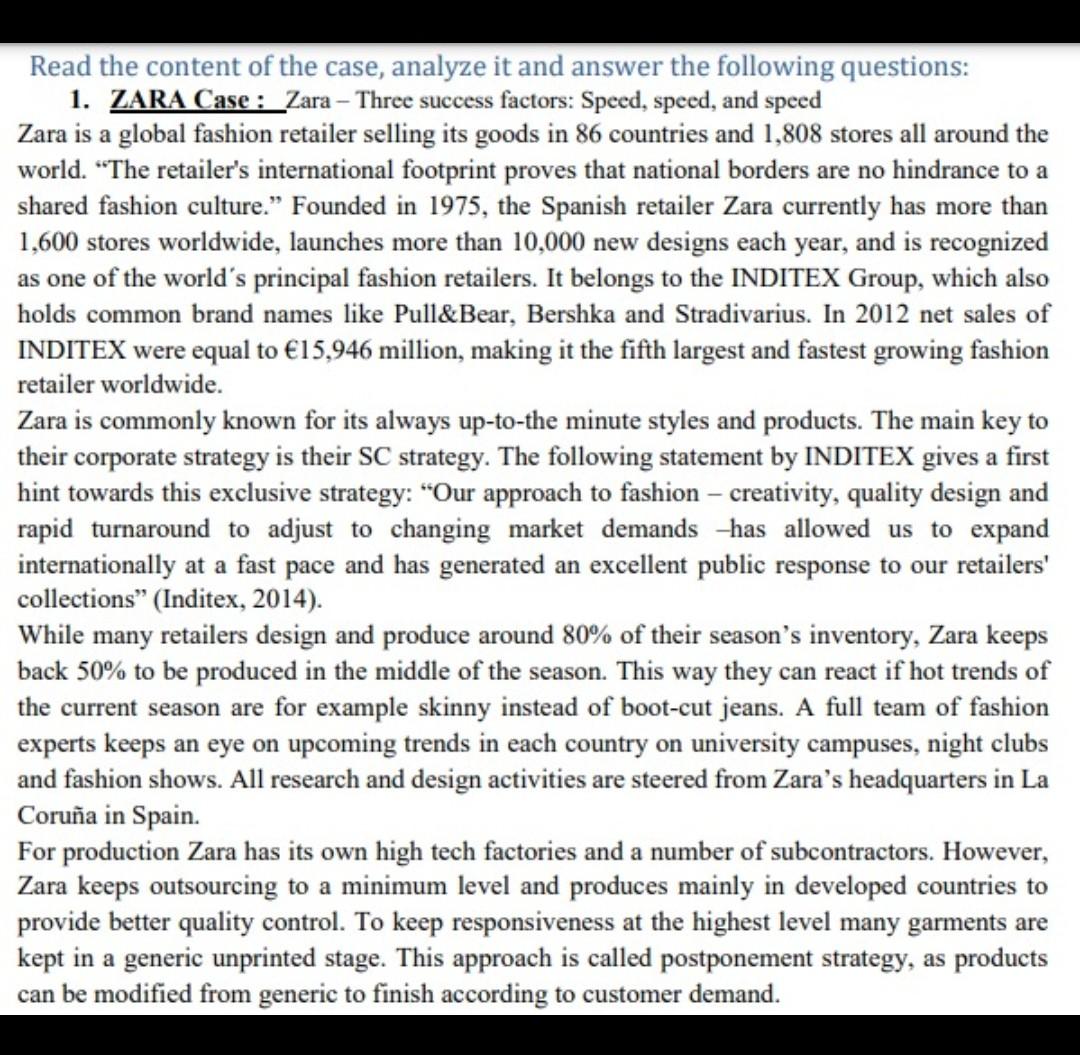
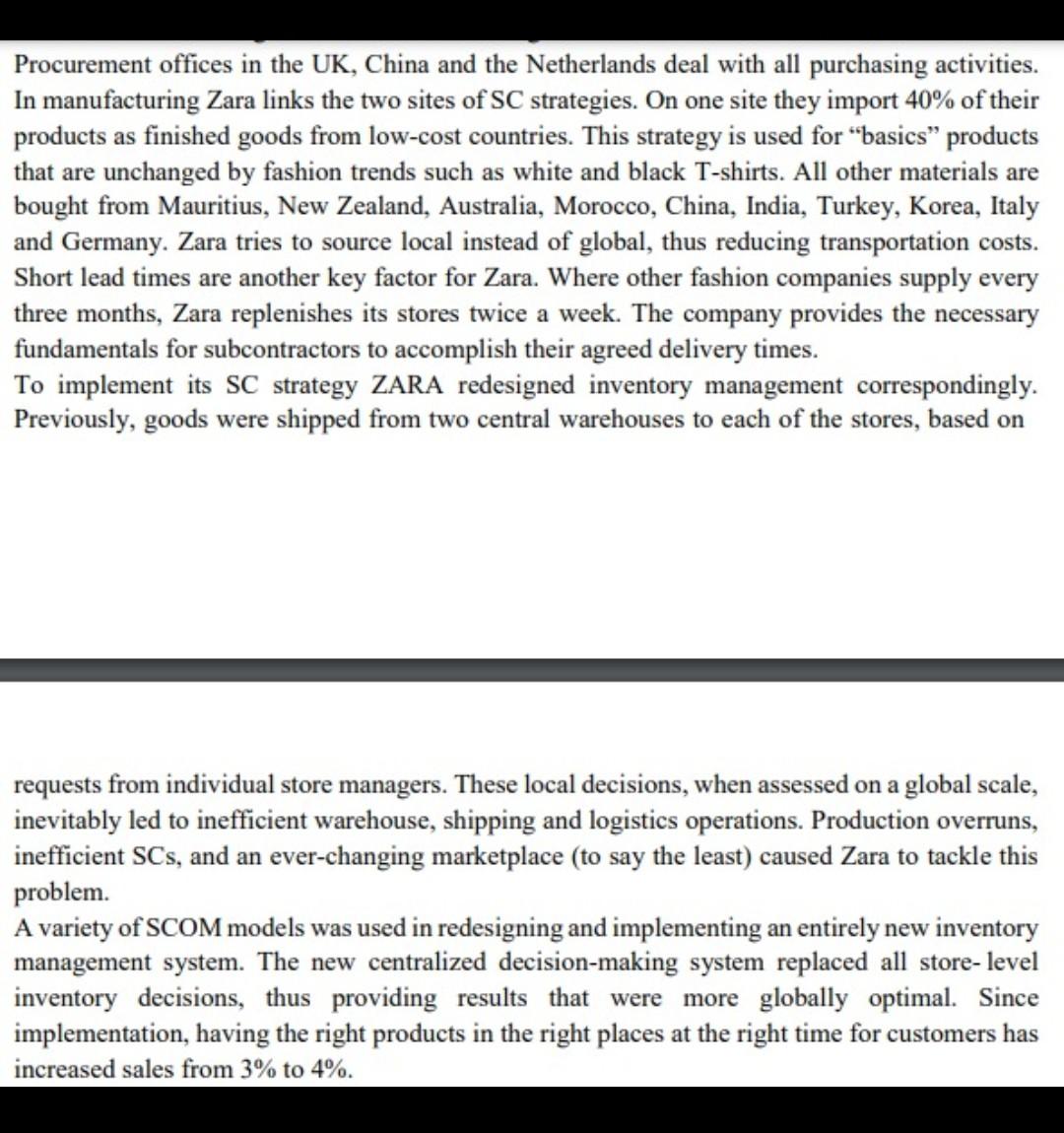
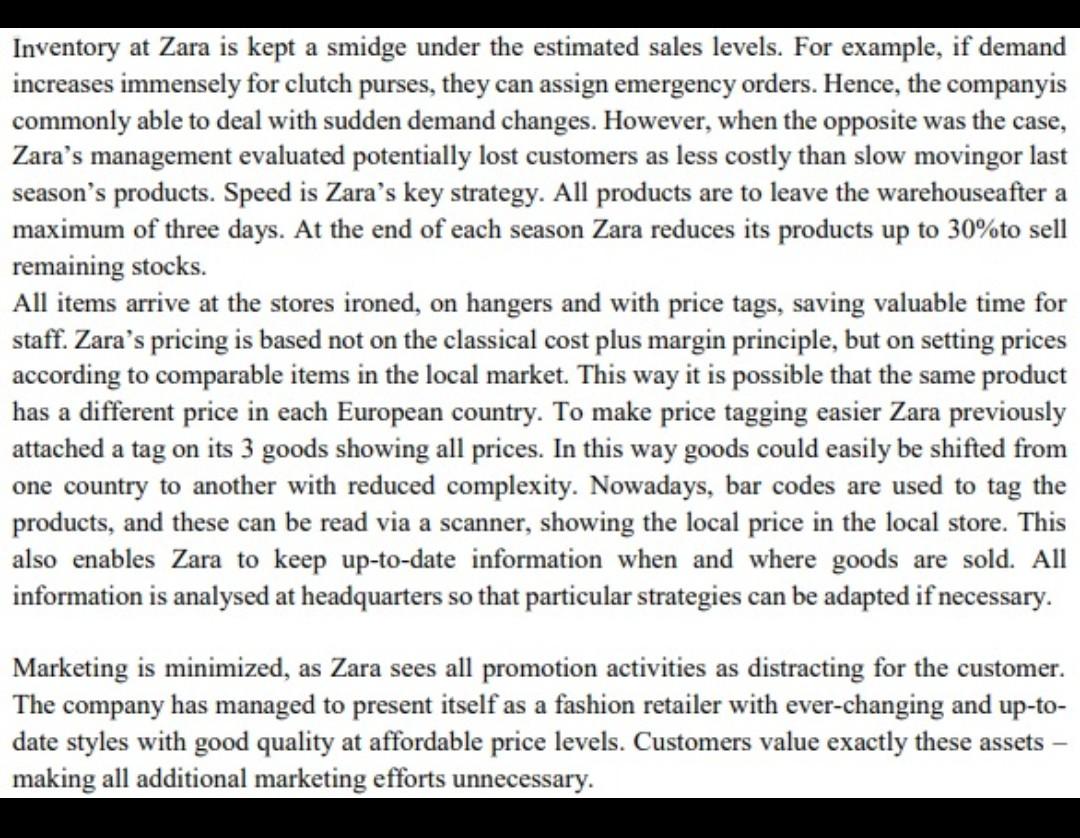
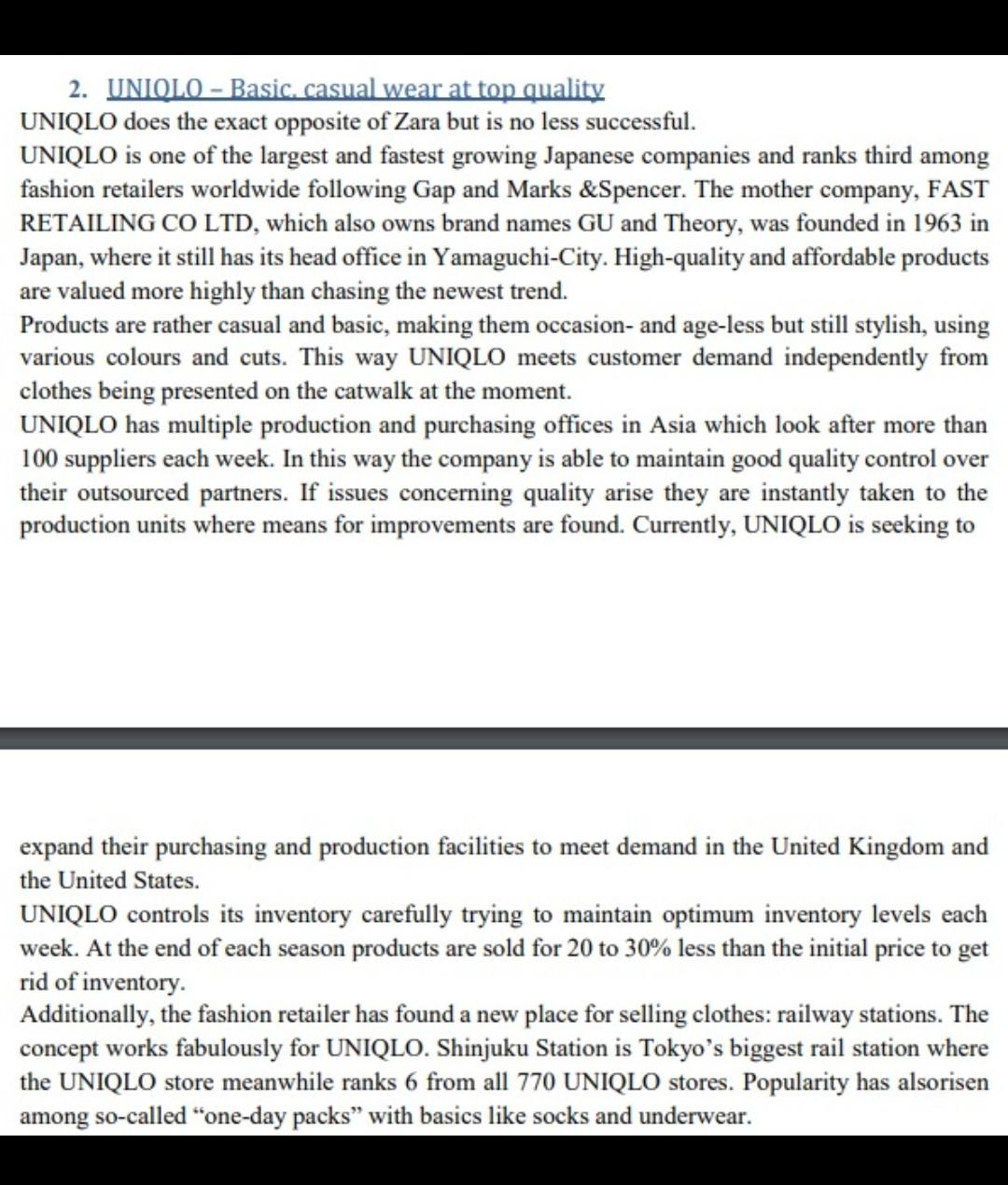
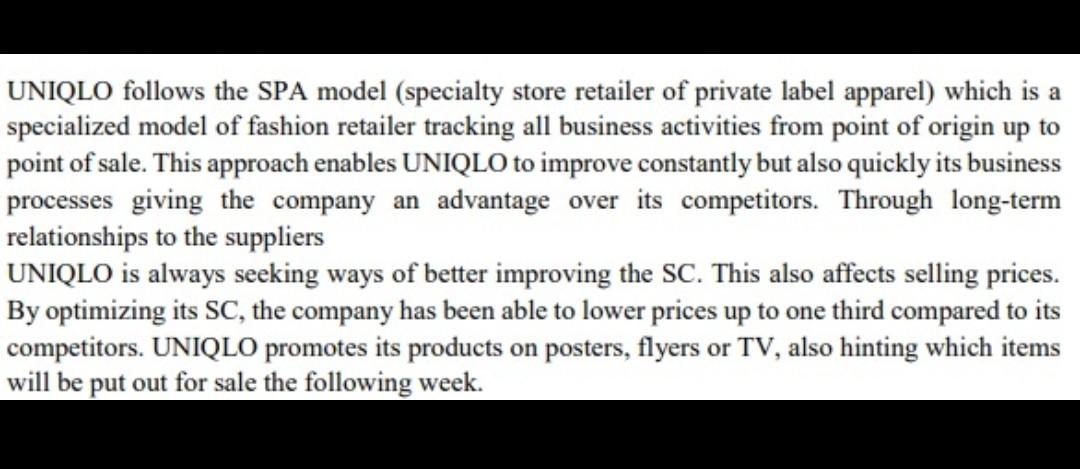
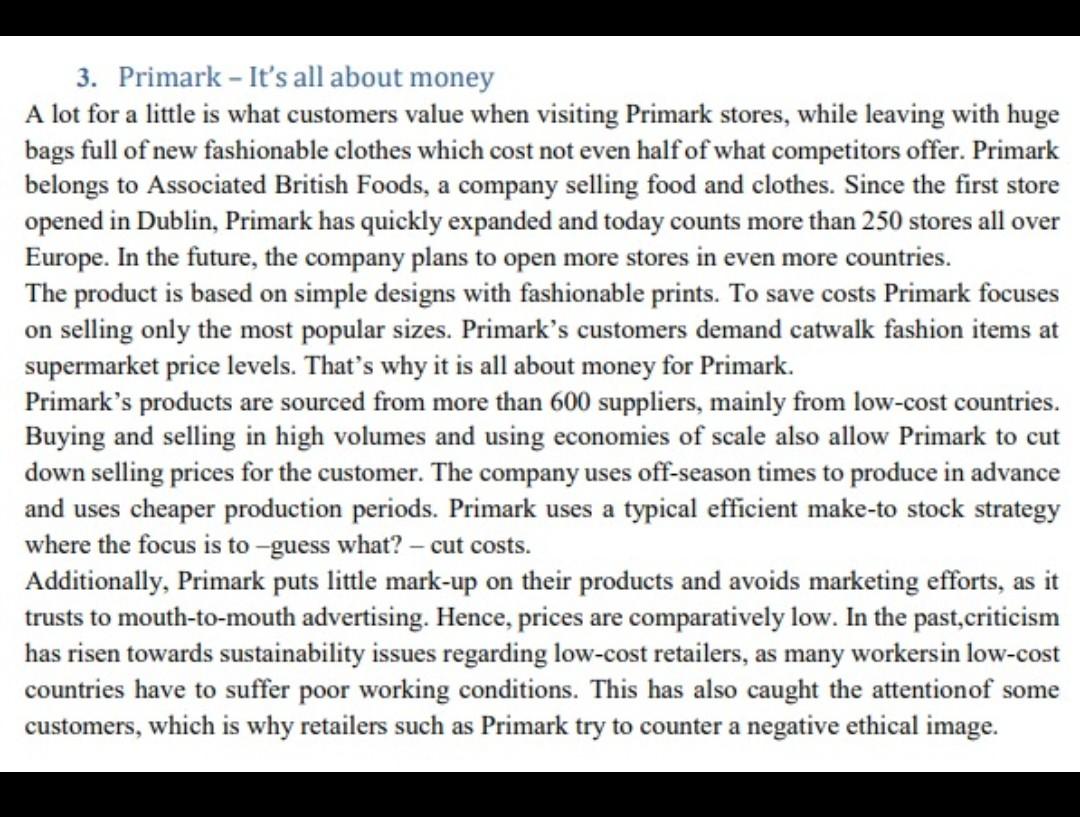
. Read the content of the case, analyze it and answer the following questions: 1. ZARA Case : _Zara - Three success factors: Speed, speed, and speed Zara is a global fashion retailer selling its goods in 86 countries and 1,808 stores all around the world. The retailer's international footprint proves that national borders are no hindrance to a shared fashion culture. Founded in 1975, the Spanish retailer Zara currently has more than 1,600 stores worldwide, launches more than 10,000 new designs each year, and is recognized as one of the world's principal fashion retailers. It belongs to the INDITEX Group, which also holds common brand names like Pull&Bear, Bershka and Stradivarius. In 2012 net sales of INDITEX were equal to 15,946 million, making it the fifth largest and fastest growing fashion retailer worldwide. Zara is commonly known for its always up-to-the minute styles and products. The main key to their corporate strategy is their SC strategy. The following statement by INDITEX gives a first hint towards this exclusive strategy: "Our approach to fashion - creativity, quality design and rapid turnaround to adjust to changing market demands has allowed us to expand internationally at a fast pace and has generated an excellent public response to our retailers' collections (Inditex, 2014). While many retailers design and produce around 80% of their season's inventory, Zara keeps back 50% to be produced in the middle of the season. This way they can react if hot trends of the current season are for example skinny instead of boot-cut jeans. A full team of fashion experts keeps an eye on upcoming trends in each country on university campuses, night clubs and fashion shows. All research and design activities are steered from Zara's headquarters in La Corua in Spain. For production Zara has its own high tech factories and a number of subcontractors. However, Zara keeps outsourcing to a minimum level and produces mainly in developed countries to provide better quality control. To keep responsiveness at the highest level many garments are kept in a generic unprinted stage. This approach is called postponement strategy, as products can be modified from generic to finish according to customer demand. Procurement offices in the UK, China and the Netherlands deal with all purchasing activities. In manufacturing Zara links the two sites of SC strategies. On one site they import 40% of their products as finished goods from low-cost countries. This strategy is used for "basics" products that are unchanged by fashion trends such as white and black T-shirts. All other materials are bought from Mauritius, New Zealand, Australia, Morocco, China, India, Turkey, Korea, Italy and Germany. Zara tries to source local instead of global, thus reducing transportation costs. Short lead times are another key factor for Zara. Where other fashion companies supply every three months, Zara replenishes its stores twice a week. The company provides the necessary fundamentals for subcontractors to accomplish their agreed delivery times. To implement its SC strategy ZARA redesigned inventory management correspondingly. Previously, goods were shipped from two central warehouses to each of the stores, based on a requests from individual store managers. These local decisions, when assessed on a global scale, inevitably led to inefficient warehouse, shipping and logistics operations. Production overruns, inefficient SCs, and an ever-changing marketplace (to say the least) caused Zara to tackle this problem. A variety of SCOM models was used in redesigning and implementing an entirely new inventory management system. The new centralized decision-making system replaced all store- level inventory decisions, thus providing results that were more globally optimal. Since implementation, having the right products in the right places at the right time for customers has increased sales from 3% to 4%. Inventory at Zara is kept a smidge under the estimated sales levels. For example, if demand increases immensely for clutch purses, they can assign emergency orders. Hence, the companyis commonly able to deal with sudden demand changes. However, when the opposite was the case, Zara's management evaluated potentially lost customers as less costly than slow movingor last season's products. Speed is Zara's key strategy. All products are to leave the warehouseafter a maximum of three days. At the end of each season Zara reduces its products up to 30%to sell remaining stocks. All items arrive at the stores ironed, on hangers and with price tags, saving valuable time for staff. Zara's pricing is based not on the classical cost plus margin principle, but on setting prices according to comparable items in the local market. This way it is possible that the same product has a different price in each European country. To make price tagging easier Zara previously attached a tag on its 3 goods showing all prices. In this way goods could easily be shifted from one country to another with reduced complexity. Nowadays, bar codes are used to tag the products, and these can be read via a scanner, showing the local price in the local store. This also enables Zara to keep up-to-date information when and where goods are sold. All information is analysed at headquarters so that particular strategies can be adapted if necessary. Marketing is minimized, as Zara sees all promotion activities as distracting for the customer. The company has managed to present itself as a fashion retailer with ever-changing and up-to- date styles with good quality at affordable price levels. Customers value exactly these assets making all additional marketing efforts unnecessary. 2. UNIQLO - Basic. casual wear at top quality UNIQLO does the exact opposite of Zara but is no less successful. UNIQLO is one of the largest and fastest growing Japanese companies and ranks third among fashion retailers worldwide following Gap and Marks &Spencer. The mother company, FAST RETAILING CO LTD, which also owns brand names GU and Theory, was founded in 1963 in Japan, where it still has its head office in Yamaguchi-City. High-quality and affordable products are valued more highly than chasing the newest trend. Products are rather casual and basic, making them occasion- and age-less but still stylish, using various colours and cuts. This way UNIQLO meets customer demand independently from clothes being presented on the catwalk at the moment. UNIQLO has multiple production and purchasing offices in Asia which look after more than 100 suppliers each week. In this way the company is able to maintain good quality control over their outsourced partners. If issues concerning quality arise they are instantly taken to the production units where means for improvements are found. Currently, UNIQLO is seeking to expand their purchasing and production facilities to meet demand in the United Kingdom and the United States. UNIQLO controls its inventory carefully trying to maintain optimum inventory levels each week. At the end of each season products are sold for 20 to 30% less than the initial price to get rid of inventory. Additionally, the fashion retailer has found a new place for selling clothes: railway stations. The concept works fabulously for UNIQLO. Shinjuku Station is Tokyo's biggest rail station where the UNIQLO store meanwhile ranks 6 from all 770 UNIQLO stores. Popularity has alsorisen among so-called "one-day packs" with basics like socks and underwear. UNIQLO follows the SPA model (specialty store retailer of private label apparel) which is a specialized model of fashion retailer tracking all business activities from point of origin up to point of sale. This approach enables UNIQLO to improve constantly but also quickly its business processes giving the company an advantage over its competitors. Through long-term relationships to the suppliers UNIQLO is always seeking ways of better improving the SC. This also affects selling prices. By optimizing its SC, the company has been able to lower prices up to one third compared to its competitors. UNIQLO promotes its products on posters, flyers or TV, also hinting which items will be put out for sale the following week. 3. Primark - It's all about money A lot for a little is what customers value when visiting Primark stores, while leaving with huge bags full of new fashionable clothes which cost not even half of what competitors offer. Primark belongs to Associated British Foods, a company selling food and clothes. Since the first store opened in Dublin, Primark has quickly expanded and today counts more than 250 stores all over Europe. In the future, the company plans to open more stores in even more countries. The product is based on simple designs with fashionable prints. To save costs Primark focuses on selling only the most popular sizes. Primark's customers demand catwalk fashion items at supermarket price levels. That's why it is all about money for Primark. Primark's products are sourced from more than 600 suppliers, mainly from low-cost countries. Buying and selling in high volumes and using economies of scale also allow Primark to cut down selling prices for the customer. The company uses off-season times to produce in advance and uses cheaper production periods. Primark uses a typical efficient make-to stock strategy where the focus is to guess what? - cut costs. Additionally, Primark puts little mark-up on their products and avoids marketing efforts, as it trusts to mouth-to-mouth advertising. Hence, prices are comparatively low. In the past, criticism has risen towards sustainability issues regarding low-cost retailers, as many workers in low-cost countries have to suffer poor working conditions. This has also caught the attentionof some customers, which is why retailers such as Primark try to counter a negative ethical image. Q3). What factors are critical for each SC strategy for Zara, UNIQLO, and Primark
Step by Step Solution
There are 3 Steps involved in it
1 Expert Approved Answer
Step: 1 Unlock

Question Has Been Solved by an Expert!
Get step-by-step solutions from verified subject matter experts
Step: 2 Unlock
Step: 3 Unlock
 Study Help