



Question: There are two drivers on a public highway. Driver h chooses speed sh, with his/her utility increasing in how fast he/she drives. The higher either
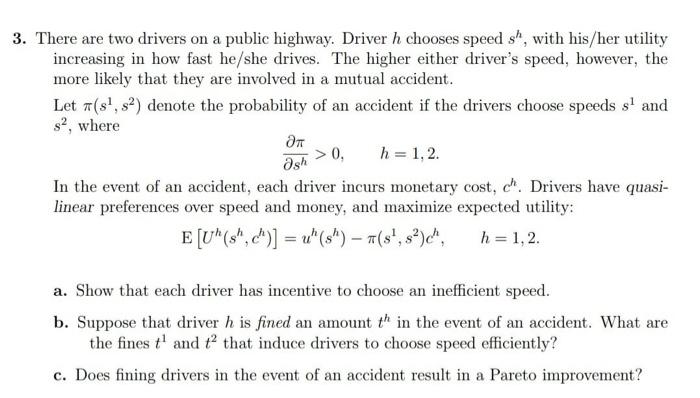
There are two drivers on a public highway. Driver h chooses speed sh, with his/her utility increasing in how fast he/she drives. The higher either driver's speed, however, the more likely that they are involved in a mutual accident. Let (s1,s2) denote the probability of an accident if the drivers choose speeds s1 and s2, where sh>0,h=1,2. In the event of an accident, each driver incurs monetary cost, ch. Drivers have quasilinear preferences over speed and money, and maximize expected utility: E[Uh(sh,ch)]=uh(sh)(s1,s2)ch,h=1,2. a. Show that each driver has incentive to choose an inefficient speed. b. Suppose that driver h is fined an amount th in the event of an accident. What are the fines t1 and t2 that induce drivers to choose speed efficiently? c. Does fining drivers in the event of an accident result in a Pareto improvement? There are two drivers on a public highway. Driver h chooses speed sh, with his/her utility increasing in how fast he/she drives. The higher either driver's speed, however, the more likely that they are involved in a mutual accident. Let (s1,s2) denote the probability of an accident if the drivers choose speeds s1 and s2, where sh>0,h=1,2. In the event of an accident, each driver incurs monetary cost, ch. Drivers have quasilinear preferences over speed and money, and maximize expected utility: E[Uh(sh,ch)]=uh(sh)(s1,s2)ch,h=1,2. a. Show that each driver has incentive to choose an inefficient speed. b. Suppose that driver h is fined an amount th in the event of an accident. What are the fines t1 and t2 that induce drivers to choose speed efficiently? c. Does fining drivers in the event of an accident result in a Pareto improvement
Step by Step Solution
There are 3 Steps involved in it

Get step-by-step solutions from verified subject matter experts