







Question: There is a project for which player 1 can exert effort e 20 that costs her c(e) = 0.5e. If player 1 and player
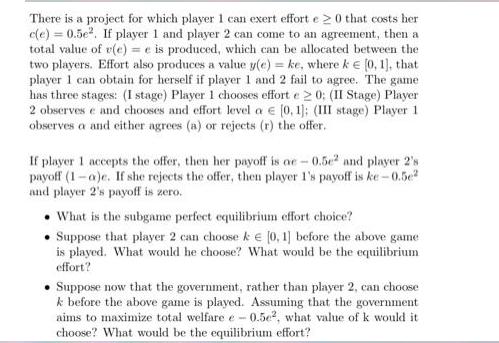
There is a project for which player 1 can exert effort e 20 that costs her c(e) = 0.5e. If player 1 and player 2 can come to an agreement, then a total value of v(e) = e is produced, which can be allocated between the two players. Effort also produces a value y(e) = ke, where k = [0, 1], that player 1 can obtain for herself if player 1 and 2 fail to agree. The game has three stages: (I stage) Player 1 chooses effort e 2 0; (II Stage) Player 2 observes e and chooses and effort level a [0, 1]; (III stage) Player 11 observes a and either agrees (a) or rejects (r) the offer. If player 1 accepts the offer, then her payoff is ac- 0.5e2 and player 2's payoff (1-a)e. If she rejects the offer, then player 1's payoff is ke-0.5e and player 2's payoff is zero. . What is the subgame perfect equilibrium effort choice? Suppose that player 2 can choose k = [0, 1] before the above game is played. What would he choose? What would be the equilibrium effort? Suppose now that the government, rather than player 2, can choose k before the above game is played. Assuming that the government aims to maximize total welfare e - 0.5e, what value of k would it choose? What would be the equilibrium effort?
Step by Step Solution
3.40 Rating (156 Votes )
There are 3 Steps involved in it
To find the subgame perfect equilibrium effort choice we need to analyze the game in stages and cons... View full answer

Get step-by-step solutions from verified subject matter experts
 Study Help