







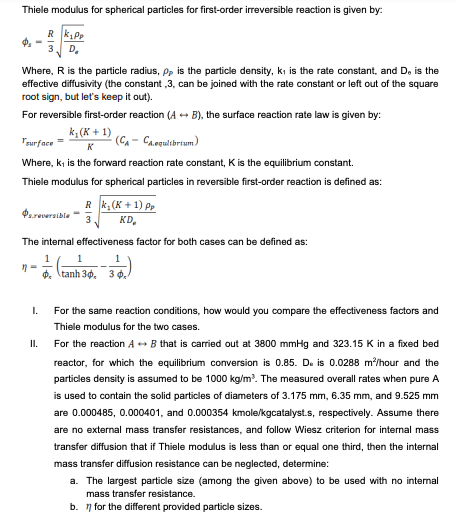
Question: Thiele modulus for spherical particles for first - order irreversible reaction is given by: s = R 3 k 1 p D e 2 Where,
Thiele modulus for spherical particles for firstorder irreversible reaction is given by:
Where, is the particle radius, is the particle density, is the rate constant, and is the
effective diffusivity the constant can be joined with the rate constant or left out of the square
root sign, but let's keep it out
For reversible firstorder reaction the surface reaction rate law is given by:
Where, is the forward reaction rate constant, is the equilibrium constant.
Thiele modulus for spherical particles in reversible firstorder reaction is defined as:
The internal effectiveness factor for both cases can be defined as:
I. For the same reaction conditions, how would you compare the effectiveness factors and
Thiele modulus for the two cases.
II For the reaction AharrB that is carried out at and in a fixed bed
particles density is assumed to be The measured overall rates when pure A
is used to contain the solid particles of diameters of and
are and kmolgcatalyst. respectively. Assume there
are no external mass transfer resistances, and follow Wiesz criterion for internal mass
transfer diffusion that if Thiele modulus is less than or equal one third, then the internal
mass transfer diffusion resistance can be neglected, determine:
a The largest particle size among the given above to be used with no internal
mass transfer resistance.
b for the different provided particle sizes.
Step by Step Solution
There are 3 Steps involved in it
1 Expert Approved Answer
Step: 1 Unlock

Question Has Been Solved by an Expert!
Get step-by-step solutions from verified subject matter experts
Step: 2 Unlock
Step: 3 Unlock
 Study Help