







Question: This answer should be 7to 8 pages and explain all questions in brief Case 1: Brad v. Lay-Z-Guy (12 points total) Brad began working at
This answer should be 7to 8 pages and explain all questions in brief
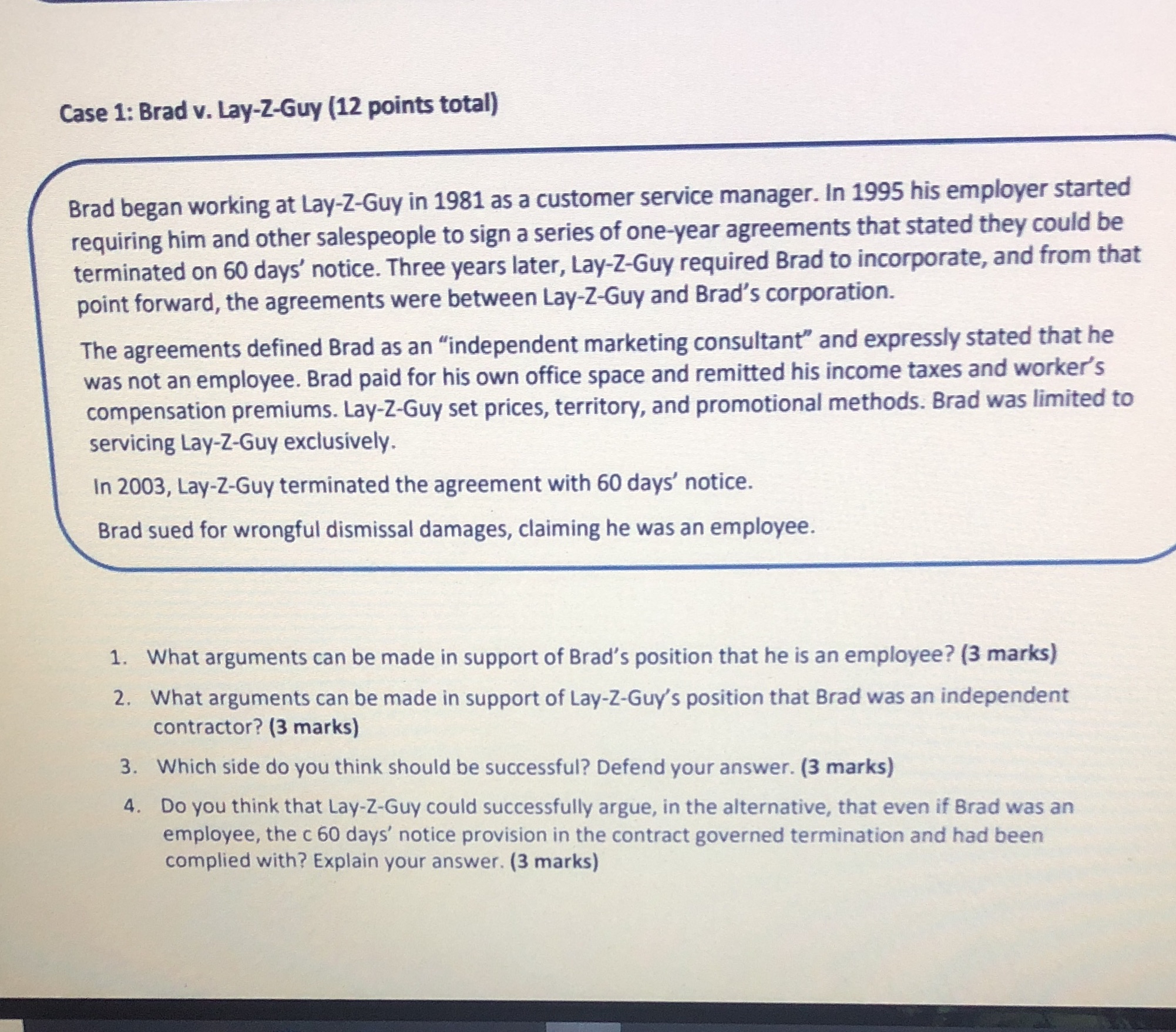
Case 1: Brad v. Lay-Z-Guy (12 points total) Brad began working at Lay-Z-Guy in 1981 as a customer service manager. In 1995 his employer started requiring him and other salespeople to sign a series of one-year agreements that stated they could be terminated on 60 days' notice. Three years later, Lay-Z-Guy required Brad to incorporate, and from that point forward, the agreements were between Lay-Z-Guy and Brad's corporation. The agreements defined Brad as an "independent marketing consultant" and expressly stated that he was not an employee. Brad paid for his own office space and remitted his income taxes and worker's compensation premiums. Lay-Z-Guy set prices, territory, and promotional methods. Brad was limited to servicing Lay-Z-Guy exclusively. In 2003, Lay-Z-Guy terminated the agreement with 60 days' notice. Brad sued for wrongful dismissal damages, claiming he was an employee. 1. What arguments can be made in support of Brad's position that he is an employee? (3 marks) 2. What arguments can be made in support of Lay-Z-Guy's position that Brad was an independent contractor? (3 marks) 3. Which side do you think should be successful? Defend your answer. (3 marks) 4. Do you think that Lay-Z-Guy could successfully argue, in the alternative, that even if Brad was an employee, the c 60 days' notice provision in the contract governed termination and had been complied with? Explain your
Step by Step Solution
There are 3 Steps involved in it

Get step-by-step solutions from verified subject matter experts
 Study Help