







Question: This assignment is about developing effective websites. There is a popular (and relatively simpler) alternative approach to evaluating the customer interface of a website called
This assignment is about developing effective websites. There is a popular (and relatively simpler) alternative approach to evaluating the customer interface of a website called the 7-Cs Framework suggested by authors Jeffrey Rayport and Bernard Jaworski.
Read the description of the 7-Cs framework from the excerpt posted (PDF file) below.
Next, visit the website of the National Basketball Association (NBA). Carefully examine the site (navigate to the various pages beyond the home page, and critique it in terms of how well the site addresses each of the 7 Cs (context, content, community, customization, communication, connection, and commerce). Make sure you describe the addressing of each C individually, including identifying what is covered well and what is covered not so well.
(Your identification and analysis of the first 6 Cs are worth 3 points each, and the 7th C is worth 2 points--making for a total of 20 points on the assignment).
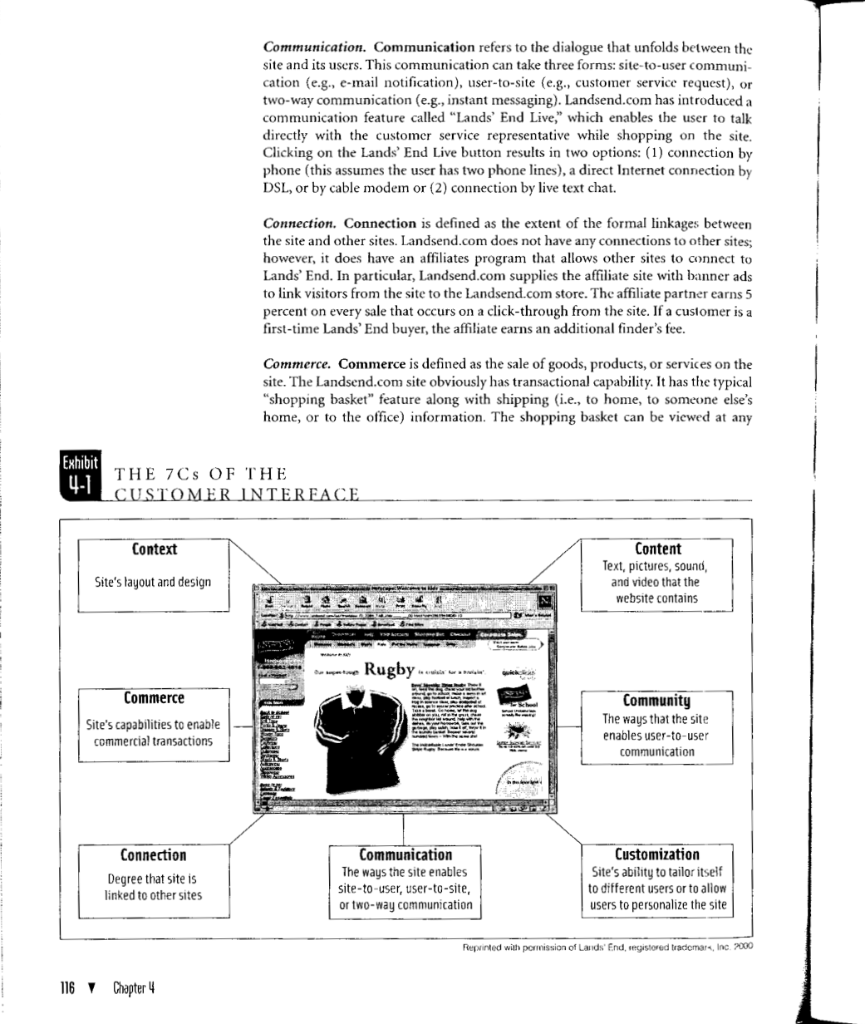
does it sell? What messages does the site communicate: Exclusivity? Low price? Ease of use? Consistent with a tightly constructed business model, well-designed sites should simultaneously attract target segment customers and repel nontargeted customers. Compelling sites communicate the core value proposition of the company and provide a compelling rationale for buying and/or visiting the site. Definitions and Simple lllustration. How then does the senior management team structure choices to enable the implementation of an effective site? Below we briefly describe the seven design choices that form the basis for an effective interface. After this brief review, we provide a more detailed explanation of each of the Cs. Context. The context of the website captures its aesthetic and functional lookand-feel. Some sites have chosen to focus heavily on interesting graphics, colors, and design features, while others have emphasized more simple utilitarian goals, such as ease of navigation. Exhibit 4-1 contains a webpage from landsend.com. Lands' End balances both aesthetic (i.e., pastel colors; simple, warm visuals) and functional (e.g., crisp, uncluttered) design elements to communicate its core benefits-traditionally designed clothing, great service, and moderate prices. In sharp contrast, Luckyjeans.com is a more hip, nontraditional brand; its website is comparatively more edgy, with bolder colors, humor (i.e., the "get lucky" slogan), and a more focused product line. Landsend.com customers might not find the Luckyjeans.com site appealing, purely because of its look-and-feel. Luckyjeans.com suggests a younger, more urban, and fashion-forward target segment. Content. Content is defined as all digital subject matter on the site. This includes the form of the digital subject matter-text, video, audio, and graphics-as well as the domains of the digital subject matter, including product, service, and information offerings. While context largely focuses on the "how" of site design, content focuses on "what" is presented. Consider once again, the landsend.com site in Exhibit 4-1. The Landsend.com site includes content pertaining to its product offerings (e.g., overstocks, kids, luggage, gifts), services, and offline support (i.e., 1-800 phone number). In terms of media, the site uses a combination of text, photographs, and graphics to convey its content. Community. Community is defined as the interaction that occurs between site users. It does not refer to site-to-user interactions. User-to-user communication can occur between two users (e.g., e-mails, joint game-playing) or between one user and many (e.g., chat rooms). Landsend.com has an innovative community feature that allows two users to shop simultaneously on its site. This trademarked service termed "Shop with a Friend" enables two users to view the site at the same time, browse together, and purchase the product. It is a virtual shopping experience. Customization. Customization is defined as the site's ability to tailor itself or to be tailored by each user. When the customization is initiated and managed by the firm, we term it tailoring. When the customization is initiated and managed by the user, we term it personalization. Let us consider two examples. On Landsend.com, the user is able to personalize the site to a limited degree, using a feature called the personal shopping account. Here, the user can enter basic personal information, complete an address book for potential recipients of purchases, and enter key dates in the reminder service. In turn, once personal profile data is entered and consumers begin to use the site, the site uses this data to tailor e-mail messages, banner ads, and the content of the site to the individual. Communication. Communication refers to the dialogue that unfolds between the site and its users. This communication can take three forms: site-to-user communication (e.g., e-mail notification), user-to-site (e.g., customer service request), or two-way communication (e.g., instant messaging). Landsend.com has introduced a communication feature called "Lands' End Live," which enables the user to talk directly with the customer service representative while shopping on the site. Clicking on the Lands' End Live button results in two options: (1) connection by phone (this assumes the user has two phone lines), a direct Internet connection by DSL, or by cable modem or (2) connection by live text chat. Connection. Connection is defined as the extent of the formal linkages between the site and other sites. Landsend.com does not have any connections to other sites; however, it does have an affiliates program that allows other sites to connect to Lands' End. In particular, Landsend.com supplies the affiliate site with banner ads to link visitors from the site to the Landsend.com store. The affiliate partner earns 5 percent on every sale that occurs on a click-through from the site. If a customer is a first-time Lands' End buyer, the affiliate earns an additional finder's fee. Commerce. Commerce is defined as the sale of goods, products, or services on the site. The Landsend.com site obviously has transactional capability. It has the typical "shopping basket" feature along with shipping (i.e., to home, to someone else's home, or to the office) information. The shopping basket can be vicwed at any
Step by Step Solution
There are 3 Steps involved in it

Get step-by-step solutions from verified subject matter experts
 Study Help