Question: This assignment is due July 18 Select one (1) question from the following about the case. Each member of your team must select a different
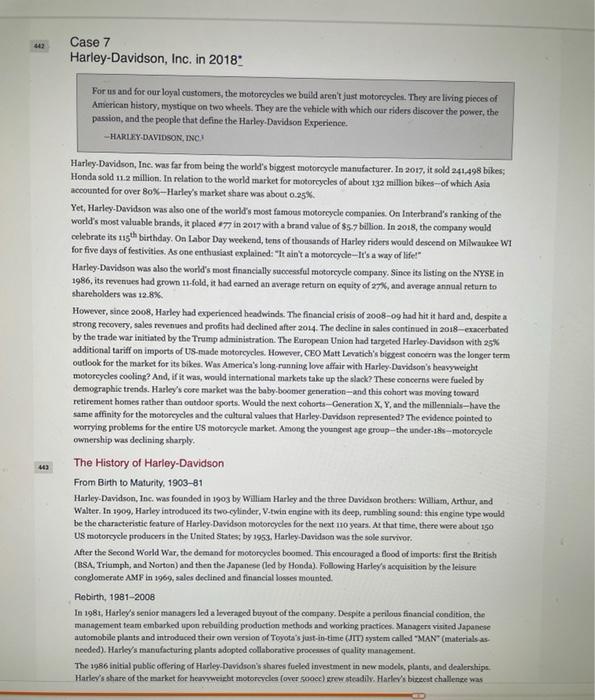
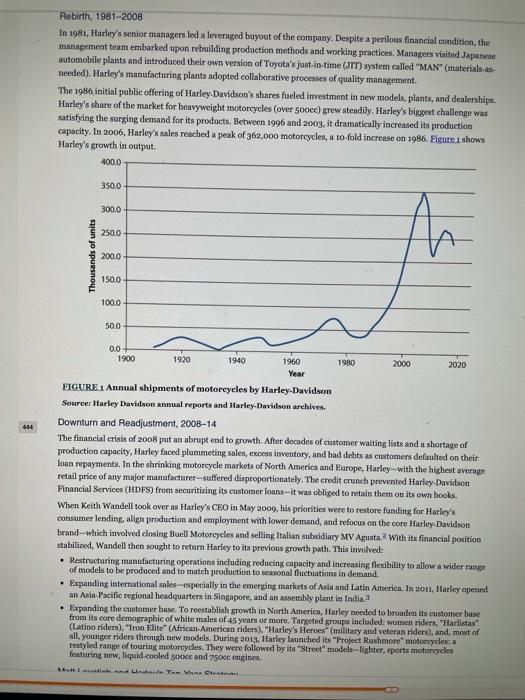
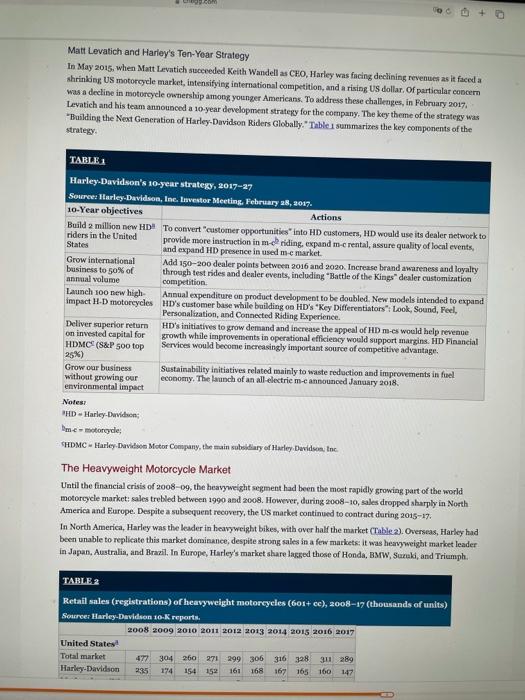
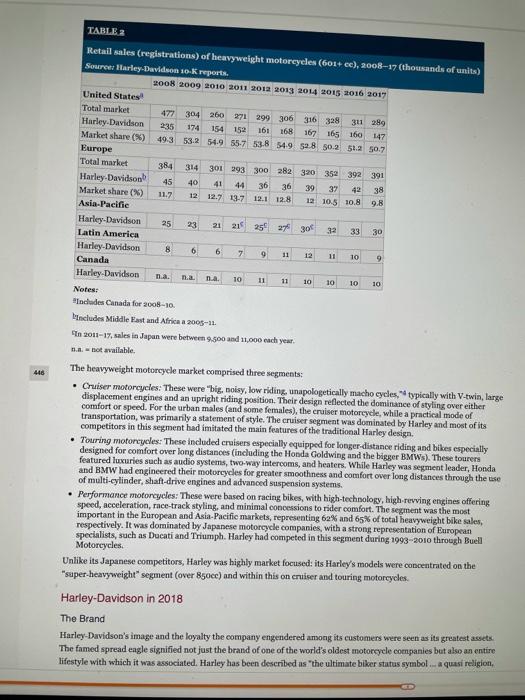
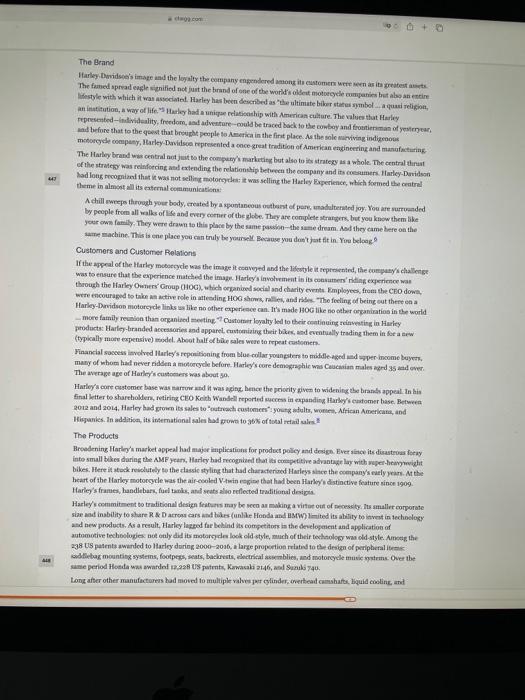
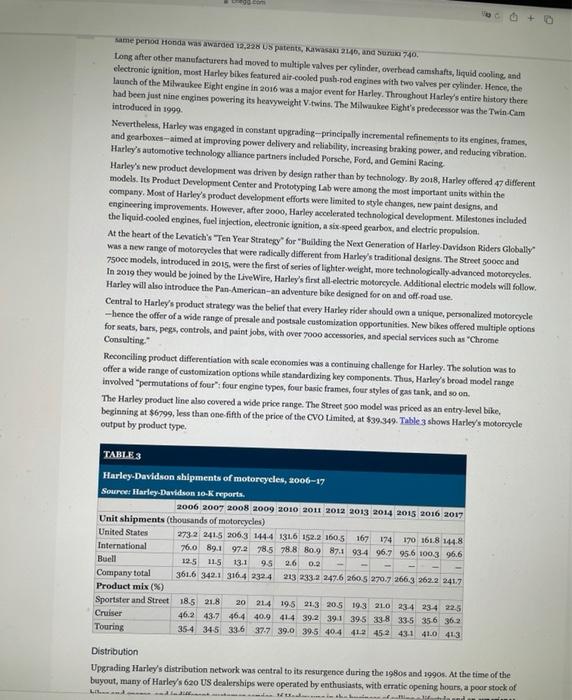
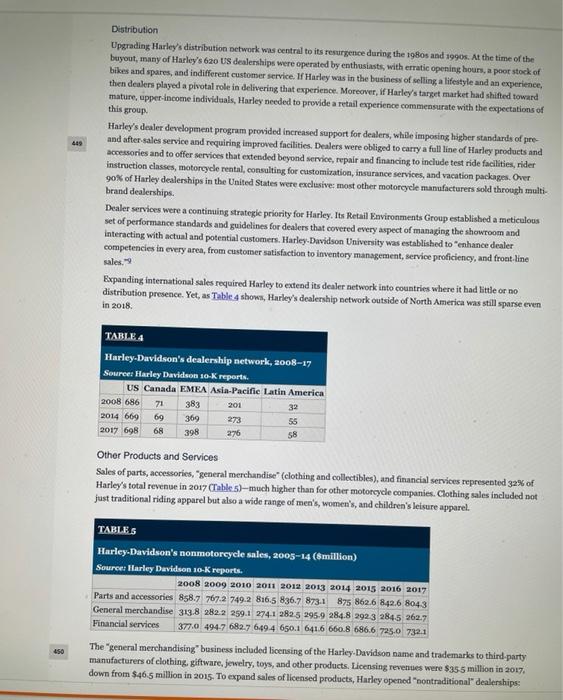
This assignment is due July 18 Select one (1) question from the following about the case. Each member of your team must select a different question. List the question and your response---Only reference materials from the case. There is no need for outside research. 1. What is Harley-Davidson's strategy? How successful has this strategy been? 2. What resources and capabilities are needed to compete within the motorcycle industry? In relation to these resources and capabilities, how does Harley-Davidson compare with other leading motorcycle companies? 3. How effectively does Harley's strategy exploit its key strengths and protecting itself from its key weaknesses? Case 7 Harley-Davidson, Inc. in 2018 For us and for our loyal customers, the motorcycles we build aren't just motorcycles. They are living pieces of American history, mystique on two wheels. They are the vehicle with which our riders discover the power, the passion, and the people that define the Harley-Davidson Experience. - HARLEY-DAVIDSON, INC Harley-Davidson, Inc. was far from being the world's biggest motorcycle manufacturer. In 2017, it sold 241498 bikes; Honda sold 11.2 million. In relation to the world market for motorcycles of about 132 million bikes-of which Asia accounted for over 80%-Harley's market share was about 0.25% Yet, Harley-Davidson was also one of the world's most famous motorcycle companies. On Interbrand's ranking of the world's most valuable brands, it placed 177 in 2017 with a brand value of $5.7 billion. In 2018, the company would celebrate its 115th birthday. On Labor Day weekend, tens of thousands of Harley riders would descend on Milwaukee WI for five days of festivities. As one enthusiast explained: "It ain't a motorcycle-It's a way of life!" Harley-Davidson was also the world's most financially successful motoreycle company. Since its listing on the NYSE in 1986, its revenues had grown 11-fold, it had earned an average return on equity of 27%, and average annual return to shareholders was 12,8% However, since 2008, Harley had experienced headwinds. The financial crisis of 2008-09 had hit it hard and despite a strong recovery, sales revenues and profits had declined after 2014. The decline in sales continued in 2018-exacerbated by the trade war initiated by the Trump administration. The European Union had targeted Harley Davidson with 25% additional tariff on imports of US-made motorcycles. However, CEO Matt Levatich's biggest concern was the longer term outlook for the market for its bikes. Was America's long-running love affair with Harley-Davidson's heavyweight motoreycles cooling? And, if it was, would international markets take up the slack? These concerns were fueled by demographic trends. Harley's core market was the baby boomer generation and this cohort was moving toward retirement homes rather than outdoor sports. Would the next cohorts-Generation X, Y, and the millennials--have the same affinity for the motorcycles and the cultural values that Harley-Davidson represented? The evidence pointed to worrying problems for the entire US motorcycle market. Among the youngest age group-the under-19s-motorcycle ownership was declining sharply. The History of Harley-Davidson From Birth to Maturity. 1903-81 Harley-Davidson, Inc. was founded in 1903 by William Harley and the three Davidson brothers: William, Arthur, and Walter. In 1909, Harley introduced its two-cylinder, V-twin engine with its deep, rumbling sound: this engine type would be the characteristic feature of Harley-Davidson motorcycles for the next 10 years. At that time there were about 150 US motorcycle producers in the United States: by 1953, Harley-Davidson was the sole survivor. After the Second World War, the demand for motorcycles boomed. This encouraged a flood of imports: first the British (BSA, Triumph, and Norton) and then the Japanese (led by Honda). Following Harley's acquisition by the leisure conglomerate AMF in 1969, sales declined and financial losses mounted. Rebirth, 1981-2008 In 1981, Harley's senior managers led a leveraged buyout of the company. Despite a perilous financial condition, the management team embarked upon rebuilding production methods and working practices Managers visited Japanese automobile plants and introduced their own version of Toyota's just-in-time (JIT) system called "MAN" (materials as needed). Harley's manufacturing plants adopted collaborative processes of quality management, The 1986 initial public offering of Harley-Davidson's shares fueled investment in new models, plants, and dealerships Harley's share of the market for heavyweight motorcycles over 500cc) grew steadily. Harley's bigest challenge was 443 Rebirth, 1981-2008 In 1981, Harley's senior managers led a leveraged buyout of the company. Despite a perilous financial condition, the management team embarked upon rebuilding production methods and working practices Managers visited Japanese automobile plants and introduced their own version of Toyota's just-in-time (JIT) system called "MAN" (materials as needed). Harley's manufacturing plants adopted collaborative processes of quality management. The 1986 initial public offering of Harley Davidson's shares fueled investment in new models, plants, and dealerships Harley's share of the market for heavyweight motorcycles (over Socc) grew steadily. Harley's biggest challenge was satisfying the surging demand for its products. Between 1996 and 2003. it dramatically increased its production capacity. In 2006, Harley's sales reached a peak of 362,000 motorcycles, a 10-fold increase on 1986. Figure 1 shows Harley's growth in output. 400.0 350.0 300.0 250.0 Thousands of units 200.0 150,0 100.0 50,0 0.0 1900 1920 1940 1960 1980 2000 2020 Year 414 FIGURE 1 Annual shipments of motoreycles by Harley-Davidson Source: Harley Davidson annual reports and Harley Davidson archives. Downturn and Readjustment, 2008-14 The financial crisis of 2008 put an abrupt end to growth. After decades of customer waiting lists and a shortage of production capacity, Harley faced plummeting sales, excess inventory, and bad debts as customers defaulted on their loan repayments. In the shrinking motoreycle markets of North America and Europe, Harley-with the highest average retail price of any major manufacturer-suffered disproportionately. The credit crunch prevented Harley-Davidson Financial Services (HDFS) from securitixing its customer loans--it was obliged to retain them on its own books. When Keith Wandell took over as Harley's CEO in May 2009, his priorities were to restore funding for Harley's consumer lending align production and employment with lower demand, and refocus on the core Harley-Davidson brand-which involved closing Buell Motorcycles and selling Italian subsidiary MV Agusta. With its financial position stabilized, Wandell then sought to return Harley to its previous growth path. This involved: Restructuring manufacturing operations including reducing capacity and increasing flexibility to allow a wider range of models to be produced and to match production to seasonal fluctuations in demand. Expanding international sales-especially in the emerging markets of Asia and Latin America. In 2011, Harley opened an Asia-Pacific regional headquarters in Singapore, and an assembly plant in India Expanding the customer base. To reestablish growth in North America, Harley needed to broaden its customer base from its core demographic of white males of 45 years or more. Targeted groups included: women riders, "Harlistas" (Latino riders). "Tron Elite (African American riders). "Harley's Heroes (military and veteran riders), and, most of all, younger riders through new models. During 2013. Harley launched its "Project Rushmore motorcycles a restyled range of touring motorcycles. They were followed by its "Street models -- lighter, sports motorcycles featuring new, liquid-cooled once and 750cc engines. Run TAR WAR COM Matt Levatich and Harley's Ten-Year Strategy In May 2015, when Matt Levatich succeeded Keith Wandell as CEO, Harley was facing declining revenues as it faced a shrinking US motorcycle market, intensifying international competition, and arising US dollar. Of particular concem was a decline in motoreycle ownership among younger Americans. To address these challenges, in February 2017. Levatich and his team announced a 10-year development strategy for the company. The key theme of the strategy was "Building the Next Generation of Harley-Davidson Riders Globally." Table summarines the key components of the strategy TABLE Harley-Davidson's 10-year strategy, 2017-27 Source: Harley-Davidson, Inc. Investor Meeting. February 28, 2017 10-Year objectives Actions Build 2 million new HD To convert"customer opportunities into HD customers, HD would use its dealer network to riders in the United provide more instruction in mriding, expand m-c rental, assure quality of local events, States and expand HD presence in used me market. Grow international Add 150-200 dealer points between 2016 and 2020. Increase brand awareness and loyalty business to 50% of through test rides and dealer events, including "Battle of the Kings" dealer customization annual volume competition Launch 100 new high- Annual expenditure on product development to be doubled. New models intended to expand impact H-D motoreycles HD's customer base while building on HD's Key Differentiators"Look, Sound, Feel, Personalization, and Connected Riding Experience. Deliver superior return HD's initiatives to grow demand and increase the appeal of HD m-es would help revenue on invested capital for growth while improvements in operational efficiency would support margins. HD Financial HDMCS (S&P soo top Services would become increasingly important source of competitive advantage 25%) Grow our business Sustainability initiatives related mainly to waste reduction and improvements in fuel without growing our economy. The launch of an all electric me announced January 2018 environmental impact Notes HD - Harley-Davidson me motorcycle SHDMC Harley-Davidson Motor Company, the main subsidiary of Harley-Davidson, Inc. The Heavyweight Motorcycle Market Until the financial crisis of 2008-09, the heavyweight segment had been the most rapidly growing part of the world motorcycle market: sales trebled between 1990 and 2008. However, during 2008-10, sales dropped sharply in North America and Europe. Despite a subsequent recovery, the US market continued to contract during 2015-17. In North America, Harley was the leader in heavyweight bikes, with over half the market Tablea). Overseas, Harley had been unable to replicate this market dominance, despite strong sales in a few markets: it was heavyweight market leader in Japan, Australia, and Brazil. In Europe, Harley's market share logged those of Honda, BMW, Suzuki, and Triumph. TABLE 2 Retail sales (registrations) of heavyweight motorcycles (601+ce), 2008-17 (thousands of units) Soureer Harley-Davidson 10-K reports. 2008 2009 2010 2011 2012 2013 2014 2015 2016 2017 United States Total market 477 304 260 271 299 306 316 328 301 289 Harley-Davidson 174 151 152 161 168 167 165 160 147 35 TABLE2 122 11 Retail sales (registrations) of heavyweight motorcycles (603+ce), 2008-17 (thousands of units) Source Harley Davidson 10-K reports 2008 2009 2010 2011 2012 2013 2014 2015 2016 2017 United States Total market 477 304 260 271 299 306 316 328 3u1 289 Harley-Davidson 235 174 154 152 161 168 167 165 160 147 Market share (%) 493 532 549 557 53.8 54.9 528 50.2 512 50.7 Europe Total market 384 314 301 993 300282 320 352 392 391 Harley Davidson 45 40 41 44 36 36 39 37 42 38 Market share (X) 11.7 12 12.7 13-7 19.1 128 12 10.5 10.8 9.8 Asia-Pacific Harley-Davidson 25 23 21 216 25 27 30% 32 30 Latin America HarleyDavidson 8 6 6 7 9 11 11 10 9 Canada Harley-Davidson na. n. a na. 10 11 10 10 10 10 Notes: Includes Canada for 2008-10 bencludes Middle East and Africa a 2005-IL In 2011-17, sales in Japan were between 9.500 and 11,000 each year. ... not available The heavyweight motorcycle market comprised three segments: Cruiser motorcycles: These were "big, noisy, low riding, unapologetically macho cycles, typically with V-twin, large displacement engines and an upright riding position. Their design reflected the dominance of styling over either comfort or speed. For the urban males (and some females), the cruiser motorcycle, while a practical mode of transportation, was primarily a statement of style. The cruiser segment was dominated by Harley and most of its competitors in this segment had imitated the main features of the traditional Harley design. Touring motorcycles: These included cruisers especially equipped for longer-distance riding and bikes especially designed for comfort over long distances (including the Houda Goldwing and the bigger BMWs). These tourers featured luxuries such as audio systems, two-way intercoms, and heaters. While Harley was segment leader, Honda and BMW had engineered their motorcycles for greater smoothness and comfort over long distances through the use of multi-cylinder, shaft-drive engines and advanced suspension systems. Performance motorcycles: These were based on racing bikes, with high-technology, high-revving engines offering speed, acceleration, race-track styling, and minimal concessions to rider comfort. The segment was the most important in the European and Asia-Pacific markets, representing 62% and 65% of total heavyweight bike sales, respectively. It was dominated by Japanese motorcycle companies, with a strong representation of European specialists, such as Ducati and Triumph. Harley had competed in this segment during 1993-2010 through Buell Motorcycles Unlike its Japanese competitors, Harley was highly market focused its Harley's models were concentrated on the "super-heavyweight" segment (over Bsocc) and within this on cruiser and touring motorcycles. Harley-Davidson in 2018 The Brand Harley-Davidson's image and the loyalty the company engendered among its customers were seen as its greatest assets. The famed spread eagle signified not just the brand of one of the world's oldest motorcycle companies but also an entire lifestyle with which it was associated. Harley has been described as "the ultimate biker status symbol ...aquasi religion, 446 o.com 441 The Brand Harley Davidson's image and the loyalty the company endered mong its custom west The funed spread eagle signified not just the bed of one of the world's moyens but festyle with which it was setel. Harley has been described as the ultimate busymbolen an institution, a way of life. Harley had a unique relationship with American culture. The values that Harley represented-dividuality, freedom, and adventure-could be traced back to the cowboy and frontman of yesteryear. wid before that to the quest that brought people to America in the first place. As the sole surviving indigenous motorcyde company, Harley Davidson representedance great tradition of American engineering and manufacturing The Harley brand was central not just to the company's marketing but also to strategy as a whole. The central of the strategy was reinforcing and extending the relationship between the company and its consumers arley Davidson had long recognised that it was not selline motore it was selling the Harley xperience, which formed the central theme in almost all its external communication Achill weeps through your body, created by a spontaneous outras el por adulterte joy. You are surrounded by people from all walks of land every corner of the globe. They are complete strangers, but you know them like your own family. They were drawn to this place by the same poten the same dream. And they came here on the a machine. This is one place you can truly be yoursell use you don't just dit in You belong Customers and Customer Relations If the appeal of the Harley motorcycle was the image it craved and the lifestyle it represented, the company's challenge was to ensure that the experience matched the image. Harley's involvement in its commending experience through the Harley Owners Group (10G), which organized social sed charity events. Employees, from the CEO down, were encouraged to taken the role in attending HOG shows, alles and the feeling of being out there on a Harley-Davidson motore links like no other experience can. It's made HOG like no other organization in the world more family reunion than organizmeting Customer loyalty led to their continuing investing in Harley products Harley-branded accessories and apparel customizing their bikes and eventually trading them in for a new (typically more expensive)del. Ahoot half of the sales were to repeat customers Financial access involved Barley's repositioning from blue color youngsters to middle-aged and per income buyers many of whom had never ridden a motorcycle before. Harley's core demographie was Caucasian malesord 35 and over The average age of Harley's customers was about Harley's core customer base was marrow and it was ging hence the priority given to widening the brands appeal to his final letter to shareholders, retiring CEO Keith Wandell reported access in expanding Hary's customer base. Between 2012 and 2014, Hurley had grown its sales to outreach customers young adults, women, African Americans, and Hispanies. In addition, its international sales had grown to 30% of total retail The Products Broadening Harley's market appeal had major implications for product policy and design. Ever since its distrofony into small bikes during the AMF years. Harley had recognised that is competitive advantage lay with perbewywight bikes. Here it turk resolutely to the classe styling that had characterised Harleys since the company's early years. At the heart of the Harley motorcycle was the air-cooled V-twin engine that had been Harley distinctive feature since 1909 Harley's fries, handlebars, lanks, and stats also reflected traditional desig Harley's commitment to traditional design features may be seen as making a virto out of necessity. Its aller corporate stand inability to share R&D across cars and bikes (unlike Honda and UMW) limited its ability to invest in technology and new products. As a result, Harley loped for behand its competitors in the development and application of automotive technologies not only did its motores lock old style, much of their technology was old-style. Among the 238 US patentowwanded to Harley during 2000-2006, a large proportion related to the design of peripherali debug mounting systems, footpegs, cats, backrests actrical emblies, and motorcycle museum. Over the same period Honda Wwwardel 12,998 Uputs, Kawasali 21:46, Sun 740. Long after other manufacturers had moved to multiple vahes per eslinder Overhead chat, liquid cooling and . G a same period Honda was awarded 12,228 US patents, aw 2140, and 740. Long after other manufacturers had moved to multiple valves per cylinder, overhead camshafts, liquid cooling and electronic ignition, most Harley bikes featured air-cooled pash-rod engines with two valves per cylinder Hence, the launch of the Milwaukee Eight engine in 2016 was a major event for Harley. Throughout Harley's entire history there had been just nine engines powering its heavyweight Vtwins. The Milwaukee Eight's predecessor was the Twin Cam introduced in 1999 Nevertheless, Harley was engaged in constant upgrading-principally incremental refinements to its engines, frames, and gearboxes - aimed at improving power delivery and reliability, increasing braking power, and reducing vibration. Harley's automotive technology alliance partners included Porsche, Ford, and Gemini Racing Harley's new product development was driven by design rather than by technology. By 2018, Harley offered 47 different models. Its Product Development Center and Prototyping lab were among the most important units within the company. Most of Harley's product development efforts were limited to style changes, new paint designs, and engineering improvements. However, after 2000, Harley accelerated technological development. Milestones included the liquid-cooled engines, fuel injection, electronie ignition, a six-speed gearbox, and electric propulsion At the heart of the Levatich's Ten Year Strategy for Building the Next Generation of Harley Davidson Riders Globally was a new range of motorcycles that were radically different from Harley's traditional designs. The Street spoce and 750cc models, introduced in 2015, were the first of series of lighter weight, more technologically advanced motorcycles In 2019 they would be joined by the LiveWire, Harley's first all electric motorcycle. Additional electric models will follow. Harley will also introduce the Pan-American-an adventure bike designed for on and off-road use. Central to Harley's product strategy was the belief that every Harley rider should own a unique, personalized motorcycle --hence the offer of a wide range of presale and postale customization opportunities. New bikes offered multiple options for seats, bars, pegs, controls, and paint jobs, with over 7000 accessories, and special services such as "Chrome Consulting Reconciling product differentiation with scale economies was a continuing challenge for Harley. The solution was to offer a wide range of customization options while standardising key components. Thus, Harley's broad model range involved "permutations of four four engine types, four basic frames, four styles of gas tank, and so on. The Harley product line also covered a wide price range, The Street 500 model was priced as an entry-level bike, beginning at $6799, less than one fifth of the price of the CVO Limited, at $39.349. Table 3 shows Harley's motorcyde output by product type TABLE 3 Harley-Davidson shipments of motorcycles, 2006-17 Source: Harley-Davidson 10-K reports. 2006 2007 2008 2009 2010 2011 2012 2013 2014 2015 2016 2017 Unit shipments (thousands of motorcycles) United States 273 2 241.5 2063 1444 131,6 152.2 160.5 167 174 170 161.8 144.8 International 76.0 89.1 97.2 78.5 78.8 80.9 87.1 934 96.7 95.6 1003 96.6 Buell 12.5 11.5 13.1 9.5 2.6 0.2 Company total 361.6 3421 316.4 2324 213 233.2 247.6 260.5 270.7 2663 2622 241.7 Product mix (X) Sportster and Street 18.5 21.8 20 214 19.5 21.3 20.5 19-3 210 23.4 234 22.5 Cruiser 46.2 43.7 46.4 409 414 39.2 39.1 39.5 338 33.5 356 36.2 Touring 35-4 345 336 377 39.0 39-5 404 412 452 431 410 413 Distribution Upgrading Harley's distribution network was central to its resurgence during the 1980s and 1990s. At the time of the buyout, many of Harley's 620 US dealerships were operated by enthusiasts, with erratic opening hours, a poor stock of Lilit Distribution Upgrading Harley's distribution network was central to its resurgence during the 1980s and 1990s. At the time of the buyout, many of Harley's 620 US dealerships were operated by enthusiasts, with erratic opening hours, a poor stock of bikes and spares, and indifferent customer service. If Harley was in the business of selling a lifestyle and an experience, then dealers played a pivotal role in delivering that experience. Moreover, if Harley's target market had shifted toward mature, upper-income individuals, Harley needed to provide a retail experience commensurate with the expectations of this group Harley's dealer development program provided increased support for dealers, while imposing higher standards of pre and after sales service and requiring improved facilities. Dealers were obliged to carry a full line of Harley products and accessories and to offer services that extended beyond service, repair and financing to include test ride facilities, rider instruction classes, motorcycle rental, consulting for customization, insurance services, and vacation packages. Over 90% of Harley dealerships in the United States were exclusive most other motorcycle manufacturers sold through multi- brand dealerships. Dealer services were a continuing strategie priority for Harley. Its Retail Environments Group established a meticulous set of performance standards and guidelines for dealers that covered every aspect of managing the showroom and interacting with actual and potential customers. Harley-Davidson University was established to enhance dealer competencies in every area, from customer satisfaction to inventory management, service proficiency, and front line sales. Expanding international sales required Harley to extend its dealer network into countries where it had little or no distribution presence. Yet, as Table 4 shows, Harley's dealership network outside of North America was still sparse even in 2018 TABLE4 Harley-Davidson's dealership network, 2008-17 Source: Harley Davidson 10-K reports US Canada EMEA Asia-Pacific Latin America 2008 686 71 383 201 32 2014 669 69 369 273 55 2017 698 68 398 276 58 Other Products and Services Sales of parts, accessories, "general merchandise" (clothing and collectibles), and financial services represented 32% of Harley's total revenue in 2017 Cable 5)-much higher than for other motorcycle companies. Clothing sales included not just traditional riding apparel but also a wide range of men's, women's, and children's leisure apparel. TABLES Harley-Davidson's nonmotorcycle sales, 2005-14 (Smillion) Sourcer Harley Davidson 10-K reports. 2008 2009 2010 2011 2012 2013 2014 2015 2016 2017 Parts and accessories 858.7 767.2 749.2 816.5 836.7 8731 875 8626 842.6 8043 General merchandise 313.8 282.2 259.1 274.1 282.5 295.9 284.8 292 3 284.5 262.7 Financial services 377.0 4947 682.7 649 4 650.1 641.6 660.8 686.6 725.0 732.1 The "general merchandising" business included licensing of the Harley-Davidson name and trademarks to third party manufacturers of clothing, giftware, jewelry, toys, and other products. Licensing revenues were $355 million in 2017, down from $46.5 million in 2015. To expand sales of licensed products, Harley opened "nontraditional dealerships 450 442 Case 7 Harley-Davidson, Inc. in 2018 For us and for our loyal customers, the motorcydes we build aren't just motorcycles. They are living pieces of American history, mystique on two wheels. They are the vehicle with which our riders discover the power, the passion, and the people that define the Harley-Davidson Experience. - HARLEY-DAVIDSON, INC HarleyDavidson, Inc. was far from being the world's biggest motorcycle manufacturer. In 2017, it sold 241498 bikes; Honda sold 11.2 million. In relation to the world market for motorcycles of about 132 million bikes-of which Asia accounted for over 80%-Harley's market share was about 0.25% Yet, Harley-Davidson was also one of the world's most famous motorcycle companies. On Interbrand's ranking of the world's most valuable brands, it placed 177 in 2017 with a brand value of $5.7 billion. In 2018, the company would celebrate its 115th birthday. On labor Day weekend, tens of thousands of Harley riders would descend on Milwaukee WI for five days of festivities. As one enthusiast explained: "It ain't a motorcycle-It's a way of life!" HarleyDavidson was also the world's most financially successful motorcycle company. Since its listing on the NYSE in 1986, its revenues had grown 11-fold, it had earned an average return an equity of 27%, and average annual return to shareholders was 12.8% However, since 2008, Harley had experienced headwinds. The financial crisis of 2008-09 had hit it hard and, despite a strong recovery, sales revenues and profits had declined after 2014. The decline in sales continued in 2018-exacerbated by the trade war initiated by the Trump administration. The European Union had targeted Harley Davidson with 25% additional tariff on imports of US-made motorcycles. However, CEO Matt Levatich's biggest concern was the longer term outlook for the market for its bikes. Was America's long-running love affair with Harley-Davidson's heavyweight motoreycles cooling? And, if it was, would international markets take up the slack? These concerns were fueled by demographic trends. Harley's core market was the baby boomer generation and this cohort was moving toward retirement homes rather than outdoor sports. Would the next cohorts-Generation X, Y, and the millennials-have the same affinity for the motoreycles and the cultural values that HarleyDavidson represented? The evidence pointed to worrying problems for the entire US motorcycle market. Among the youngest age group --the under-18s-motorcycle ownership was declining sharply. The History of Harley-Davidson From Birth to Maturity, 1903-11 HarleyDavidson, Inc. was founded in 1903 by William Harley and the three Davidson brothers: William, Arthur, and Walter. In 1909, Harley introduced its two-cylinder, V-twin engine with its deep, rumbling sound: this engine type would be the characteristic feature of Harley-Davidson motorcycles for the next 10 years. At that time, there were about 150 US motorcycle producers in the United States: by 1953, Harley-Davidson was the sole survivor. After the Second World War, the demand for motorcycles boomed. This encouraged a flood of imports: first the British (BSA, Triumph, and Norton) and then the Japanese (led by Honda). Following Harley's acquisition by the leisure conglomerate AMF in 1969, sales declined and financial losses mounted. Rebirth, 1981-2008 In 1981, Harley's senior managers led a leveraged buyout of the company. Despite a perilous financial condition, the management team embarked upon rebuilding production methods and working practices Managers visited Japanese automobile plants and introduced their own version of Toyota's just-in-time (JIT) system called "MAN" (materials as needed). Harley's manufacturing plants adopted collaborative processes of quality management The 1986 initial public offering of Harley-Davidson's shares fueled investment in new models, plants, and dealerships Harley's share of the market for heavyweight motoreveles (over scocc) grew steadily. Harley's bittest challenge was









 Study Help