Question: this case study begins by describing how a new chief took an inside out approach to changing the police department ( see the inside out
this case study begins by describing how a new chief took an inside out approach to changing the police department ( see the inside out approach described in chapter 10 ) compare chief Mangan's approach on Spokane to chief Couper's approach described in chapter 10. what is the circumstance in which such an inside out approach might be recommended, or not recommended
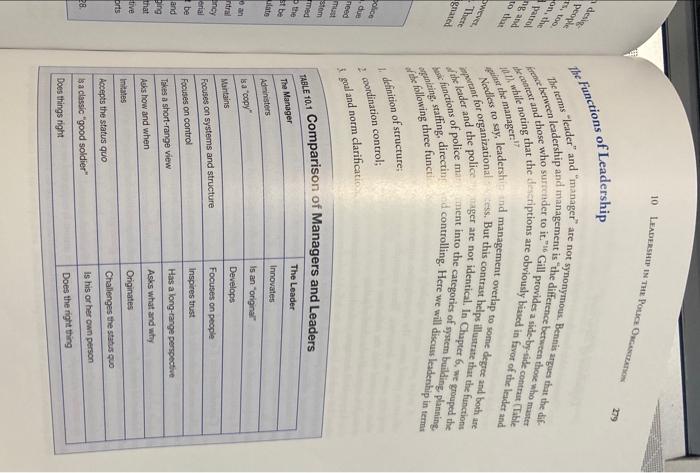
Spokane, Washington Spokane, a city of approximately 190,000 residents, is nestled in a valley on Washington's western border with ldato. The largest city between Minneapolis and Seattle, the greater Spokane area is home to almost 1 million people. This case study describes some of the key features of the strategic planning pro- cess used by Chief Terry Mangan to accomplish positive change in the Spokane Police Department (SPD). When Mangan became Spalace Chief of Police he did not have, nor did he ever create, a long-term "master plan de spelled out, step-by-step, how the department would move to community policing. Instead, he sought to create an environ- ment in which many different players-both inside and outside the department-could bring different ideas and plans to the table. While Mangan wanted to move the depart- ment closer to the community, as an outsider who needed to win the trust and respect of the department, his first goal was to improve the department's morale by upgrading equipment. It became very evident to me that we weren't going to go anyplace in this depart- ment with any kind of community efforts unless we addressed some real funda- mental needs. When I came here ... people were working out of a basement with steampipes overhead, World War II surplus lockers ... and old, smelly towels hanging over them. No exercise or work-out rooms, broken toilets, radios that didn't work. Crummy equipment and not enough people. Lowest staff level in the state for a city of this size. You can't tell people their job is important unless you address their (basic) needs. So we focused internally on getting them the stuff and the equipment and the working conditions that would say, "You really are important." During his first year in Spokane, Mangan attended more than 400 community meetings. At these meetings, Mangan spoke about the need for a new partnership with the community. Mangan told Spokane's citizens that this is a good police department, but it's a police department that has severe restrictions in terms of the number of people we have. Here's what we want to do as a police department. ... we are the lowest staffed police department in the need your fed oth safety. We tous te thursan in Wienced people to come in and become help to do it. More importany w ten wie Within two years he was ready to turn his so chance While Mangan was open about his own and adopting a more commune ponce policin, to transmit this mission throughout les of the houd outside the department. Mango del to piwo memben. After accepting the position Maps bepaling duals inside the department and is the community in the antal leaders, from all swom tanks anda who it change was going to occut. Bertaking Mga ders and invited them to a stries of open dionice bodo Mangan took command, he athered there is a form poup that met several awnings cach week to discuss nesses and make recommendations for improving the death chide for Mangan to both send his ideas to the departments fost about how the organization perceived itself The web Accions Mangan ciplained. The purpose of this to be who where we are trying to go, how we going to get there and shadow to do it Equally important by bringing in all loves of the department into think Mangan gained support for his change forts and was stoly challenged by a guard personnel Soon after these meetings began. Mangan formally turned the proven into a tragis planning committee, and increased its membership Commimet mensen decibed process that improved communication throughout the department. "Everybody fat in opportunity to talk without fear of repercusions, and there were a lot of things said in those meetings that just needed to be said so that people could at the out a committee member explained. A patrol officer who participated aid that he enjoyed the opportunity to hash out ideas with members of ocet units in the department, and gain a broader perspective about the organization. Knowing that the shid was actually listening to their ideas was very important to committee members, most of whom kad tever previously been given such an opportunity. Mangan, who ensured that the groupe decisions were consistent with his broader visions, described his role in the group as the sounding board" or the mirror. I would weak it and push is a inte bit hent and little bit there, and incorporate the best of this group ideas and that gopi ident? Mangan said. While the planning committee discussed numerous ises ficing the department, Mangan tasked them with a critical project defining the departments values Emery 480 CASE STUDIES agency has a unique culture, an organizational culture that is part of its history and its traditions," Mangan said. I felt it was really important to take that organizational culture and examine it. and that history, and say who were are and what we stand for and why. To make that work, people have to have ownership of it, and to have ownership of it means that everybody in the department has to have a crack at it. Mangan first gathered several values statements from other police departments and presented them to the strategic planning committee. The committee drafted a values statement that was presented to the rest of the department for feedback and revised. After a final draft was approved. Mangan assigned the committee to create a "hook for the two-page values statement. When devising the hook, Mangan told his committee to use the FBI as a model. "Anybody that works in that Hoover building, from the janitor on up, will tell you that FBI stands not just for Federal Bureau of Investigation, but it stands for Fidelity, Bravery, and Integrity, the three values of the FBI." Mangan said. Using the initials SPD as a starting point, the planning committee decided on Service, Pride, and Dedication." from which all of the department's values would flow. The strategic planning committee also designed a patrol manual that helped oper- ationalize community policing into concrete responsibilities within the patrol division. While the stated purpose of the plan was to provide direction and purpose for the man- agement of the patrol division, it explicitly encouraged all personnel to take risks and innovative approaches to problem solving. Working closely with the community was another expressed goal for the patrol division. "The Patrol Division exists to ... improve police/community relations through the quality and quantity of contacts between citizens and members of the division." This model fit Mangan's goal of encouraging innovation at all levels of the department. "We said to the patrol officers and supervisors) the best ideas come from you folks, so you figure out what's going to work and what's not going to work." Mangan said. As a manager, Mangan was described by many in the department as an "idea guy." He was receptive to new ideas, and would sometimes give his staff the broad vision for a program without filling in many details. While Mangan was the source of some new ideas, and final decision-making authority still rested with the chief and his command staff, he wanted to empower supervisors and line officers to develop ideas and programs on their own. As was previously discussed, the newly developed patrol manual expressly encouraged this bottom-up development of new programs, by assigning the patrol divi- sion commander, shift lieutenants, and sergeants to develop programs that identified and addressed long-term problems within their sectors. In order to facilitate this, all shift commanders were required to work with sergeants and patrol officers and create yearly management plans that identified and analyzed problem areas and proposed solutions. mited to the city manager and city council) The path er goals and objectives became the basis for a sort that the dome nelop and maintain communication with insando These new tasks were added to the prison and we management responsibilities. While Mann spanded the civil service regulations controlled promotion throughout all of the departe Mon cope for the assistant chief and chic position, he had bude to place who were not up to the new role. Asad, Mangan identiteinde in the department who were innovators and gave them hority to destrom gardless of their rank Some supervisors welcomed this new ability to intendimente, department members, this modd o empowerment created to with the organization. That really kind of disturbed the table nation. had speants that were given responsibilities and ... the captains and lots times werent even aware of things that were going on in the Som goment people realized that they had been kind of ... niih... maybe so sid. And, while some supervisors thrived in this new coment, becue pion were not given much explicit training about their ow role, others whow to do their jobs in this new cra. This created a situation in which some other Weg dual messages from the organization: the chief want me to work on dosely with the o some ducen or road-blocks ... and they were simply being bypassed department member community, but my sergeant wants me to collect stats. Source: Adapted from Peter M. Sheingold, nd. "National COPS Evaluation: Organitztieta Change Case Study - Spokane, Washington." Online 2. www.nein garajeans, contudy spokane.html. DISCUSSION QUESTIONS 1. Chief Mangan's approach to organizational change in Spokrewed on developing ditentum and a vision statement. Compare the values that were developed in Sockene to the surgeons objectives and values presented in Chapter 3. In what was resercu expression logo purpose different? Why do they dier? Which are most import and why 2. This case study begins by describing how a new chat took our sertach to charging the poor dipartment (see "The Inside-Out Approach to Quality Police Chapter 10 Compare Diet Megos approach in Spokane to Chief Couper's prach described in Chapter 10. What are the creators in which such an inside-out approach might be recommended or not recommended a Comcere Chief Mangan's management and leadership styles to trea Soussed in Chacters and 18 Which styles and techniques did he most exercity leyo rin, how wel oid his style ft neesot the situation in the Spokane Police Department at the time? What were the strength and weakhouse one couch Pet Case vangen woed to improve the Solare Police Department? CHAPTER 10 LE 6 rship in the Police Ornization LEARNING OBJECTIVES Bentify the three basic leadership functie Cite the factor that separates managers from leaders. . . Cite the five sources of influence. Che five general styles of leadership. . Cite the findings of studies that attempted to identify the personality traits and other personal characteristics that separate good leaders from bad ones. Characterize Fiedler's situational model of effective leadership. Distinguish between the managerial grid and Hersey and Blanchard's situational theory of Explain the inside-out approach to quality police leadership. Identity six categories of police organizational failure. Identity some of the environmental factors that constrain the police leader. leadership . . a Leadership is a difficult concept to define. To some, leadership is a science that can be mastered through study and practice. Others regard it as an art and maintain that leaders are born, not made. Some believe that leaders are respected and admired by their followers. Others believe that they are feared. It is not uncommon for people to believe that real leaders can be identified by their ability to take charge in all situations. Others believe that leadership is situational and that different group members will emerge in leadership roles in different situations in accordance with formal credentials, proven cxpertise, charisma, and connections. None of these perceptions of leadership is completely right or completely wrong. Because leadership involves a complex combination of activities and behaviors, it is not 10 LEADEM THE POLO stained See Der the last decade, the development of police leadership has began to attention. Existing leadership development program offel by FR: National Academy PERFY Senior Management Intes Police, with Police Institute" have been augmented by state le domain. Como bestern University's Center for Public Safety and the University of wid, Texas, North Carolina Kentucky and discwhere. Also, the fan con e and Bureau of Justice Assistance have supported national police og Several individual law enforcement agencies have initiated to e and the LACP has established the leadership in Police Organics deroboment programs, including the Los Angeles Police Department and down og leadership throughout their organizations. It has become mody In recent years, police executives have become particularly concerned about devel beat officers need to use leadership in die mity har mery other is a leader cants lieutenants, and captains need to exercise cabhip within the police tation. In addition, chiefs and shritts are more conscious of the wordt de diap fave leaders to carry on after they retire. IACP past president Mary Ann V. police chief in Gaithersburg. Maryland. put it well: Unfortunately in our desire to address the immediate needs of our agencies and communities, we sometimes fail to plan for the future leadership needs of out departments and our noble profession. This is a critical oversight, because we complish today but also by how we prepare our agencies to confront the challenges of the future. The Police Leader as a Subsystem One of the most important factors to consider in discussing leadership is that the lander is an individual whose behavior is influenced by numerous variables. Thus, at an individual, the police leader's behavior is influenced by his or her own attitudes roles . self-concept, motivation, perception, and communication abilities A leader, like other individuals, participates in more than one group. So one may be a leader of some groups, but also be a non-leading member of other groups. A chief of police, for example, might be president of her local school's parent/teacher association, president of the state association of chiefs of police, a member of the Rotary Club, and a member of the IACP. Aspects of group behavior and interaction, including conformity, cohesiveness, output limitation, cooperation, competition, and conflict, all have their influence on the leader to command the A police chief is, by definition, a formal leader; that is, the chief has been commanding a squad or place formala assigned to the police department. All other police managers are nared as the person in charge and has been granted authority shift commander has formal authority with respect to all the patrol offices and sergeants working during a given tour of duty, and the director of the plan The sergeant has formal authority with respect to research division has formal authority with respect to the members angel effective leader The terms "formal leader and manager mean essentially the same necessarily a complete leader is considerably more to leadership than simply being given authority and being di as the person in charge (see "Police Managers and Police Leaders," Box 104). division cine, OR a formal leader/manager is not BOX 10.1 Police Managers and Police Leaders function he must attach a high value to protecting constitutional quarantees of trees A police administrator must be fully aware of the sensitive and delicate nature du for various systems to assure accountability on the part of the police to the body politice process, and freedom from unreasonable search and seizure. He must fully appreciate and the operation of the various other systems which the police employ. He must be well be knowledgeable regarding the legislative process, the functioning of the criminal Justice about different categories of deviant conduct, the range of behavioral problems of concert police and the dynamics of the various political and social movements in our society. He conversant with the major issues of current public interest that involve the police and be ato Beyond these basic requirements, a leader in the police field is often expected to agency that has been drifting without clear objectives and principles for years. He is the figure in any attempts to effect significant changes in the organization and staffing of the skill. He must be aware of the need for change and committed to achieving it. He must and in the form of services it provides. This requires a great deal more than traditional maraes open, challenging, curious, and innovative. He must be sufficiently confident of his capacity and sufficiently secure in his position to take risks and to conduct experiments. He must be unge in discussing them in the public forum. in his determination. He must have a masterful capacity to relate well to the various elements the comprise his community so as to win support for his programs, as well as an equally eache ability to relate to his own personnel, eliciting their best performance and coordinating their efforts toward his pre-established goals. Source: Herman Goldstein, 1977. Policing a Free Society. Cambridge, MA: Ballinger, pp. 227-228 10 LEADERSHIP IS THE POINTS 279 people VO om the gan to the obviously biased in favor of the leader and The Functions of Leadership neberwen leadership and management is the difference between those who master The terms "leader and manager" are not synonymous. Bennis argues that the dif text and those who surrender to it." Gill provides a side-by-side contrast Table Mall while noting that the descriptions are Needless to say, leadershind management overlap to some degree and both are the manager: ess. But this contrast helps illustrate that the functions portant for organizational ger are not identical. In Chapter 6, wc grouped the Wale lader and the police wanting, staffing, directind controlling. Here we will discuss leadership in terms sese functions of police definition of structure; EVEL "The ma ment into the categories of system building planning the following three func lice due need must stom 2 coordination control; goal and norm clarificatio Comparison of Managers and Leaders TABLE 10.1 med the st be lata The Leader The Manager Innovates Administers is a copy Is an original ntral Develops Focuses on people Maintains Focuses on systems and structure Focuses on control ancy arial be and ping that tive prts Inspires trust Has a long-range perspective Takes a short-range view Asks what and why Asks how and when Originates Initates Challenges the status quo Accepts the status quo 28 is his or her own person Is a classic "good soldier" Does things right Does the right thing









 Study Help