Question: this is a case study for research method class please help by answering question #4 #5 and #6 only please match question with answer The
this is a case study for research method class please help by answering question #4 #5 and #6 only please match question with answer
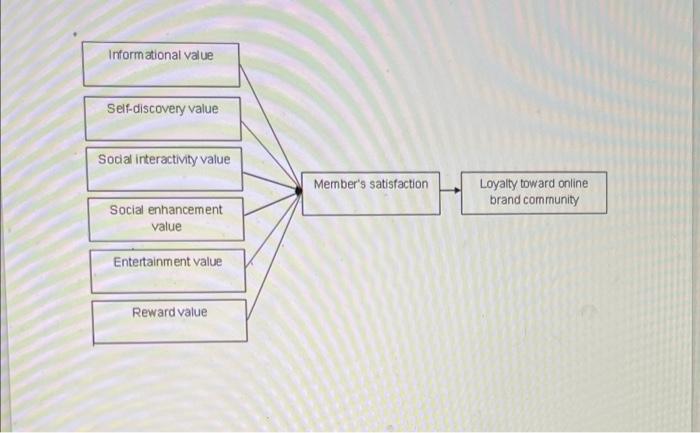
The SOCIAL NETWORK The growing use of social network sites (such as Facebook) and online communities (such as the Apple Computer community, the community of Harley-Davidson riders, and the community of Starbucks customers) provides exciting opportunities for organizations. Online brand communities allow organizations to engage and interact with customers, obtain market information, sell and advertise products, rapidly disseminate information, develop long-term relationships with the community, and eventually influence consumers' preferences and behavior (Dholakia and Bagozzi, 2001, Dholakia, Bagozzi, and Pearo, 2004, Franke and Shah, 2003, Muniz and Schau, 2005, Tedjamulia, Olsen, Dean, and Albrecht, 2005). "Brand community" is a term that is used to describe like-minded consumers who identify with a particular brand and share significant traits, such as "a shared consciousness, rituals, traditions, and a sense of moral responsibility" (Muniz and O'Guinn, 2001, p. 412). Online brand communities are based on their core value - the brand- and grow by building relationships with and among members interested in the brand (Jang et al, 2008). There are several possible categorizations of online brand communities, but they are generally grouped into two categories based on who initiates and manages the community; (1) company-initiated communities, built by the company that owns the brand, and (2) user-initiated communities, voluntarily built by their members (that is, the consumer) (e.g. Armstrong and Hagel 1996; Kozinets 1999). These two types of brand communities provide different opportunities for marketers. For instance, a brand community on a company website is one of the key determinants of attracting consumers to and retaining customers on the website (Nysveen and Pedersen, 2004). Consumer-initiated online brand communities may provide helpful information about other consumers' experiences with the product or service and the strengths and weaknesses of products or services (Jang et al. 2008). The success of online brand communities is heavily dependent on consumer participation in the online brand community. To determine why consumers participate in online brand cortmunities, business student Jesse Eisenberg has developed a model based on extant service marketing literature. The main idea in this literature is that perceived value, and satisfaction are antecedents of the intention to use a product or service (Anderson, Fornell, and Lehmann 1994; Bolton and Drew 1991; Grnroos 1990; Hocutt 1998; Kang. Lee, and Choi 2007; Ravald and Grnroos 1996). Jesse wants to apply this idea to consumer participation in online brand communities. According to Jesse, "members will probably be satisfied with an online brand community and have the intention to participate in the community when they derive value from the community. Therefore it is important to know which values members may derive from participating in an online brand community." A thorough review of the literature has convinced Jesse that participation in online brand communities depends on the communities' perceived informational value, sell-discovery value, social interactivily value, social enhancement value, entertainment value, and reward value (e.9., Dholakia, Bagazzi, and Pearo 2004; Flanagin and Metzger 2001). Figure 1 provides a graphical representation of Jesse's ideas. Eigure 1 An excellent theoretical framework identifies and defines the essential variables in the situation relevant to the problem and subsequently describes and explains the interconnections among these variables. 1. Three essential features should be present in any theoretical framework. Discuss these features. Jesse has undertaken a literature review to develop his conceptual model. 2a. Are there any altemative approaches that would allow Jesse to develop a conceptual model? 2b. Describe the advantages and disadvantages of undertaking a literature review to develop a model. 3. Label the variables of Jesse's conceptual model in terms of independent, dependent, moderating, and/or mediating variables. 4. Develop the relevant hypotheses based on Jesse's model (use directional hypotheses). Jesse explains the relationship between entertainment value, satisfaction, and members' future intention to participate. Entertainment value Several people participate in online communities to be entertained, play, or relax (Armstrong and Hagel, 1996, Dholakla, Bagozzl, and Pearo, 2004, Ridings and Gefen, 2004). Entertainment value can be derived from fun and relaxation through playing games or inferacting with others (Dholakia, Bagozzi, and Pearo 2004): Many enjoy encountering and solving online challonges or contests (McKenna and Bargh 1999). In addition, specific and challenging goals may provide an online community entertainment value (Beonen et al. 2004). Providing entertainment within a company-initiated online brand community is expected to affect the percerved value of the online brand community. Providing sufficient entertainment value with an online brand community of a food brand of Foodprints, including photos, videos, contests, or games, might attract members. 5. Provide a thorough evaluation of Jespe's arguments. 6. Provide the relevant hypothesis









 Study Help