Question: this is a case study read and solve question CASE STUDY 2.2: Employers Found Guilty of Criminal Negligence Causing Death Metron Construction Corporation was the
this is a case study read and solve question
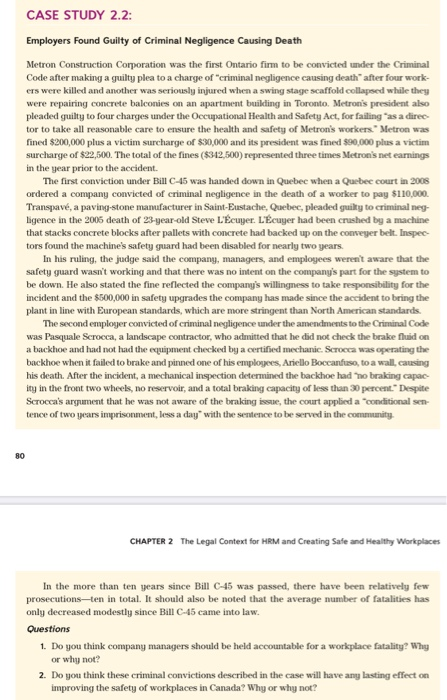
CASE STUDY 2.2: Employers Found Guilty of Criminal Negligence Causing Death Metron Construction Corporation was the first Ontario firm to be convicted under the Criminal Code after making a guilty plea to a charge of "criminal negligence causing death" after four work- ers were killed and another was seriously injured when a swing stage scaffold collapsed while they were repairing concrete balconies on an apartment building in Toronto. Metron's president also pleaded guilty to four charges under the Occupational Health and Safety Act, for failing as a direc tor to take all reasonable care to ensure the health and safety of Metron's workers." Metron was fined $200,000 plus a victim surcharge of $30,000 and its president was fined $90,000 plus a victim surcharge of $22,500. The total of the fines ($312,500) represented three times Metron's net earnings in the year prior to the accident. The first conviction under Bill C-45 was handed down in Quebec when a Quebec court in 2008 ordered a company convicted of criminal negligence in the death of a worker to pay $110,000 Transpav, a paving-stone manufacturer in Saint-Eustache, Quebec, pleaded guilty to criminal neg- ligence in the 2005 death of 23-year-old Steve L'cuyer. L'cuyer had been crushed by a machine that stacks concrete blocks after pallets with concrete had backed up on the conveyer belt. Inspec tors found the machine's safety guard had been disabled for nearly two years. In his ruling, the judge said the company, managers, and employees weren't aware that the safety guard wasn't working and that there was no intent on the company's part for the system to be down. He also stated the fine reflected the company's willingness to take responsibility for the incident and the $500,000 in safety upgrades the company has made since the accident to bring the plant in line with European standards, which are more stringent than North American standards. The second employer convicted of criminal negligence under the amendments to the Criminal Code was Pasquale Scrocca, a landscape contractor, who admitted that he did not check the brake fluid on a backhoe and had not had the equipment checked by a certified mechanic. Scrocca was operating the backhoe when it failed to brake and pinned one of his employees, Aniello Boccanfuso, to a wall, causing his death. After the incident, a mechanical inspection determined the backhoe had no braking capac ity in the front two wheels, no reservoir, and a total braking capacity of less than 30 percent. Despite Scrocca's argument that he was not aware of the braking issue, the court applied a conditional sen- tence of two years imprisonment, less a day with the sentence to be served in the community 80 CHAPTER 2 The Legal Context for HRM and Creating Safe and Healthy Workplaces In the more than ten years since Bill C-45 was passed, there have been relatively few prosecutionsten in total. It should also be noted that the average number of fatalities has only decreased modestly since Bill C-45 came into law. Questions 1. Do you think company managers should be held accountable for a workplace fatality? Why or why not? 2. Do you think these criminal convictions described in the case will have any lasting effect on improving the safety of workplaces in Canada? Why or why not









 Study Help