







Question: this is a design and analysis algorithm problem Problem 4 (The thief's plan) A thief is planning on burglarizing some subset of n consecutive houses
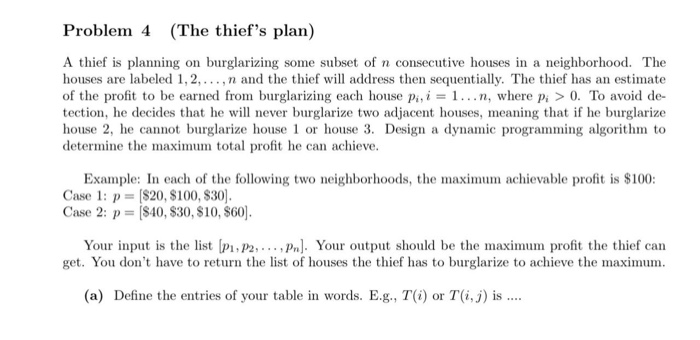



Problem 4 (The thief's plan) A thief is planning on burglarizing some subset of n consecutive houses in a neighborhood. The houses are labeled 1,2,...,n and the thief will address then sequentially. The thief has an estimate of the profit to be earned from burglarizing each house pii= 1...n, where pi > 0. To avoid de- tection, he decides that he will never burglarize two adjacent houses, meaning that if he burglarize house 2, he cannot burglarize house 1 or house 3. Design a dynamic programming algorithm to determine the maximum total profit he can achieve. Example: In each of the following two neighborhoods, the maximum achievable profit is $100: Case 1: p = ($20, $100, $30). Case 2: p = ($40, $30, $10, $60). Your input is the list (P1, P2, ...,Pn). Your output should be the maximum profit the thief can get. You don't have to return the list of houses the thief has to burglarize to achieve the maximum. (a) Define the entries of your table in words. E.g., T() or Ti, j) is .... (b) State recurrence for entries of table in terms of smaller subproblems. (c) Write pseudocode for your algorithm to solve this problem. (d) Analyze the running time of your algorithm
Step by Step Solution
There are 3 Steps involved in it

Get step-by-step solutions from verified subject matter experts
 Study Help