







Question: This is All information provided, there inst anything missing. I'm not sure how I could edit it this is the document that was provided to
This is All information provided, there inst anything missing. I'm not sure how I could edit it this is the document that was provided to me.
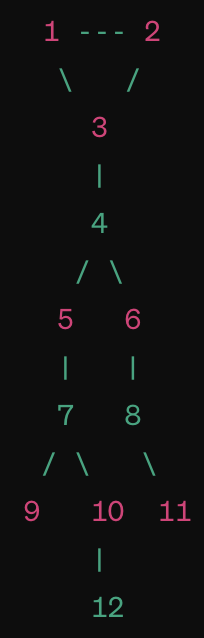
Repost, as the previous solution was just red-wording the steps. Please help me answer question one, to the best of my understanding I'll attach what I have completed I'm not sure if its right or wrong.
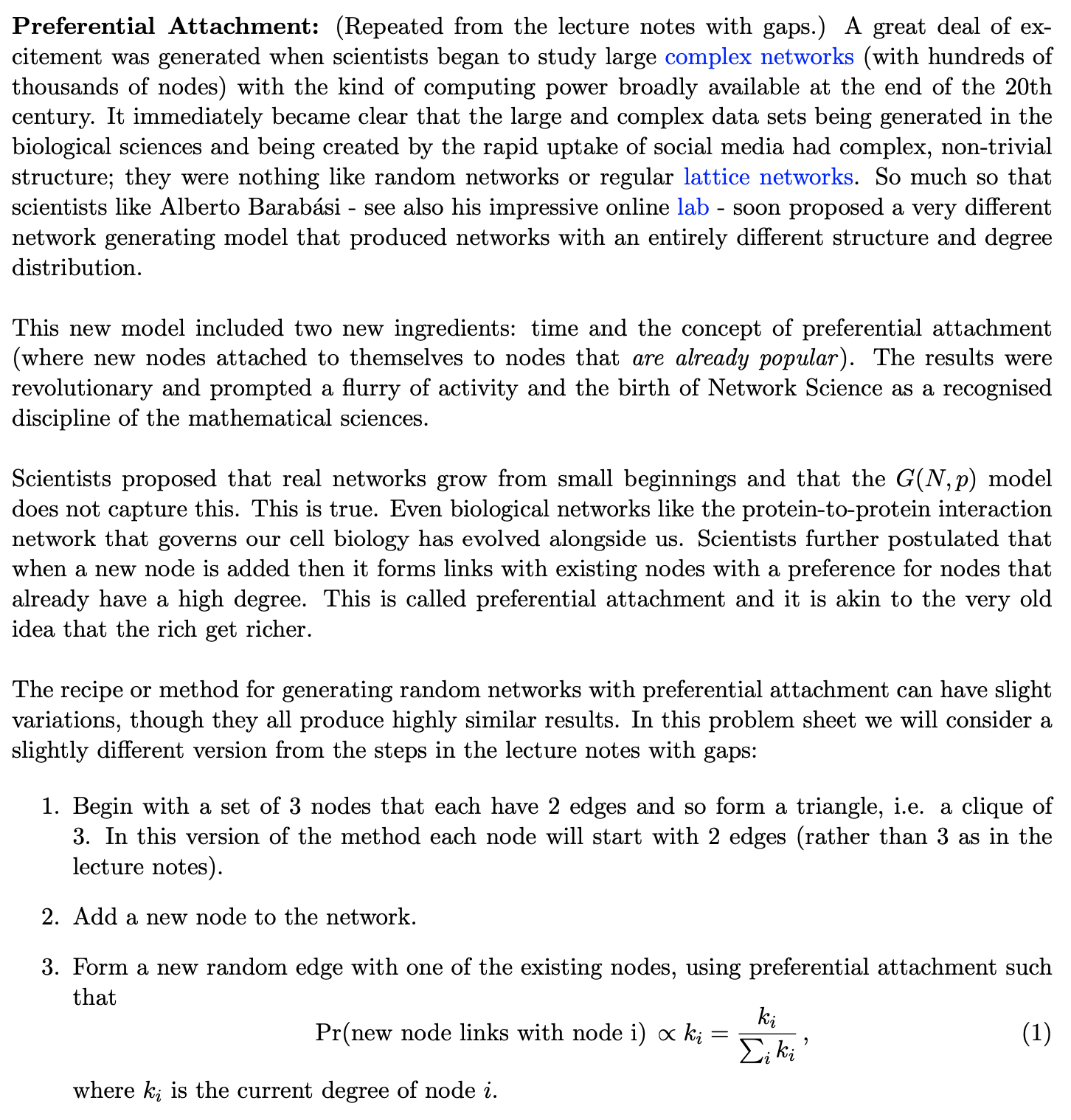
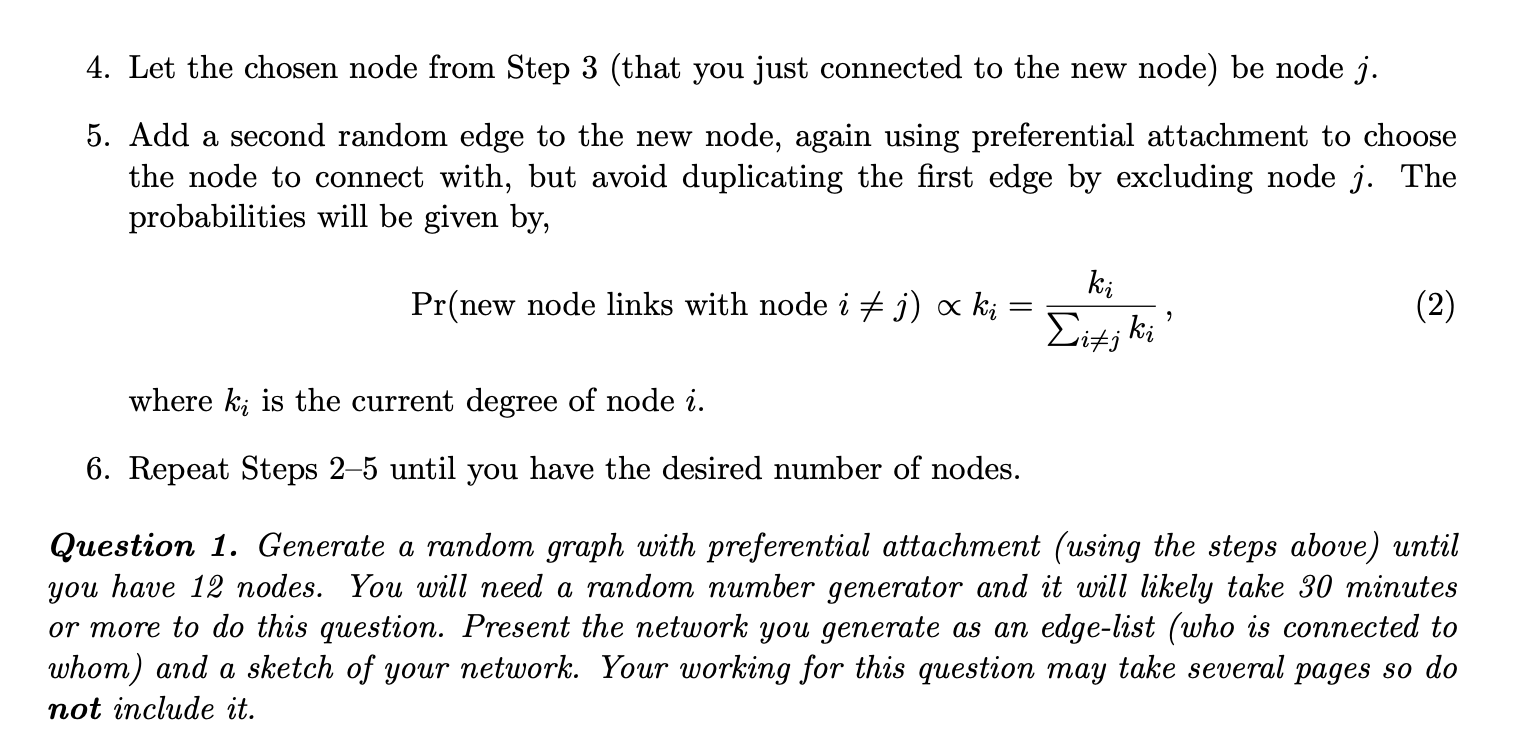
Preferential Attachment: (Repeated from the lecture notes with gaps.) A great deal of ex- citement was generated when scientists began to study large complex networks (with hundreds of thousands of nodes) with the kind of computing power broadly available at the end of the 20th century. It immediately became clear that the large and complex data sets being generated in the biological sciences and being created by the rapid uptake of social media had complex, non-trivial structure; they were nothing like random networks or regular lattice networks. So much so that scientists like Alberto Barabadsi - see also his impressive online lab - soon proposed a very different network generating model that produced networks with an entirely different structure and degree distribution. This new model included two new ingredients: time and the concept of preferential attachment (where new nodes attached to themselves to nodes that are already popular). The results were revolutionary and prompted a flurry of activity and the birth of Network Science as a recognised discipline of the mathematical sciences. Scientists proposed that real networks grow from small beginnings and that the G(N,p) model does not capture this. This is true. Even biological networks like the protein-to-protein interaction network that governs our cell biology has evolved alongside us. Scientists further postulated that when a new node is added then it forms links with existing nodes with a preference for nodes that already have a high degree. This is called preferential attachment and it is akin to the very old idea that the rich get richer. The recipe or method for generating random networks with preferential attachment can have slight variations, though they all produce highly similar results. In this problem sheet we will consider a slightly different version from the steps in the lecture notes with gaps: 1. Begin with a set of 3 nodes that each have 2 edges and so form a triangle, i.e. a clique of 3. In this version of the method each node will start with 2 edges (rather than 3 as in the lecture notes). 2. Add a new node to the network. 3. Form a new random edge with one of the existing nodes, using preferential attachment such that Pr(new node links with node i) o k; = Yok (1) where k; is the current degree of node 1. 4. Let the chosen node from Step 3 (that you just connected to the new node) be node j. 5. Add a second random edge to the new node, again using preferential attachment to choose the node to connect with, but avoid duplicating the first edge by excluding node j. The probabilities will be given by, ki Pr(new node links with node i # j)
Step by Step Solution
There are 3 Steps involved in it

Get step-by-step solutions from verified subject matter experts
 Study Help