Question: this is an easy english task , can you please do it so fast for me in less than 30 minutes . Activity 27 Writing
this is an easy english task , can you please do it so fast for me in less than 30 minutes .
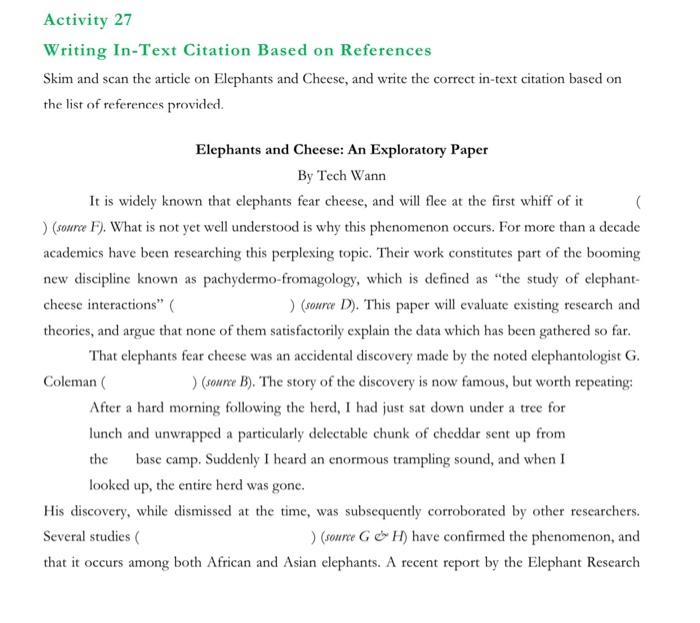
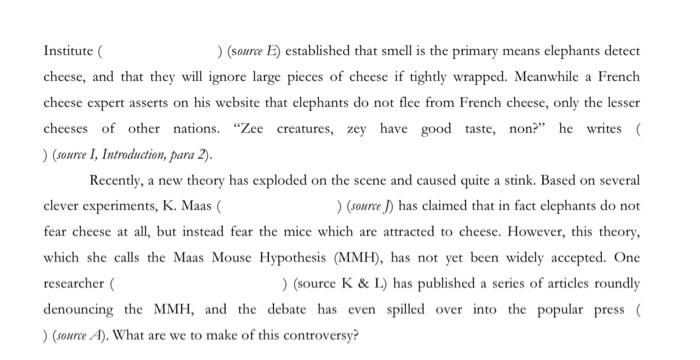
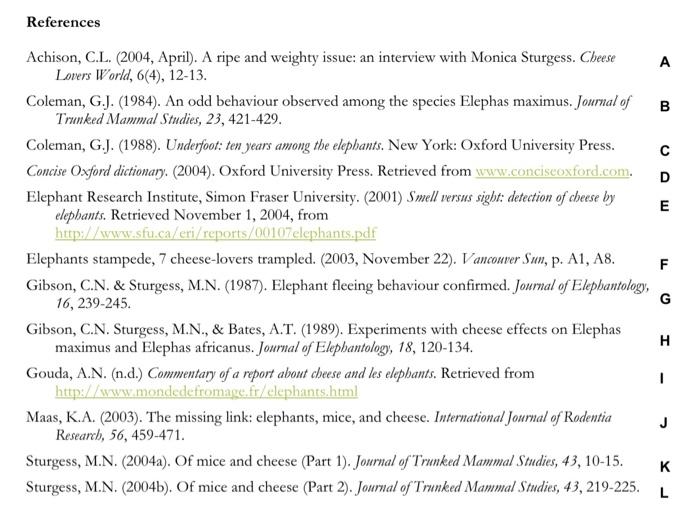
Activity 27 Writing In-Text Citation Based on References Skim and scan the article on Elephants and Cheese, and write the correct in-text citation based on the list of references provided. Elephants and Cheese: An Exploratory Paper By Tech Wann It is widely known that elephants fear cheese, and will flee at the first whiff of it (source F). What is not yet well understood is why this phenomenon occurs. For more than a decade academics have been researching this perplexing topic. Their work constitutes part of the booming new discipline known as pachydermo-fromagology, which is defined as "the study of elephant- cheese interactions" (source D). This paper will evaluate existing research and theories, and argue that none of them satisfactorily explain the data which has been gathered so far. That elephants fear cheese was an accidental discovery made by the noted elephantologist G. Coleman ) (sourer B). The story of the discovery is now famous, but worth repeating: After a hard morning following the herd, I had just sat down under a tree for lunch and unwrapped a particularly delectable chunk of cheddar sent up from the base camp. Suddenly I heard an enormous trampling sound, and when I looked up, the entire herd was gone. His discovery, while dismissed at the time, was subsequently corroborated by other researchers. Several studies (source GH) have confirmed the phenomenon, and that it occurs among both African and Asian elephants. A recent report by the Elephant Research a a Institute (source E) established that smell is the primary means elephants detect cheese, and that they will ignore large pieces of cheese if tightly wrapped. Meanwhile a French cheese expert asserts on his website that elephants do not flee from French cheese, only the lesser cheeses of other nations. "Zee creatures, zey have good taste, non?" he writes (source I, Introduction, para 2). Recently, a new theory has exploded on the scene and caused quite a stink. Based on several clever experiments, K. Maas (source) has claimed that in fact elephants do not fear cheese at all, but instead fear the mice which are attracted to cheese. However, this theory, which she calls the Maas Mouse Hypothesis (MMH), has not yet been widely accepted. One researcher ) (source K & L) has published a series of articles roundly denouncing the MMH, and the debate has even spilled over into the popular press (source A). What are we to make of this controversy? References Achison, C.L. (2004, April). A ripe and weighty issue: an interview with Monica Sturgess. Cheese Lovers World, 6(4), 12-13. Coleman, G.J. (1984). An odd behaviour observed among the species Elephas maximus. Journal of B Trunked Mammal Studies, 23, 421-429. Coleman, G.J. (1988). Underfoot: ten years among the elephants. New York: Oxford University Press. Concise Oxford dictionary. (2004). Oxford University Press. Retrieved from www.conciscoxford.com. D Elephant Research Institute, Simon Fraser University. (2001) Smell versus sight: detection of cheese by E elephants. Retrieved November 1, 2004, from http://www.sfu.ca/eri/reports/00107 elephants.pdf Elephants stampede, 7 cheese-lovers trampled. (2003, November 22). Vancouver Sun, p. A1, A8. F Gibson, C.N. & Sturgess, M.N. (1987). Elephant fleeing behaviour confirmed. Journal of Elephantology, 16, 239-245. Gibson, C.N. Sturgess, M.N., & Bates, A.T. (1989). Experiments with cheese effects on Elephas maximus and Elephas africanus. Journal of Elephantology, 18, 120-134. Gouda, A.N. (n.d.) Commentary of a report about cheese and les elephants. Retrieved from http://www.mondedefromage.fr/elephants.html Maas, K.A. (2003). The missing link: elephants, mice, and cheese. International Journal of Rodentia Research, 56, 459-471. Sturgess, M.N. (2004). Of mice and cheese (Part 1). Journal of Trunked Mammal Studies, 43, 10-15. Sturgess, M.N. (2004). Of mice and cheese (Part 2). Journal of Trunked Mammal Studies, 43, 219-225. L 6 H