Question: This is based on Motivation Theories. please answer each question. 1. Based on the Equity theory, how would you feel and how would you react
This is based on Motivation Theories. please answer each question.
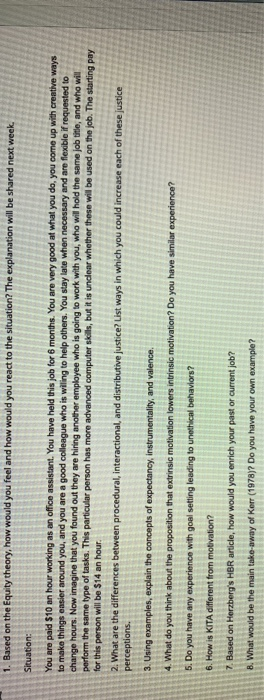
1. Based on the Equity theory, how would you feel and how would you react to the situation? The explanation will be shared next week. Situation: You are paid $10 an hour working as an office assistant. You have held this job for 6 months. You are very good at what you do, you come up with creative ways to make things easier around you, and you are a good colleague who is willing to help others. You stay late when necessary and are flexible if requested to change hours. Now imagine that you found out they are hiring another employee who is going to work with you, who will hold the same job title, and who will perform the same type of tasks. This particular person has more advanced computer skills, but it is unclear whether these will be used on the job. The starting pay for this person will be $14 an hour. 2. What are the differences between procedural, interactional, and distributive justice? List ways in which you could increase each of these justice perceptions. 3. Using examples, explain the concepts of expectancy, instrumentality, and valence. 4. What do you think about the proposition that extrinsic motivation lowers intrinsic motivation? Do you have similar experience? 5. Do you have any experience with goal setting leading to unethical behaviors? 6. How is KITA different from motivation? 7. Based on Herzberg's HBR article, how would you enrich your past or current job? 8. What would be the main take-away of Kerr (1978)? Do you have your own example? 1. Based on the Equity theory, how would you feel and how would you react to the situation? The explanation will be shared next week. Situation: You are paid $10 an hour working as an office assistant. You have held this job for 6 months. You are very good at what you do, you come up with creative ways to make things easier around you, and you are a good colleague who is willing to help others. You stay late when necessary and are flexible if requested to change hours. Now imagine that you found out they are hiring another employee who is going to work with you, who will hold the same job title, and who will perform the same type of tasks. This particular person has more advanced computer skills, but it is unclear whether these will be used on the job. The starting pay for this person will be $14 an hour. 2. What are the differences between procedural, interactional, and distributive justice? List ways in which you could increase each of these justice perceptions. 3. Using examples, explain the concepts of expectancy, instrumentality, and valence. 4. What do you think about the proposition that extrinsic motivation lowers intrinsic motivation? Do you have similar experience? 5. Do you have any experience with goal setting leading to unethical behaviors? 6. How is KITA different from motivation? 7. Based on Herzberg's HBR article, how would you enrich your past or current job? 8. What would be the main take-away of Kerr (1978)? Do you have your own example









 Study Help