







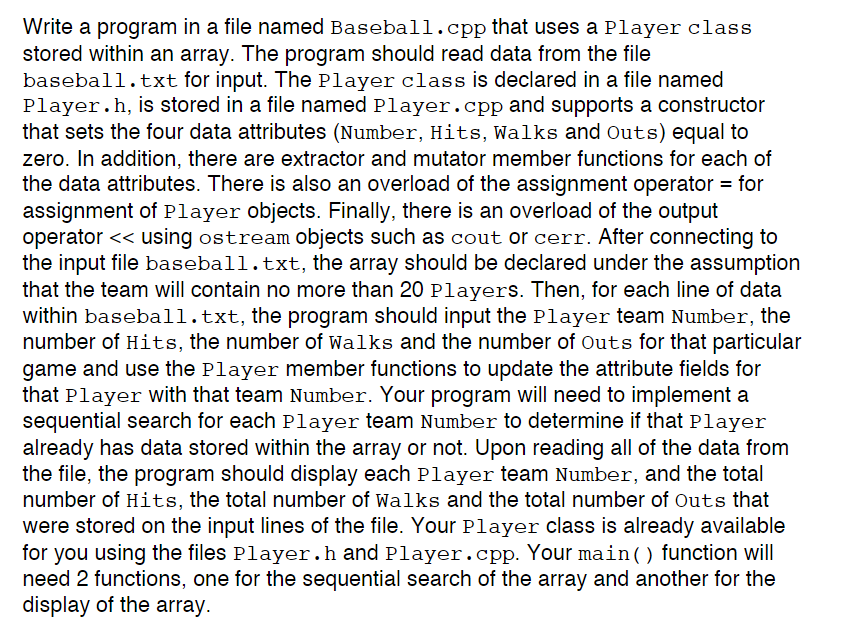
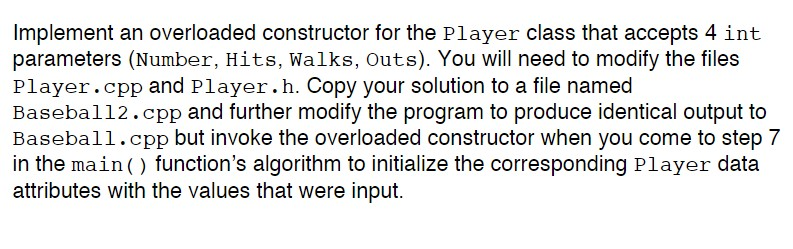
Question: This is C++ Problem, needs to be compiled with GNU++ Compiler All of the files needed for this (baseball.cpp, player.h Player.cpp, and baseball.txt are provided
This is C++ Problem, needs to be compiled with GNU++ Compiler
All of the files needed for this (baseball.cpp, player.h Player.cpp, and baseball.txt are provided below.
Baseball.cpp
#include "Player.h"
#include
#include
// declaration of functions
// implementation of the main program
int main()
{
// 1) connect to input file
fstream fin("baseball.txt");
// objects used to store data
const int LIST_LENGTH = 20;
int number = 0, // number, hits, walks, outs
hits,
walks,
outs,
players,
index,
teamSize = 0;
// 2) output descriptive messages
cout
// 3) declare an array of LIST_LENGTH players
// 4) attempt to input the data for the first Player
fin >> number >> hits >> walks >> outs;
// 5) loop on end of file
while (!fin.eof())
{
// 6) find the index of this Player's number
// 7) if player number is not in the list
// 7a) set the Number field for team[teamSize]
// 7b) set the Hits field for team[teamSize]
// 7c) ste the Walks field for team[teamSize]
// 7d) set the Outs field for team[teamSize]
// 7e) increase teamSize by 1
// 8) else player number is in the list
// 8a) update the Hits field for team[index]
// 8b) update the Walks field for team[index]
// 8c) update the Outs field for team[index]
// 9) attempt to input the data for the next Player
fin >> number >> hits >> walks >> outs;
}
// 10) display the results
// 11) disconnect from input file
fin.close();
} // end of main
void displayArray(Player team[], int team_size)
{
cout
// 2) loop over team size
for (int i=0; i
{
// 3) display i'th player
cout
}
}
baseball.txt
1 2 2 2 19 0 5 1 2 0 0 6 18 4 2 0 4 1 2 3 12 2 2 2 7 0 0 3 8 1 4 1 10 2 2 2 3 2 1 3 11 6 0 0 2 0 5 1 19 0 0 6 17 4 2 0 9 3 2 1 4 2 1 3 3 1 2 3 7 0 0 3
player.cpp
#include "Player.h"
#include
#include
using namespace std;
Player::Player()
{
Number = Hits = Walks = Outs = 0;
}
int Player::getNumber() const
{
return Number;
}
int Player::getHits() const
{
return Hits;
}
int Player::getWalks() const
{
return Walks;
}
int Player::getOuts() const
{
return Outs;
}
void Player::setNumber(int n)
{
Number = n;
}
void Player::setHits(int h)
{
Hits = h;
}
void Player::setWalks(int w)
{
Walks = w;
}
void Player::setOuts(int o)
{
Outs = o;
}
// support for assignments
const Player& Player::operator=(const Player & p)
{
// bypass self assignment
if (this != &p)
{
Number = p.Number;
Hits = p.Hits;
Walks = p.Walks;
Outs = p.Outs;
}
return *this;
}
// support for output to the monitor
ostream& operator
{
out
return out;
}
// end of the class member functions
Player.h
#ifndef PLAYER #define PLAYER
#include
class Player { public: // member functions // constructor Player(); // extractors int getNumber() const; int getHits() const; int getWalks() const; int getOuts() const; // mutators void setNumber(int); void setHits(int); void setWalks(int); void setOuts(int); // support for assignments and output to the monitor const Player& operator=(const Player &); friend ostream& operator
private: // data attributes int Number, Hits, Walks, Outs; };
// end of the class #endif
Write a program in a file named Baseball.cpp that uses a Player class stored within an array. The program should read data from the file baseball.txt for input. The Player class is declared in a file named Player.h, is stored in a file named Player.cpp and supports a constructor that sets the four data attributes (Number, Hits, Walks and Outs) equal to zero. In addition, there are extractor and mutator member functions for each of the data attributes. There is also an overload of the assignment operator foir assignment of Player objects. Finally, there is an overload of the output operator
Step by Step Solution
There are 3 Steps involved in it

Get step-by-step solutions from verified subject matter experts
 Study Help