





Question: This is one question with sections; please zoom in for more details or open image in a new tab. If the full question is not
This is one question with sections; please zoomThis is one question with sections; please zoomThis is one question with sections; please zoomThis is one question with sections; please zoom in for more details or open image in a new tab. If the full question is not answered it will be downvoted.
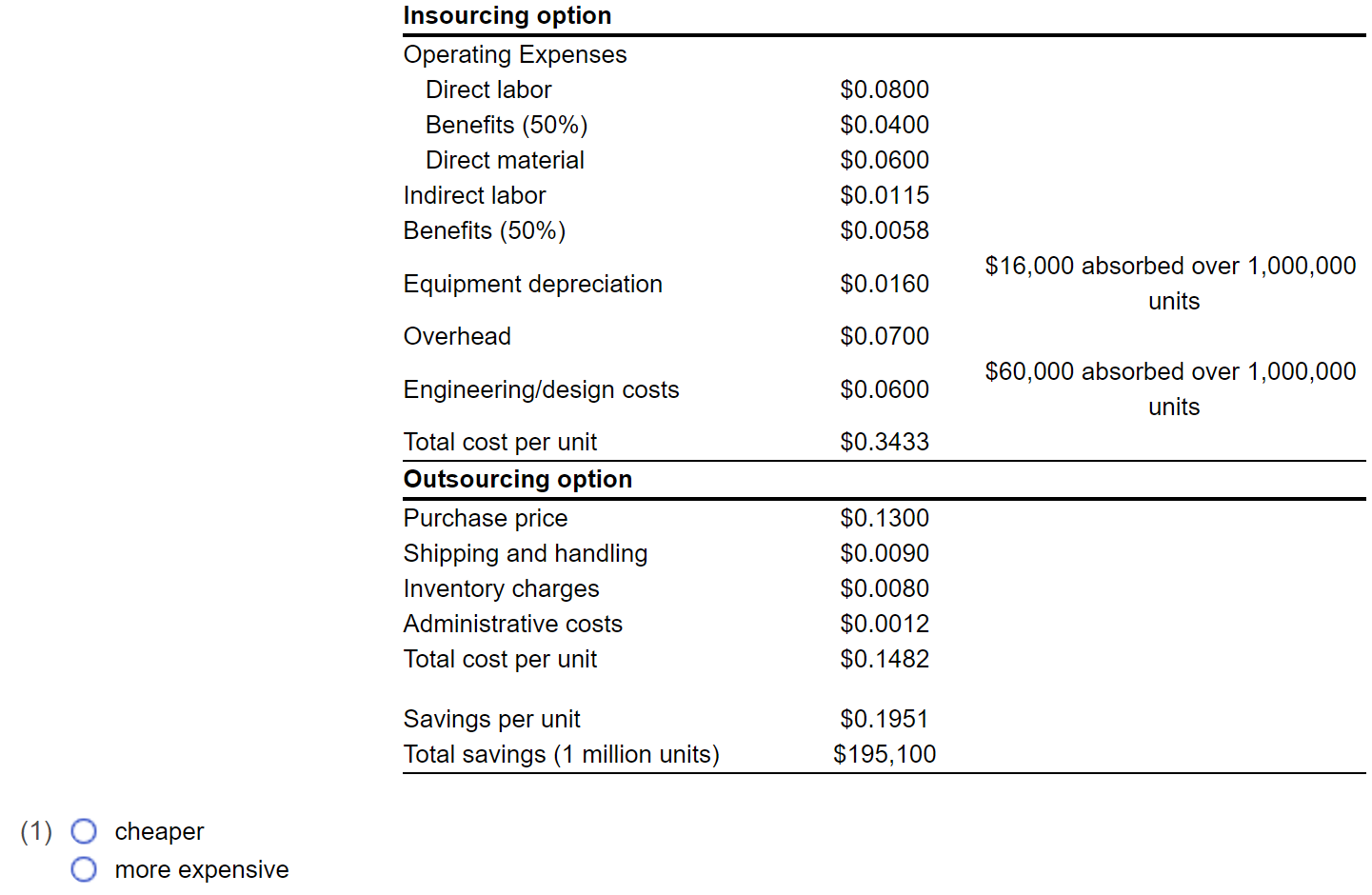
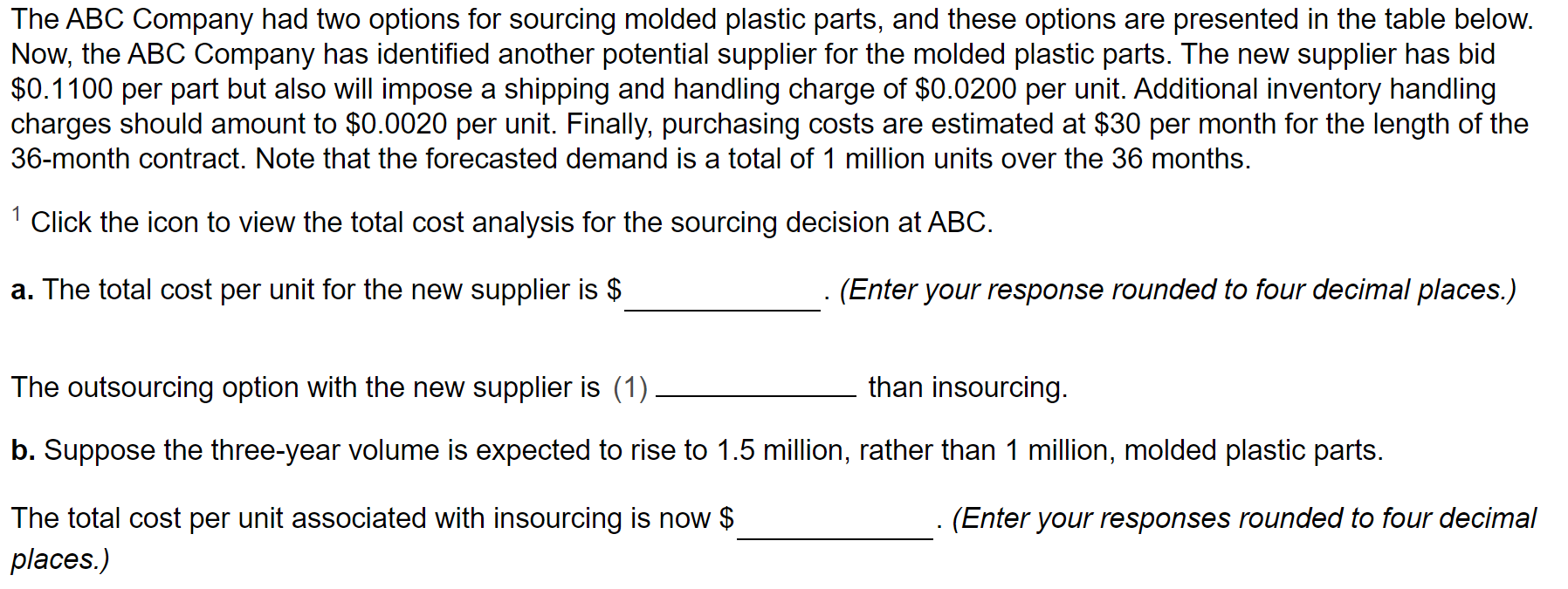
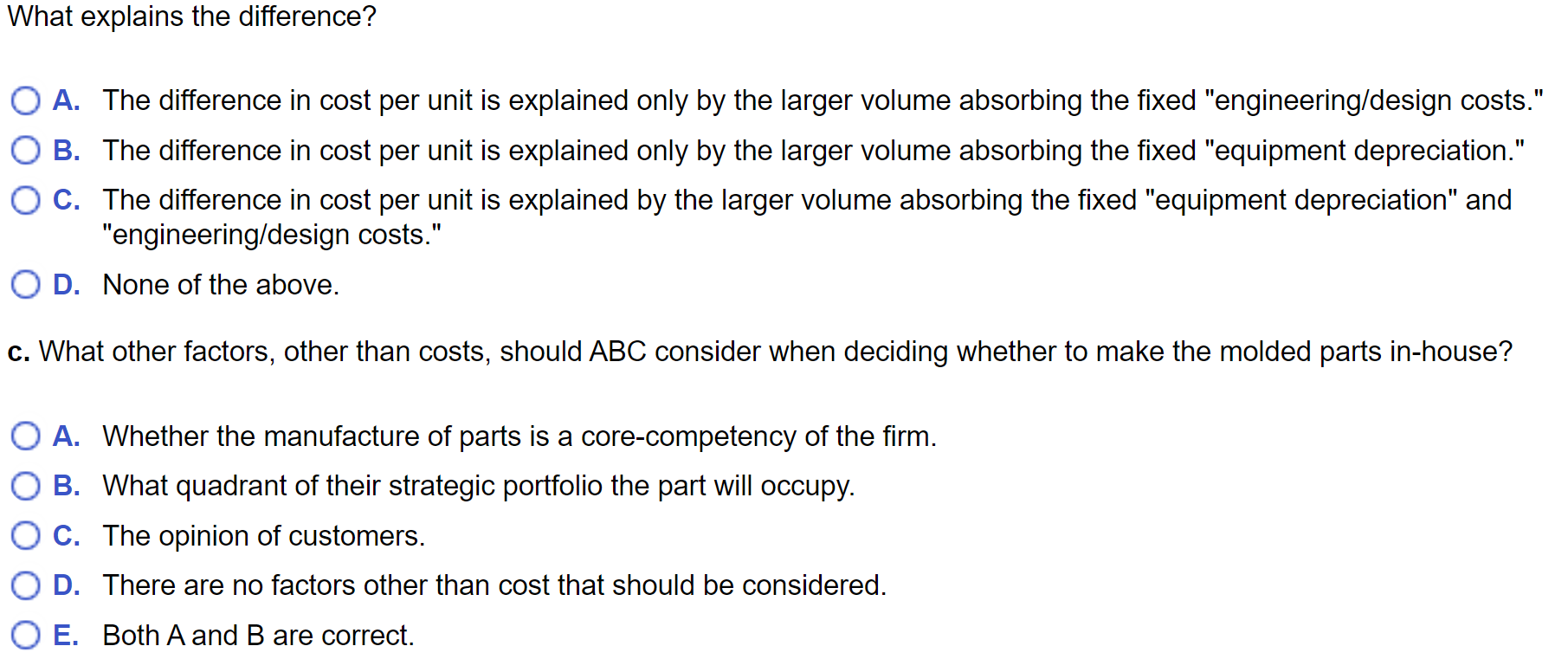
The ABC Company had two options for sourcing molded plastic parts, and these options are presented in the table below. Now, the ABC Company has identified another potential supplier for the molded plastic parts. The new supplier has bid $0.1100 per part but also will impose a shipping and handling charge of $0.0200 per unit. Additional inventory handling charges should amount to $0.0020 per unit. Finally, purchasing costs are estimated at $30 per month for the length of the 36-month contract. Note that the forecasted demand is a total of 1 million units over the 36 months. 1 Click the icon to view the total cost analysis for the sourcing decision at ABC. a. The total cost per unit for the new supplier is $ (Enter your response rounded to four decimal places.) The outsourcing option with the new supplier is (1). than insourcing. b. Suppose the three-year volume is expected to rise to 1.5 million, rather than 1 million, molded plastic parts. (Enter your responses rounded to four decimal The total cost per unit associated with insourcing is now $ places.) What explains the difference? A. The difference in cost per unit is explained only by the larger volume absorbing the fixed "engineering/design costs." OB. The difference in cost per unit is explained only by the larger volume absorbing the fixed "equipment depreciation." OC. The difference in cost per unit is explained by the larger volume absorbing the fixed "equipment depreciation" and "engineering/design costs." OD. None of the above. c. What other factors, other than costs, should ABC consider when deciding whether to make the molded parts in-house? O A. Whether the manufacture of parts is a core-competency of the firm. OB. What quadrant of their strategic portfolio the part will occupy. O C. The opinion of customers. OD. There are no factors other than cost that should be considered. O E. Both A and B are correct. Insourcing option Operating Expenses Direct labor Benefits (50%) Direct material Indirect labor Benefits (50%) $0.0800 $0.0400 $0.0600 $0.0115 $0.0058 Equipment depreciation $0.0160 $16,000 absorbed over 1,000,000 units Overhead $0.0700 Engineering/design costs $0.0600 $60,000 absorbed over 1,000,000 units $0.3433 Total cost per unit Outsourcing option Purchase price Shipping and handling Inventory charges Administrative costs Total cost per unit $0.1300 $0.0090 $0.0080 $0.0012 $0.1482 Savings per unit Total savings (1 million units) $0.1951 $195, 100 (1) O cheaper more expensive

Step by Step Solution

There are 3 Steps involved in it

1 Expert Approved Answer
Step: 1 Unlock blur-text-image

Question Has Been Solved by an Expert!

Get step-by-step solutions from verified subject matter experts

Step: 2 Unlock
Step: 3 Unlock

Students Have Also Explored These Related General Management Questions!