







Question: THIS IS THE EXAMPLE DISCUSSION PLEASE HELP ME TO ROUGH DISCUSSION LIKE THE EXAMPLE ABOVE FOR THE EXPERIMENT BELOW [INTRODUCIION] In this experiment, vanadium acetylacetonate,
![LIKE THE EXAMPLE ABOVE FOR THE EXPERIMENT BELOW [INTRODUCIION] In this experiment,](https://dsd5zvtm8ll6.cloudfront.net/si.experts.images/questions/2024/09/66f8d4a18e3a3_39366f8d4a131fc1.jpg)

THIS IS THE EXAMPLE DISCUSSION
PLEASE HELP ME TO ROUGH DISCUSSION LIKE THE EXAMPLE ABOVE FOR THE EXPERIMENT BELOW
![[EXPLANNIING ABOUT THE PROCEDURE] At first, reduction of vanadium oxide, V2O5 takes](https://dsd5zvtm8ll6.cloudfront.net/si.experts.images/questions/2024/09/66f8d4a2ac82f_39466f8d4a24f785.jpg)
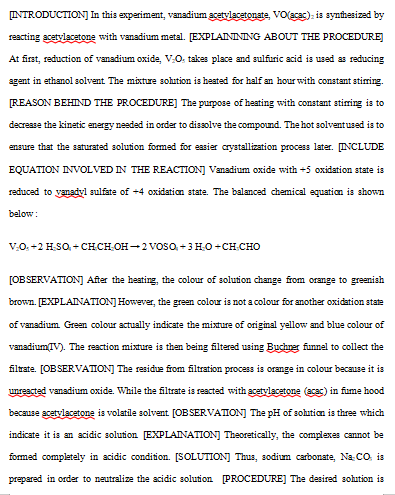
[INTRODUCIION] In this experiment, vanadium acetylacetonate, VO(acac) 2 is synthesizad by reacting acetylacetone with vanadium metal. [EXPLANNIING ABOUT THE PROCEDURE] At first, reduction of vanadium oxide, V2O5 takes place and sulfuric acid is used as reducing agent in ethanol solvent. The mixture sohtion is heated for half an hour with constant atirring. [REASON BEHIND THE PROCEDURE] The purpose of heating with constant stirring is to decresse the kinetic energy needed in order to dissolve the compound. The hot solvent used is to ensure that the saturated solution formed for essier crystallization process later. [CNCLUDE EQUATION INVOLVED IN THE REACTION] Vanadium oxide with +5 oxidation state is reduced to yanadyl sulfate of +4 oxidation state. The balanced chemical equaticn is shown below: V2O5+2H2SO4+CHCH2OH2VOSO4+3H2O+CH3CHO3 [OBSERVATION] After the heating, the colour of solution change from orange to greenish brown. [EXPLAINATION] However, the green colour is not a colour for another oxidation state of vanadium. Green colour actually indicate the mixture of original yellow and blue colour of vanadium(V). The reaction mixture is then being filtered using Buchner funnel to collect the filtrate. [OBSERVATION] The residue from filtration process is orange in colour because it is unreacted vanadium oxide. While the filtrate is reacted with acetylacetone (acac) in fume hood because acetylacetone is volatile solvent [OBSERVATION] The pH of sohticn is three which indicate it is an acidic solution [EXPLANNATION] Theoretically, the complexes cannot be formed completely in acidic condition. [SOLUTION] Thus, sodium carbonate, Na,CO is prepared in order to neutralize the acidic solution [PROCEDURE] The desired sohtion is neutral solution with pH 7 . So, after adding a smallamount of sodium carbonate, Na-CO the pH of the solution need to be tested using universal pH test paper strips and compared it with the reference given.[EXPLAINATION] This action is to prevent getting an alkaline solution instead of neutral solution. As the sodium carbonate, NaCO5 is added into the acidic solution, the bubbles formation can be observed. This is becanse, based on the chemical equation below, the carbon dioxide is one of the byproduct of this reaction. VOSO4+2(Hacac+NaCO5[VO(acac)2]+NaSO4+H2O+CO2 [OBSERVATION] After the total of 68mL of sodium carbonate, NaCO was added, the pH sohtion is neutral which indicate the complexes is completely formed. In order to collect the final product, the vacuum filtation is carried out. [EXPLANNATION]The final product is being washed with a small amount of ethanol because vanadium acetylacetonate is slightly sohble in ethanol. Thus, the washing procass purposes are to purify the final product and to incresse the yield The final product is a cryatalline blue powder of vanadium acetylacatonate, VO(acac), and the blue colour indicates the oxidation state of +4 vanadium. [EXPLAINATION ABOUT THE EXPERINENTI] Basically, agetylacetone is a weak acid with pKa of 9. Acetylacetone (acac) can readily convert to enol form when undergo kete-enol tautomerism reaction and enol form is the common form of acetylacetone because it is more stable due to conjugation. Then, the enol form is being deprotonated by Bronsted-Lowry base usually carbonate ions to give negative charged acetylacetonate ion called anion of acas, acetylacetone. Deprotonation is to make acetylacetone to function as ligand where then being coordinates with metal atom to produce stable complexes. Acetylacetonate (acac) is a bidentate ligand which have two point of attachment to the metal atom. The attachment is through two oxygen atoms of acetylacetonate ions. [FINDDNG] The percentage yield of final product which is vamadium acetylacetonate, VO(acac)2 is 71.61%. The percentage yield is quite lower due to some yield might lost during filtration process. B. Determination of the Percentage of Ligands in K3[Fe(C2O4)3]3H2O 1. Weigh out 0.20g of the coordination compound that was previously prepared. 2. Boil the sample with 50mL of 1M sulphuric acid in a conical flask. 3. Allow the solution to cool to 60C and titrate slowly with the KMnO4 solution provided ( KMnO4 that is standardised in Part A). 4. The end point is reached when the addition of one drop of permanganate solution produces a permanent pink colour. Record your results in a table shown below. 5. Repeat the titration until consistent results are obtained
Step by Step Solution
There are 3 Steps involved in it

Get step-by-step solutions from verified subject matter experts
 Study Help