Question: this is the question. you will need these four pages to answer the question. please use the study case. 3. What do you think are
this is the question.
you will need these four pages to answer the question.
please use the study case.
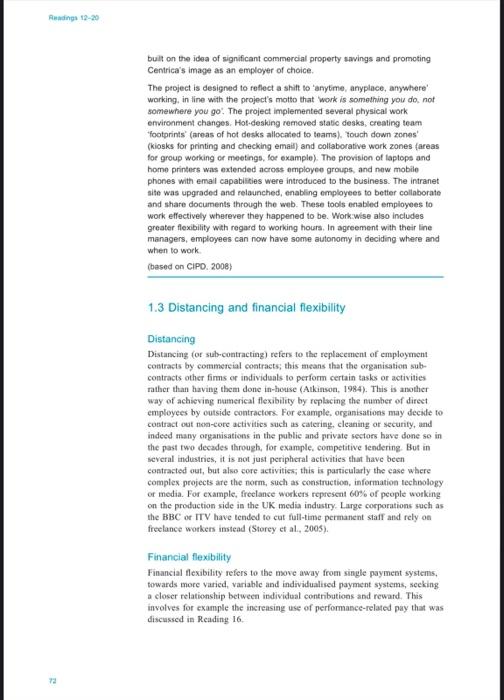
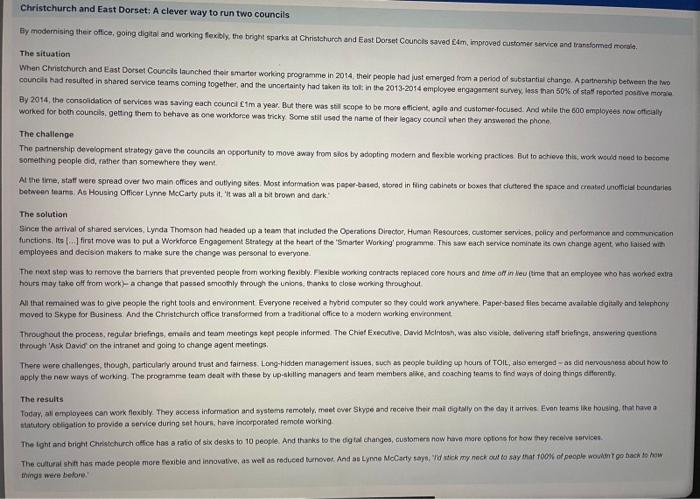
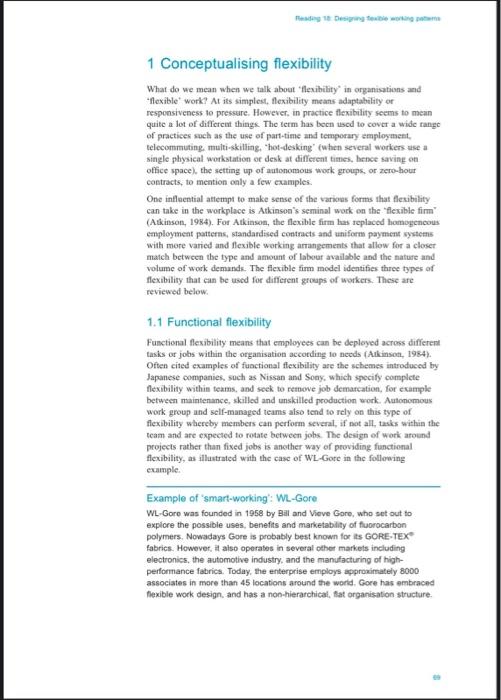
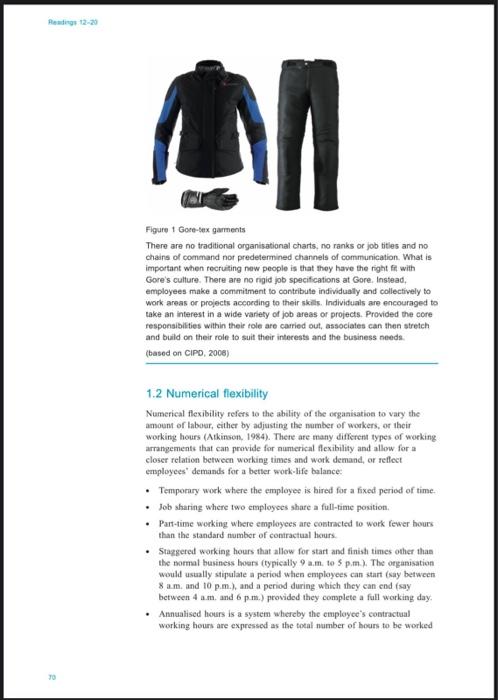
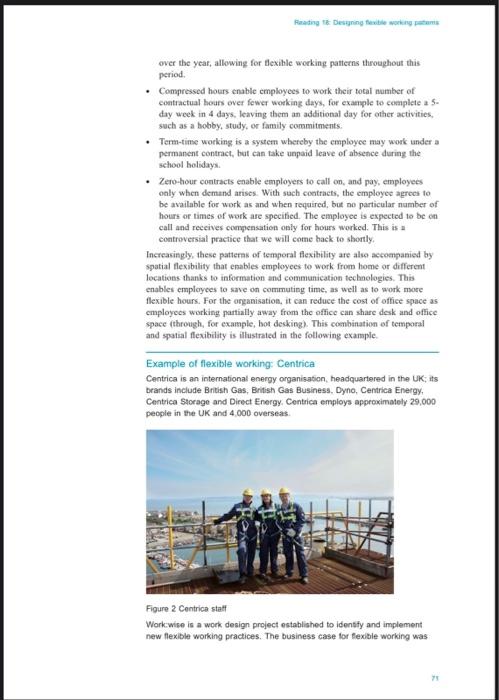
3. What do you think are the benefits and the potential disadvantages to employees from the changes to more flexible working patterns? [Guidance to students: Again, use concepts from Reading 18 to help you answer this question. Again, make sure that you use concepts and ideas from B100 Block 2 explicitly and reference them correctly. Use examples from the case to support your answer. The case study focuses mostly on the benefits of flexible working to Christchurch and East Dorset Council. In this question, you are being asked to consider the benefits, as well as the potential disadvantages for employees, not for the Council as an employer. You have 200 words to answer this question. To stay within that limit, you will have to focus on some key benefits and disadvantages for employees, rather than trying to list as many as possible. While you need to use examples from the case to evidence your answer, you do not need to include lengthy quotes from the case.] (Approximately 200 words for this question) 18 Desem 1 Conceptualising flexibility What do we mean when we talk about flexibility in organisations and flexible work? At its simplest, flexibility means adaptability or responsiveness to pressure. However, in practice flexibility seems to mean quite a lot of different things. The term has been used to cover a wide range of practices such as the use of part-time and temporary employment telecommuting multi-skilling, hot-desking when several workers use a single physical workstation or desk at different times, hence saving on office space), the setting up of autonomous work groups, or zero-hour contracts, to mention only a few examples. One influential attempt to make sense of the various forms that flexibility can take in the workplace is Atkinson's seminal work on the flexible for (Atkinson, 1984). For Atkinson, the flexible firm has replaced homogeneous employment patterns, standardised contracts and uniform payment systems with more varied and flexible working arrangements that allow for a closer match between the type and amount of labour available and the nature and volume of work demands. The flexible firm model identifies three types of flexibility that can be used for different groups of workers. These are reviewed below 1.1 Functional flexibility Functional flexibility means that employees can be deployed across different tasks or jobs within the organisation according to needs (Atkinson, 1954). Often cited examples of functional flexibility are the schemes introduced by Japanese companies, such as Nissan and Sony, which specify complete flexibility within teams, and seek to remove job demarcation, for example between maintenance, skilled and unskilled production work. Autonomous work group and self-managed teams also tend to rely on this type of flexibility whereby members can perform several, if not all tasks within the team and are expected to rotate between jobs. The design of work around projects rather than fixed jobs is another way of providing functional flexibility, as illustrated with the case of WL-Gore in the following example, Example of 'smart-working': WL-Gore WL-Gore was founded in 1958 by Bailand Vieve Gore, who set out to explore the possible uses, benefits and marketability of fluorocarbon polymers. Nowadays Gore is probably best known for its GORE-TEX fabrics. However, it also operates in several other markets including electronics, the automotive industry, and the manufacturing of high- performance fabrics. Today, the enterprise employs approximately 8000 associates in more than 45 locations around the world. Gore has embraced flexible work design, and has a non-hierarchical. at organisation structure Ring 12-20 AM Figure 1 Gore-tex garments There are no traditional organisational charts, no ranks or job titles and no chains of command nor predetermined channels of communication. What is important when recruiting new people is that they have the right ft with Gore's culture. There are no rigid job specifications at Gore. Instead, employees make a commitment to contribute individually and collectively to work areas or projects according to their skills. Individuals are encouraged to take an interest in a wide variety of job areas or projects. Provided the core responsibilities within their role are carried out, associates can then stretch and build on their role to suit their interests and the business needs (based on CIPO, 2008) 1.2 Numerical flexibility Numerical flexibility refers to the ability of the organisation to vary the amount of labour, either by adjusting the number of workers, or their working hours (Atkinson, 1984). There are many different types of working arrangements that can provide for numerical flexibility and allow for a closer relation between working times and work demand, or reflect employees' demands for a better work-life balance: Temporary work where the employee is hired for a fixed period of time. . Job sharing where two employees share a full-time position, Part-time working where employees are contracted to work fewer hours than the standard number of contractual hours Staggered working hours that allow for start and finish times other than the normal business hours (typically 9 am to 5pm. The organisation would usually stipulate a period when employees can start (say between 8 am, and 10 p.m.), and a period during which they can end say between 4 a.m. and 6pm.) provided they complete a full working day Annualised hours is a system whereby the employee's contractual working hours are expressed as the total number of hours to be worked 0 Reading to Desyning flexible working tems over the year, allowing for flexible working patterns throughout this period. Compressed hours enable employees to work their total number of contractual hours over fewer working days, for example to complete a S. day week in 4 days, leaving them an additional day for other activities, such as a hobby, study, or family commitments. Term-time working is a system whereby the employee may work under a permanent contract, but can take unpaid leave of absence during the school holidays Zero-hour contracts enable employers to call on, and pay, employees only when demand arises. With such contracts, the employee agrees to be available for work as and when required, but no particular number of hours or times of work are specified. The employee is expected to be on call and receives compensation only for hours worked. This is a controversial practice that we will come back to shortly. Increasingly, these patterns of temporal flexibility are also accompanied by spatial flexibility that enables employees to work from home or different locations thanks to information and communication technologies. This enables employees to save on commuting time, as well as to work more flexible hours. For the organisation, it can reduce the cost of office space as employees working partially away from the office can share desk and office space (through, for example, hot desking). This combination of temporal and spatial flexibility is illustrated in the following example. Example of flexible working: Centrica Centrica is an international energy organisation, headquartered in the UK; its brands include British Gas, British Gas Business, Dyno, Centrica Energy, Centrica Storage and Direct Energy Contrica employs approximately 29,000 people in the UK and 4.000 overseas. Figure 2 Centrica sta Work wise is a work design project established to identify and implement new flexible working practices. The business case for fexible working was Rundings 19-20 built on the idea of significant commercial property savings and promoting Centrica's Image as an employer of choice. The project is designed to reflect a shift to anytime, anyplace, anywhere working, in line with the project's motto that work is something you do not somewhere you go. The project implemented several physical work environment changes. Hot-desking removed static desks, creating team footprints (areas of hot desks allocated to teams). Touch down zones! (kiosks for printing and checking email and collaborative work zones (areas for group working or meetings, for example). The provision of laptops and home printers was extended across employee groups, and new mobile phones with email capabilities were introduced to the business. The intranet site was upgraded and relaunched, enabling employees to better collaborato and share documents through the web. These tools enabled employees to work effectively wherever they happened to be. Work wise also includes greater flexibility with regard to working hours. In agreement with their line managers, employees can now have some autonomy in deciding where and when to work (based on CIPO. 2008) 1.3 Distancing and financial flexibility Distancing Distancing (or sub-contracting) refers to the replacement of employment contracts by commercial contracts; this means that the organisation sub- contracts other firms or individuals to perform certain tasks or activities rather than having them done in-house (Atkinson, 1984). This is another way of achieving numerical flexibility by replacing the number of direct employees by outside contractors. For example, organisations may decide to contract out non-core activities such as catering, cleaning or security, and indeed many organisations in the public and private sectors have done so in the past two decades through, for example, competitive tendering. But in several industries, it is not just peripheral activities that have been contracted out, but also core activities, this is particularly the case where complex projects are the norm, such as construction, information technology or media. For example, freelance workers represent 60% of people working on the production side in the UK media industry. Large corporations such as the BBC or ITV have tended to cut full-time permanent staff and rely on freelance workers instead (Storey et al., 2005). Financial flexibility Financial flexibility refers to the move away from single payment systems, towards more varied, variable and individualised payment systems, seeking a closer relationship between individual contributions and reward. This involves for example the increasing use of performance-related pay that was discussed in Reading 16 Christchurch and East Dorset: A clever way to run two councils By modernising their office, going digital and working fexbly the bright sparks at Christchurch and East Dorset Councils saved Cam, improved customer service and transformed one The situation When Christchurch and East Dorset Councils launched their smarter working programme in 2014, their people had just emerged from a period of substantial change Apartnership between the two councils had resulted in shared service teams coming together, and the uncertainty had taken its to in the 2013-2014 employee engagement survey, less than 50% of staff reported positive more By 2014, the consolidation of services was saving each council Etma year. But there was still scope to be more eficient, agile and customer-focused. And while the 600 employees now offically worked for both councils, getting them to behave as one workforce was tricky Some stil used the name of the legacy council when they answered the phone The challenge The partnership development strategy gave the councils an opportunity to move away from sios by adopting modern and flexible working practions But to achieve this work would need to become something people did, rather than somewhere they want At the time, wat were spread over two main offices and outlying sites. Most mommation was pacerbated, stored in tiling cabinets or bones that cluttered me space and created notice boundaries between teams As Housing Officer Lynne McCarty puts it. 't was all a bit brown and dark The solution Since the arrival of shared services, Lyrda Thomson had headed up a team that included the Operations Director, Human Resources, customer services, policy and performance and communcation functions. Its first move was to put a Workforce Engagement Strategy at the heart of the Smarter Working programme. This saw each service nominate its own change agent wholaised with employees and decision makers to make sure the change was personal to everyone The next step was to remove the barriers that prevented people from working exibly. Flexible working contracts replaced core hours and time of in New time that an employee who has worked extra hours may take off from work - a change that passed smoothly through the unions, thanks to close working throughout All that remained was to give people the right tools and environment Everyone received a hybrid computer so they could work anywhere. Paper-based files became avalatie digital and selephony moved to Skype for Business And the Christchurch office transformed from a traditional office to a modern working environment Throughout the process, roguar briefings, emain and team meetings kopt people informed. The Chat Executive, David Mcintosh, was aho vaible, delivering staff befiafrist, answering qutione through 'Ask David on the intranet and going to change agent meetings There were challenges, though, particularly around trust and famess. Long-hidden management issues, such as people bulding up hours of TOIL, also energed - as did nervousness about how to apply the new ways of working. The programme team dealt with these by pakilling managers and team members alike, and coaching teams to find ways of doing things differently The results Today, all employees can work flexibly. They access information and aysters remotely, most ower Skype and receive their mai digtaly on the day it arrives Evan teams te housing, that have statutory obligation to provide a service during set hours, have incorporated remote working The light and bright Christchurch office has a ratio of six desks to 10 people. And thanks to the digtal changes, customers now have more options for how they receive service The cultural shit has made people more exible and innovative, as well as reduced turnover And so Lynne McCarty say, "dick my neck out to say that 100% of people would go back to how things were before









 Study Help