







Question: This problem explores basic properties of the quantum harmonic oscillator using ladder operators. Recall that the ladder operators are two particular linear combinations of r
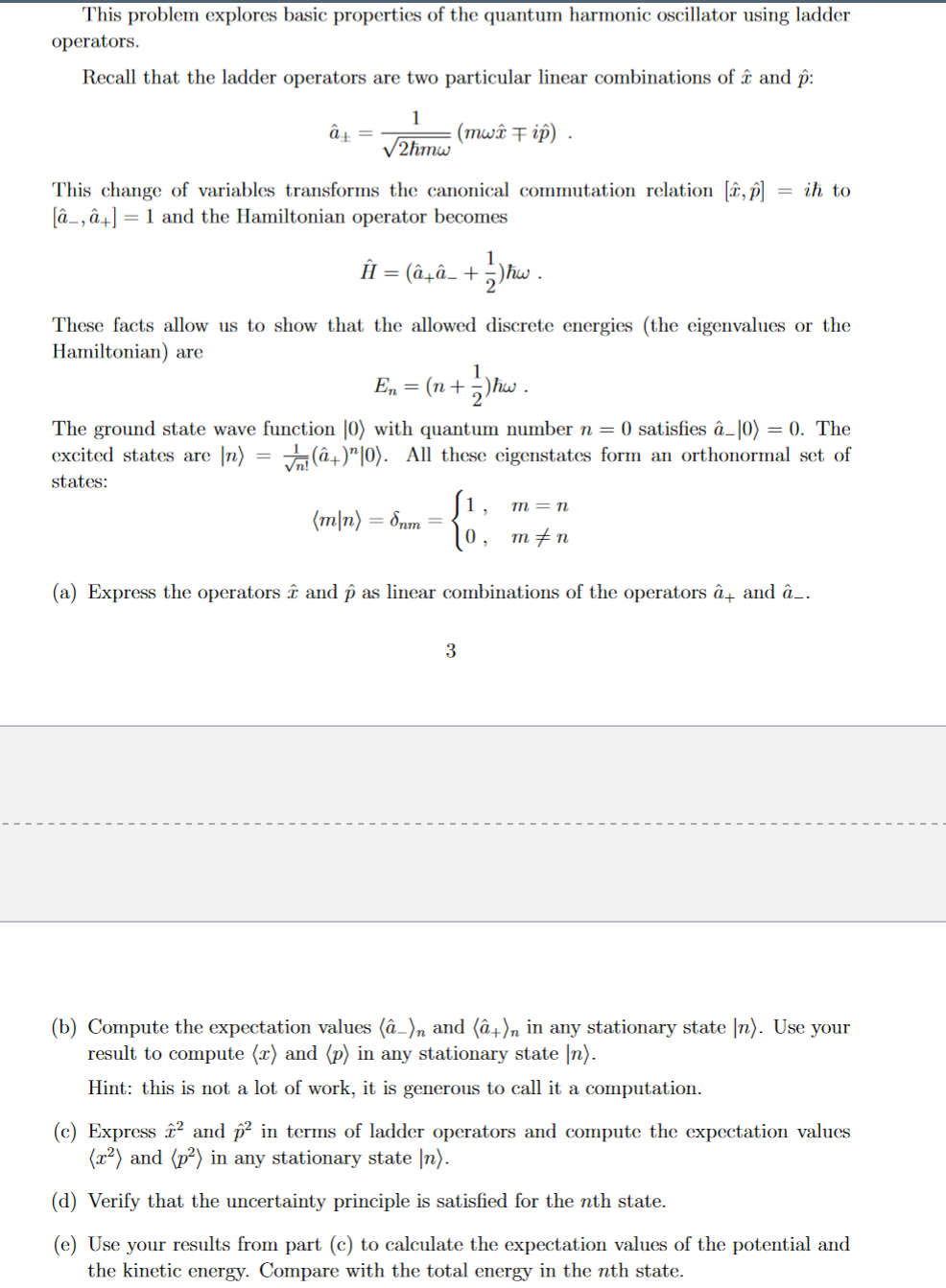
This problem explores basic properties of the quantum harmonic oscillator using ladder operators. Recall that the ladder operators are two particular linear combinations of r and p: at = (mwi Fip) . V2hmw This change of variables transforms the canonical commutation relation [x, p] = ih to [a_, a+] = 1 and the Hamiltonian operator becomes H = (a+ a_+ 5 )hw. These facts allow us to show that the allowed discrete energies (the eigenvalues or the Hamiltonian) are En = (n+ - )hw . The ground state wave function |0) with quantum number n = 0 satisfies a_|0) = 0. The excited states are [n) = (a+)"|0). All these eigenstates form an orthonormal set of states: (m) = onm = m = n m # n (a) Express the operators i and p as linear combinations of the operators a+ and a_. 3 (b) Compute the expectation values (a_)n and (a+)n in any stationary state [n). Use your result to compute (x) and (p) in any stationary state In). Hint: this is not a lot of work, it is generous to call it a computation. (c) Express a2 and p2 in terms of ladder operators and compute the expectation values (x2) and (p2) in any stationary state In). (d) Verify that the uncertainty principle is satisfied for the nth state. (e) Use your results from part (c) to calculate the expectation values of the potential and the kinetic energy. Compare with the total energy in the nth state
Step by Step Solution
There are 3 Steps involved in it

Get step-by-step solutions from verified subject matter experts
 Study Help