







Question: This problem shows how different propagation models can lead to very different SNRs ( and therefore different link performance ) for a given system design.
This problem shows how different propagation models can lead to very different SNRs and therefore different link performance for a given system design. Consider a linear cellular system using frequency division, as might operate along a highway or rural road. Each cell is allocated a certain band of frequencies, and these frequencies are reused in cells spaced a distance d away. Assume the system has square cells, km per side, and that all mobiles transmit at the same power P
For the following propagation models, determine the minimum distance that the cells operating in the same frequency band must be spaced so that uplink SNR the ratio of the minimum received signal-to-interference power from mobiles to base station is greater than dB
You can ignore all interferers except thosefrom the two nearest cells operating at the same frequency.
a Propagation from both signal and interference follow a freespace model.
b Propagation for both signal and interference follow the simplified pathloss model with dm K and n
c Propagation for the signal follows the simplified pathloss model with d m K andn while propagation of the interference follows the same model but with n Base StationCell Center
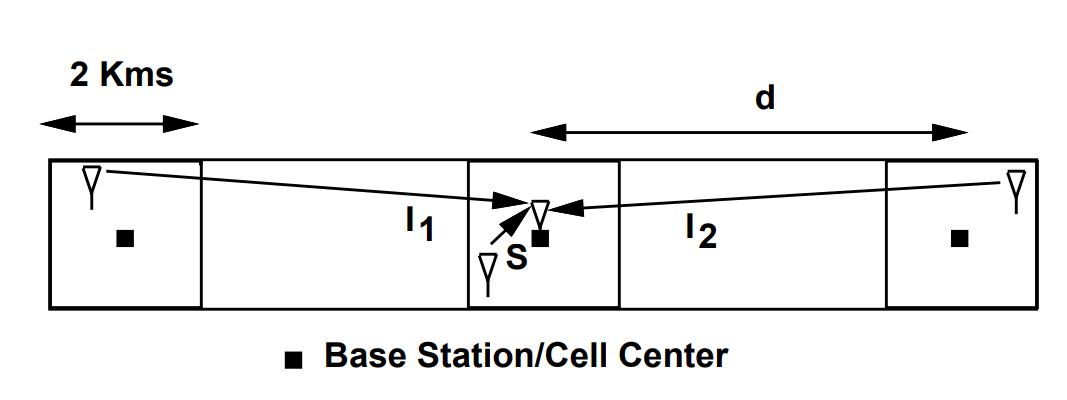
2 Kms |1 12 Base Station/Cell Center d
Step by Step Solution
There are 3 Steps involved in it
1 Expert Approved Answer
Step: 1 Unlock

Question Has Been Solved by an Expert!
Get step-by-step solutions from verified subject matter experts
Step: 2 Unlock
Step: 3 Unlock
 Study Help