This question is from the Consultancy management course-Please summarise the case study.
Book name-Management consultancy - Joe O mohaney
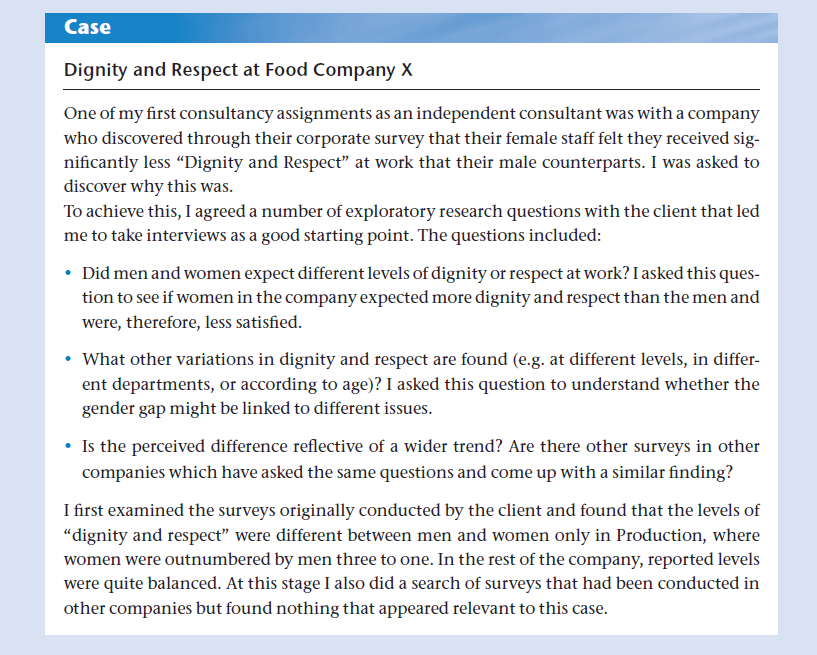
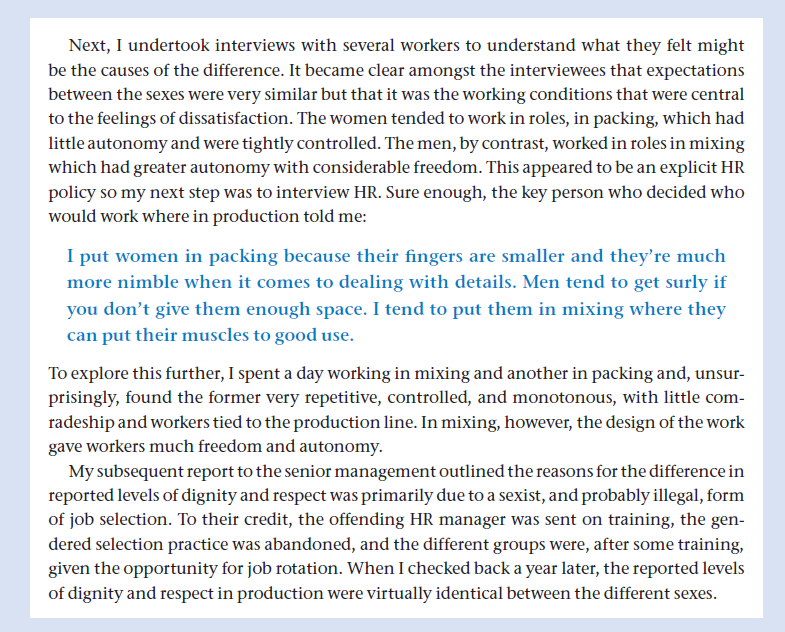
Case Dignity and Respect at Food Company X One of my first consultancy assignments as an independent consultant was with a company who discovered through their corporate survey that their female staff felt they received sig- nificantly less Dignity and Respect at work that their male counterparts. I was asked to discover why this was. To achieve this, I agreed a number of exploratory research questions with the client that led me to take interviews as a good starting point. The questions included: Did men and women expect different levels of dignity or respect at work? I asked this ques- tion to see if women in the company expected more dignity and respect than the men and were, therefore, less satisfied. What other variations in dignity and respect are found (e.g. at different levels, in differ- ent departments, or according to age)? I asked this question to understand whether the gender gap might be linked to different issues. Is the perceived difference reflective of a wider trend? Are there other surveys in other companies which have asked the same questions and come up with a similar finding? I first examined the surveys originally conducted by the client and found that the levels of "dignity and respect were different between men and women only in Production, where women were outnumbered by men three to one. In the rest of the company, reported levels were quite balanced. At this stage I also did a search of surveys that had been conducted in other companies but found nothing that appeared relevant to this case. Next, I undertook interviews with several workers to understand what they felt might be the causes of the difference. It became clear amongst the interviewees that expectations between the sexes were very similar but that it was the working conditions that were central to the feelings of dissatisfaction. The women tended to work in roles, in packing, which had little autonomy and were tightly controlled. The men, by contrast, worked in roles in mixing which had greater autonomy with considerable freedom. This appeared to be an explicit HR policy so my next step was to interview HR. Sure enough, the key person who decided who would work where in production told me: I put women in packing because their fingers are smaller and they're much more nimble when it comes to dealing with details. Men tend to get surly if you don't give them enough space. I tend to put them in mixing where they can put their muscles to good use. To explore this further, I spent a day working in mixing and another in packing and, unsur- prisingly, found the former very repetitive, controlled, and monotonous, with little com- radeship and workers tied to the production line. In mixing, however, the design of the work gave workers much freedom and autonomy. My subsequent report to the senior management outlined the reasons for the difference in reported levels of dignity and respect was primarily due to a sexist, and probably illegal, form of job selection. To their credit, the offending HR manager was sent on training, the gen- dered selection practice was abandoned, and the different groups were, after some training, given the opportunity for job rotation. When I checked back a year later, the reported levels of dignity and respect in production were virtually identical between the different sexes




