







Question: Three problems, 100 points total. You must show schematics, and steps of your calculations (sufficient for graders to understand your logic) to get full
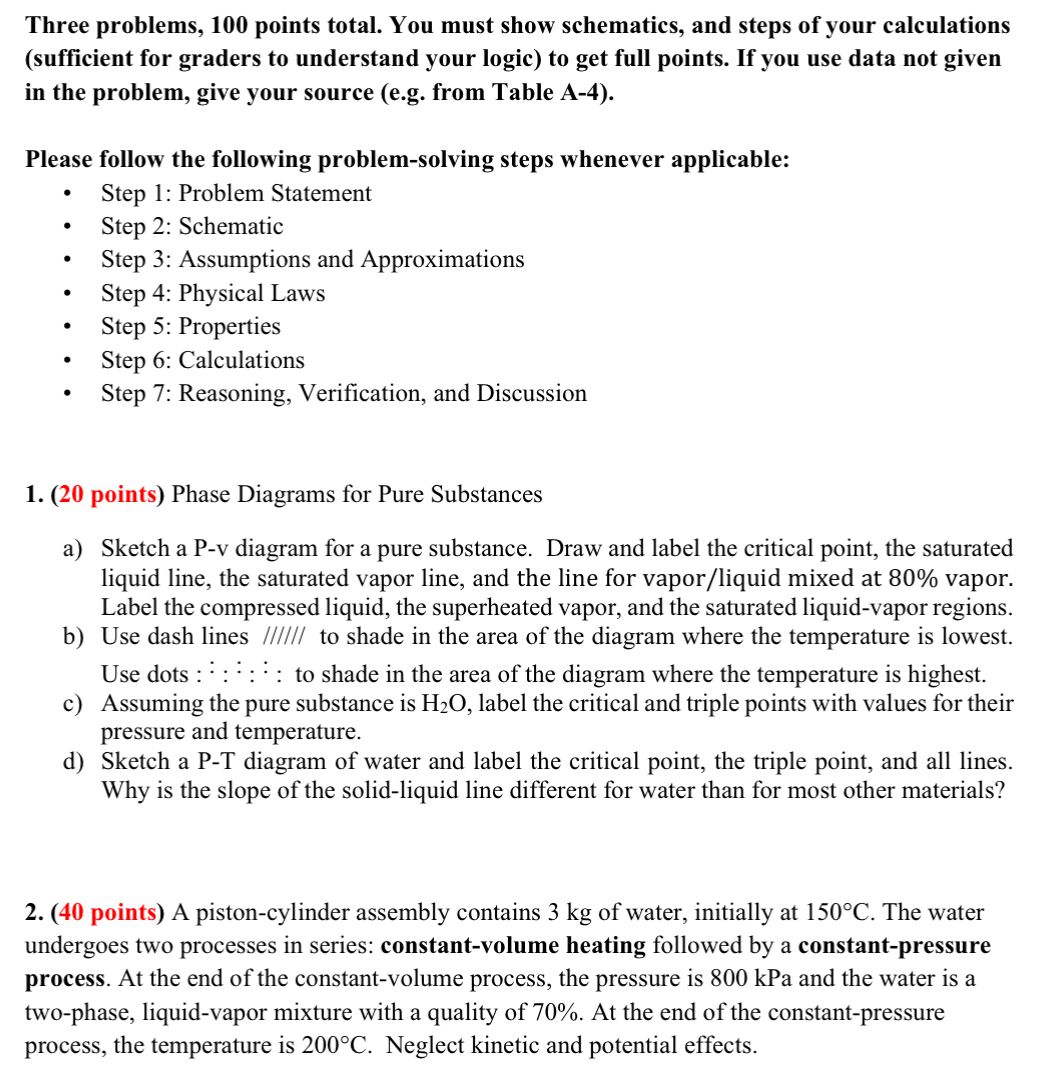
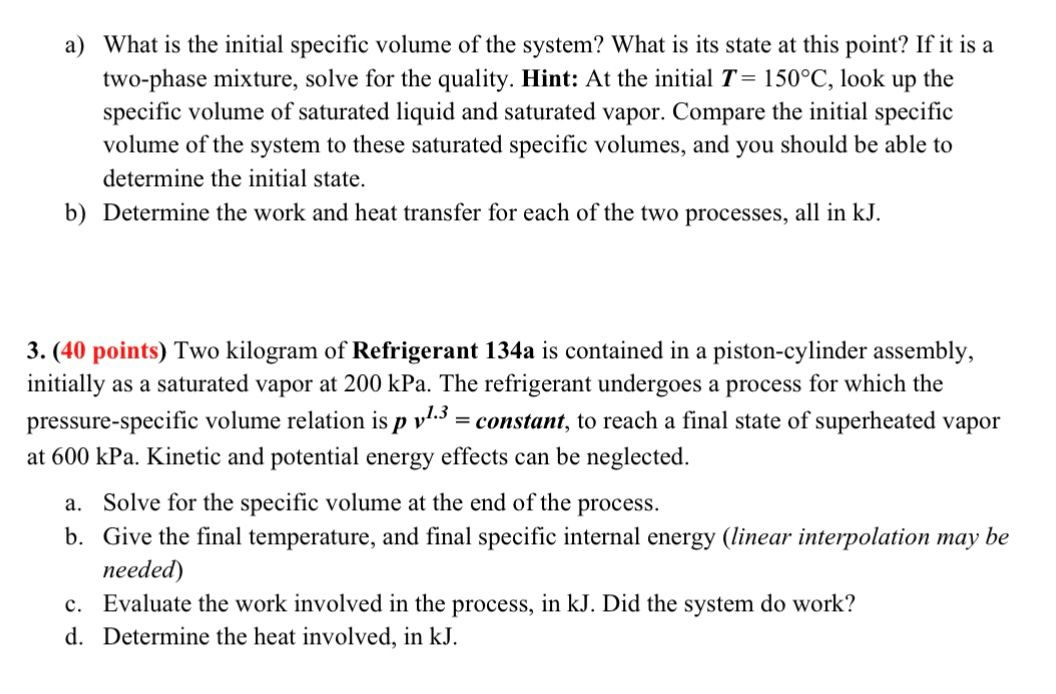
Three problems, 100 points total. You must show schematics, and steps of your calculations (sufficient for graders to understand your logic) to get full points. If you use data not given in the problem, give your source (e.g. from Table A-4). Please follow the following problem-solving steps whenever applicable: Step 1: Problem Statement Step 2: Schematic Step 3: Assumptions and Approximations Step 4: Physical Laws Step 5: Properties Step 6: Calculations . Step 7: Reasoning, Verification, and Discussion 1. (20 points) Phase Diagrams for Pure Substances a) Sketch a P-v diagram for a pure substance. Draw and label the critical point, the saturated liquid line, the saturated vapor line, and the line for vapor/liquid mixed at 80% vapor. Label the compressed liquid, the superheated vapor, and the saturated liquid-vapor regions. b) Use dash lines ////// to shade in the area of the diagram where the temperature is lowest. Use dots : to shade in the area of the diagram where the temperature is highest. c) Assuming the pure substance is HO, label the critical and triple points with values for their pressure and temperature. d) Sketch a P-T diagram of water and label the critical point, the triple point, and all lines. Why is the slope of the solid-liquid line different for water than for most other materials? 2. (40 points) A piston-cylinder assembly contains 3 kg of water, initially at 150C. The water undergoes two processes in series: constant-volume heating followed by a constant-pressure process. At the end of the constant-volume process, the pressure is 800 kPa and the water is a two-phase, liquid-vapor mixture with a quality of 70%. At the end of the constant-pressure process, the temperature is 200C. Neglect kinetic and potential effects. a) What is the initial specific volume of the system? What is its state at this point? If it is a two-phase mixture, solve for the quality. Hint: At the initial T = 150C, look up the specific volume of saturated liquid and saturated vapor. Compare the initial specific volume of the system to these saturated specific volumes, and you should be able to determine the initial state. b) Determine the work and heat transfer for each of the two processes, all in kJ. 3. (40 points) Two kilogram of Refrigerant 134a is contained in a piston-cylinder assembly, initially as a saturated vapor at 200 kPa. The refrigerant undergoes a process for which the pressure-specific volume relation is p v1.3 = constant, to reach a final state of superheated vapor at 600 kPa. Kinetic and potential energy effects can be neglected. a. Solve for the specific volume at the end of the process. b. Give the final temperature, and final specific internal energy (linear interpolation may be needed) c. Evaluate the work involved in the process, in kJ. Did the system do work? d. Determine the heat involved, in kJ.
Step by Step Solution
There are 3 Steps involved in it
Solutions Step 1 Given that Mass of water m3kg Initial temperature T1150C Pressure at the end of constantvolume process P2800kPa Quality at the end of constantvolume process x20770 Final temperature T... View full answer

Get step-by-step solutions from verified subject matter experts
 Study Help