Question: Thumbs Up Will Be Given For Answer. Chapter 6 Case Question (Taiwan) A map in the case shows that over 60% of Taiwan's export goes
Thumbs Up Will Be Given For Answer.
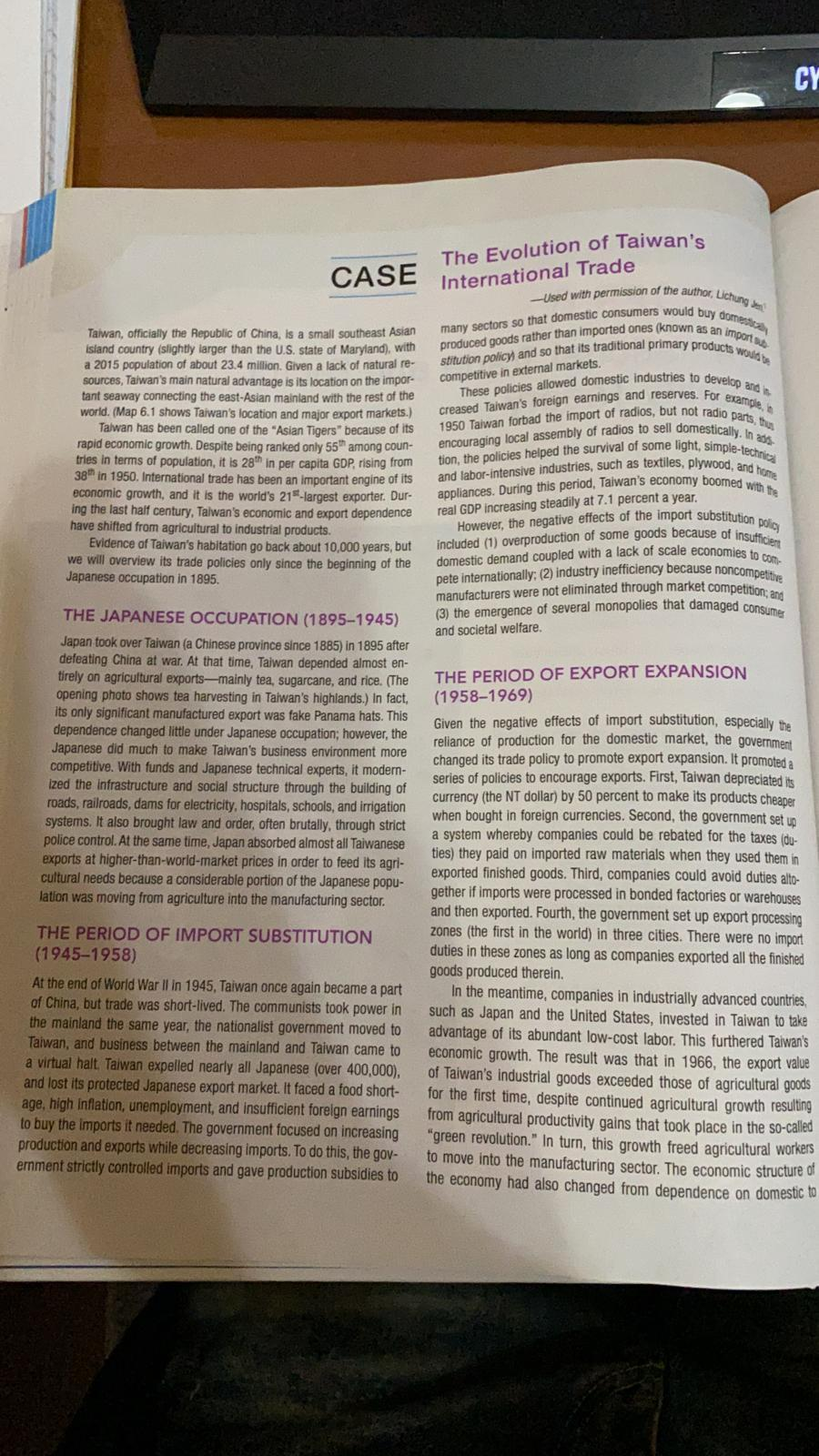
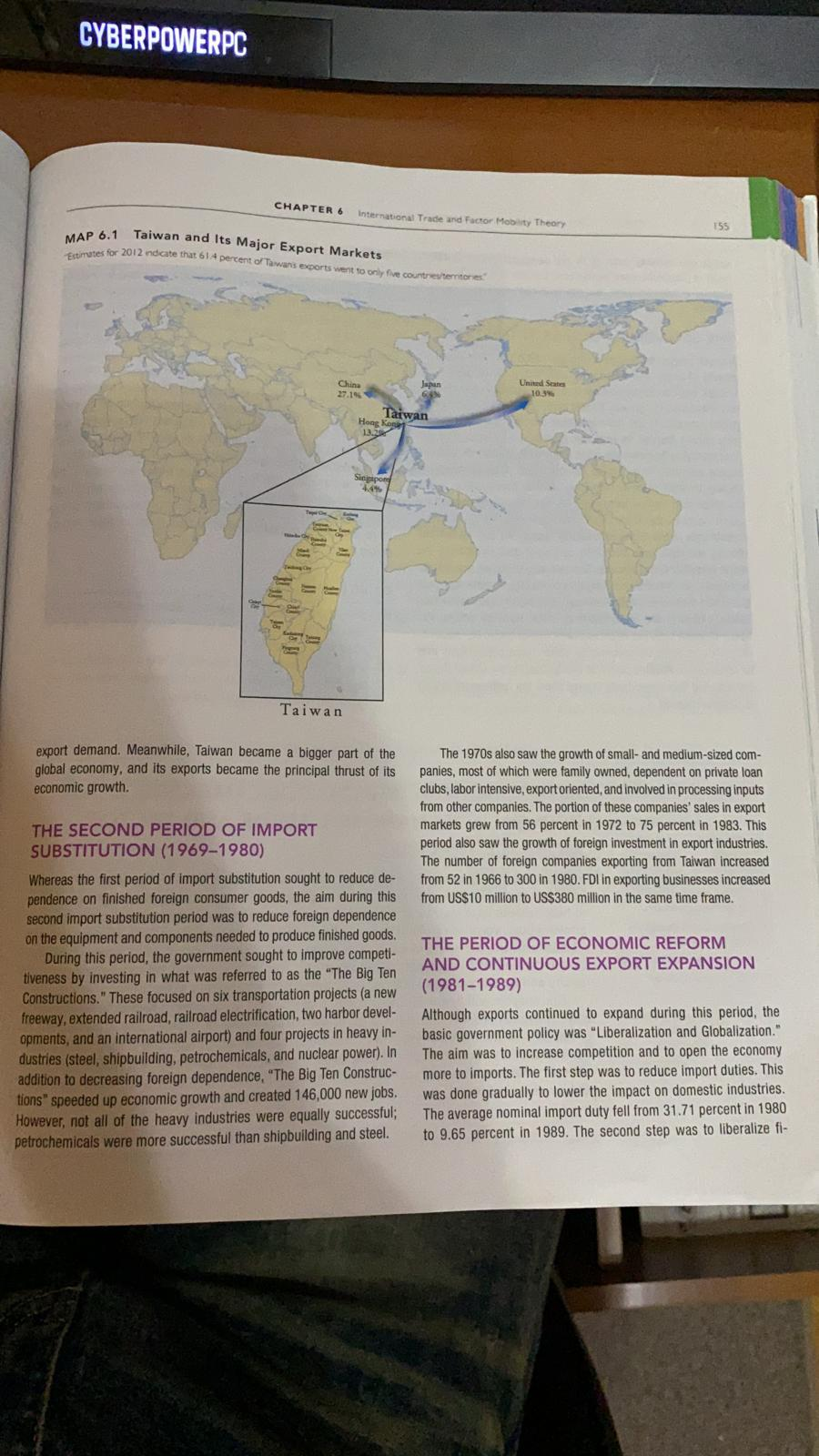
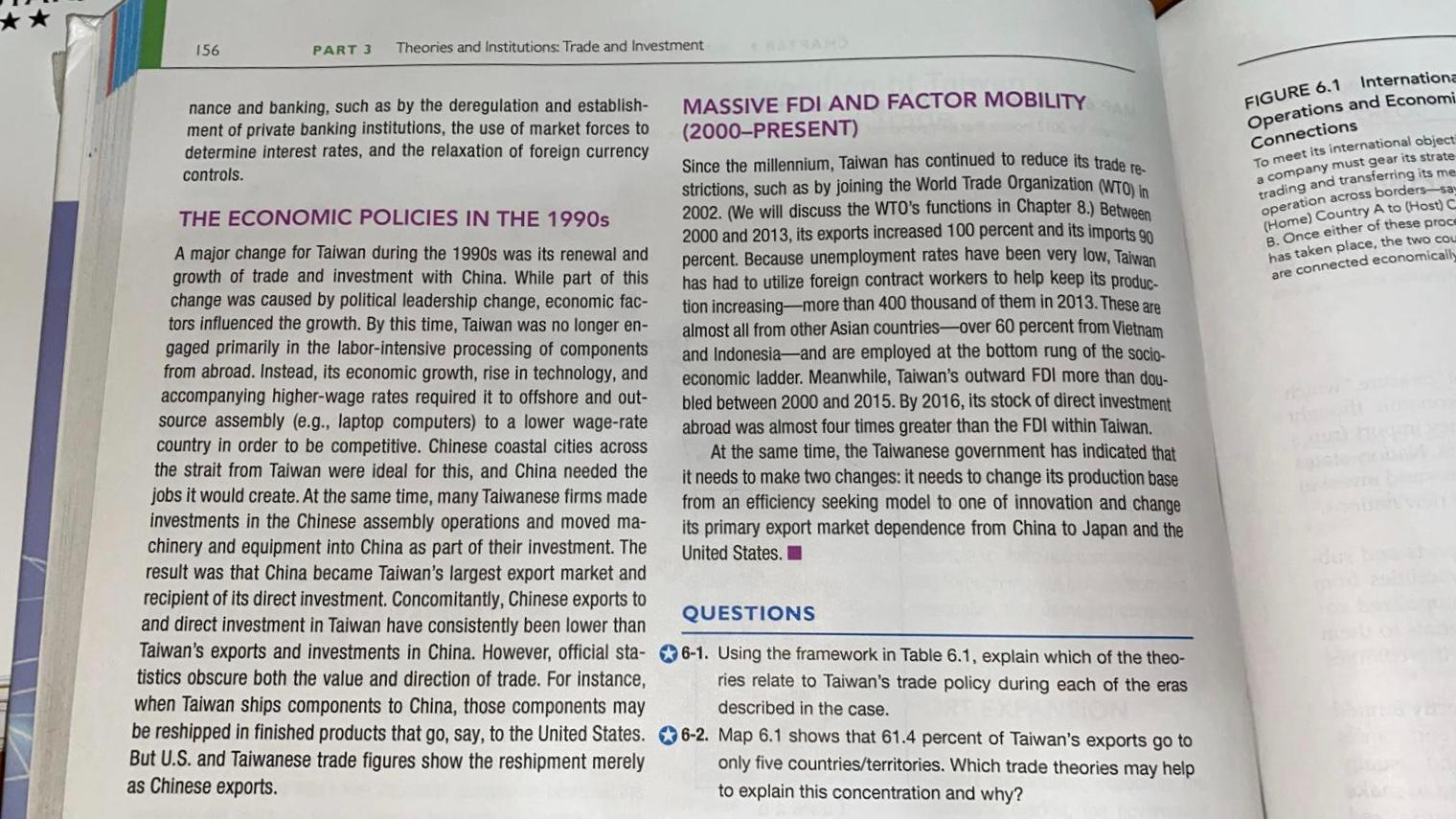
Chapter 6 Case Question (Taiwan) A map in the case shows that over 60% of Taiwan's export goes to five countries, why is this and which trade theory may help explain the concentration? CASE hor, Lichungen ad buy dom as an import ry products would S. State of Maryland), with Taiwan, officially the Republic of China, is a small southeast Asian island country (slightly larger than the U.S. state of Maryland), with a 2015 population of about 23.4 million. Given a lack of natural re- sources, Taiwan's main natural advantage is its location on the impor- tant seaway connecting the east-Asian mainland with the rest of the world. (Map 6.1 Shows Taiwan's location and major export markets.) Talwan has been called one of the "Asian Tigers" because of its rapid economic growth. Despite being ranked only 55 among coun- tries in terms of population, it is 28th in per capita GDP, rising from 38 in 1950. International trade has been an important engine of its economic growth, and it is the world's 21-largest exporter. Dur- ing the last half century, Talwan's economic and export dependence have shifted from agricultural to industrial products. Evidence of Taiwan's habitation go back about 10,000 years, but yu back about 10,000 years, but we will overview its trade policies only since the beginning of the Japanese occupation in 1895. the "Asian Tigers" because of its The Evolution of Taiwan's International Trade -Used with permission of the author, Lich many sectors so that domestic consumers would be produced goods rather than imported ones (known as a stitution policy and so that its traditional primary or competitive in external markets. These policies allowed domestic industries to de creased Taiwan's foreign earnings and reserves. For 1950 Taiwan forbad the import of radios, but not radio encouraging local assembly of radios to sell domestical tion, the policies helped the survival of some light, sim and labor-intensive industries, such as textiles, plywood appliances. During this period, Taiwan's economy boomer real GDP increasing steadily at 7.1 percent a year. However, the negative effects of the import substitution included (1) overproduction of some goods because of in domestic demand coupled with a lack of scale economies pete internationally: (2) Industry inefficiency because noncom manufacturers were not eliminated through market competitie (3) the emergence of several monopolies that damaged and societal welfare. to develop and For example, radio parts, thus estically. In 206 ht, simple-technic wwood, and home y boomed with the per capita GOP, rising from ostitution policy ause of insufficient nomies to com use noncompetitive at competitions, and damaged consume THE JAPANESE OCCUPATION (1895-1945) Japan took over Taiwan a Chinese province since 1885) in 1895 after defeating China at war. At that time, Taiwan depended almost en- tirely on agricultural exports-mainly tea, sugarcane, and rice. (The opening photo shows tea harvesting in Taiwan's highlands.) In fact, its only significant manufactured export was fake Panama hats. This dependence changed little under Japanese occupation; however, the Japanese did much to make Taiwan's business environment more competitive. With funds and Japanese technical experts, it modern- ized the infrastructure and social structure through the building of roads, railroads, dams for electricity, hospitals, schools, and irrigation systems. It also brought law and order, often brutally, through strict police control. At the same time, Japan absorbed almost all Taiwanese exports at higher-than-world-market prices in order to feed its agri- cultural needs because a considerable portion of the Japanese popu- lation was moving from agriculture into the manufacturing sector. THE PERIOD OF IMPORT SUBSTITUTION (1945-1958) THE PERIOD OF EXPORT EXPANSION (1958-1969) Given the negative effects of import substitution, especially the reliance of production for the domestic market, the government changed its trade policy to promote export expansion. It promoted a series of policies to encourage exports. First, Taiwan depreciated the Currency (the NT dollar) by 50 percent to make its products cheaper when bought in foreign currencies. Second, the government set un a system whereby companies could be rebated for the taxes (du- ties) they paid on imported raw materials when they used them in exported finished goods. Third, companies could avoid duties alto- gether if imports were processed in bonded factories or warehouses and then exported. Fourth, the government set up export processing zones (the first in the world) in three cities. There were no import duties in these zones as long as companies exported all the finished goods produced therein. in the meantime, companies in industrially advanced countries such as Japan and the United States, invested in Taiwan to take advantage of its abundant low-cost labor. This furthered Taiwan's economic growth. The result was that in 1966. the export value of Taiwan's industrial goods exceeded those of agricultural goods for the first time, despite continued agricultural growth resulting from agricultural productivity gains that took place in the so-called "green revolution." In turn, this growth freed agricultural workers to move into the manufacturing sector. The economic structure of the economy had also changed from dependence on domestic to At the end of World War II in 1945, Taiwan once again became a part of China, but trade was short-lived. The communists took power in the mainland the same year, the nationalist government moved to Taiwan, and business between the mainland and Taiwan came to a virtual halt. Talwan expelled nearly all Japanese (over 400,000), and lost its protected Japanese export market. It faced a food short- age, high Inflation, unemployment, and insufficient foreign earnings to buy the Imports it needed. The government focused on increasing production and exports while decreasing imports. To do this, the gov- ernment strictly controlled imports and gave production subsidies to CYBERPOWERPC CHAPTER 6 International Trade and Factor Mobity Theory MAP 6.1 Taiu Estimates for 2012 6.1 Taiwan and Its Major Export Markets es for 2012 ndicate that percent of Tawans exports went to only five courtes territories United Seat 10 Taiwan Hong Kong Siapore Taiwan export demand. Meanwhile, Taiwan became a bigger part of the global economy, and its exports became the principal thrust of its economic growth. The 1970s also saw the growth of small- and medium-sized com- panies, most of which were family owned, dependent on private loan clubs, labor intensive, export oriented, and involved in processing inputs from other companies. The portion of these companies' sales in export markets grew from 56 percent in 1972 to 75 percent in 1983. This period also saw the growth of foreign investment in export industries. The number of foreign companies exporting from Taiwan increased from 52 in 1966 to 300 in 1980. FDI in exporting businesses increased from US$10 million to US$380 million in the same time frame. THE SECOND PERIOD OF IMPORT SUBSTITUTION (1969-1980) Whereas the first period of import substitution sought to reduce de- pendence on finished foreign consumer goods, the aim during this second import substitution period was to reduce foreign dependence on the equipment and components needed to produce finished goods. During this period, the government sought to improve competi- tiveness by investing in what was referred to as the "The Big Ten Constructions." These focused on six transportation projects (a new freeway, extended railroad, railroad electrification, two harbor devel- opments, and an international airport) and four projects in heavy in- dustries (steel, shipbuilding, petrochemicals, and nuclear power). In addition to decreasing foreign dependence, "The Big Ten Construc- tions" speeded up economic growth and created 146,000 new jobs. However, not all of the heavy Industries were equally successful; petrochemicals were more successful than shipbuilding and steel. THE PERIOD OF ECONOMIC REFORM AND CONTINUOUS EXPORT EXPANSION (1981-1989) Although exports continued to expand during this period, the basic government policy was "Liberalization and Globalization." The aim was to increase competition and to open the economy more to imports. The first step was to reduce import duties. This was done gradually to lower the impact on domestic industries. The average nominal import duty fell from 31.71 percent in 1980 to 9.65 percent in 1989. The second step was to liberalize fi- 156 PART 3 Theories and Institutions: Trade and Investment FIGURE 6.1 Internationa erations and Economi nance and banking, such as by the deregulation and establish- ment of private banking institutions, the use of market forces to determine interest rates, and the relaxation of foreign currency controls. Connections To meet its international object a company must gear its strate trading and transferring its me operation across borders-sa (Home) Country A to (Host) B. Once either of these prog has taken place, the two cou are connected economicalb THE ECONOMIC POLICIES IN THE 1990s A major change for Taiwan during the 1990s was its renewal and growth of trade and investment with China. While part of this change was caused by political leadership change, economic fac- tors influenced the growth. By this time, Taiwan was no longer en- gaged primarily in the labor-intensive processing of components from abroad. Instead, its economic growth, rise in technology, and accompanying higher-wage rates required it to offshore and out- source assembly (e.g., laptop computers) to a lower wage-rate y (u.g., laptop computers) to a lower wage-rate country in order to be competitive. Chinese coastal cities across the strait from Taiwan were ideal for this, and China needed the jobs it would create. At the same time, many Taiwanese firms made investments in the Chinese assembly operations and moved ma- chinery and equipment into China as part of their investment. The result was that China became Taiwan's largest export market and recipient of its direct investment. Concomitantly, Chinese exports to and direct investment in Taiwan have consistently been lower than Taiwan's exports and investments in China. However, official sta- tistics obscure both the value and direction of trade. For instance, when Taiwan ships components to China, those components may be reshipped in finished products that go, say, to the United States. But U.S. and Taiwanese trade figures show the reshipment merely as Chinese exports. MASSIVE FDI AND FACTOR MOBILITY (2000-PRESENT) Since the millennium, Taiwan has continued to reduce its trade strictions, such as by joining the World Trade Organization (WTON 2002. (We will discuss the WTO's functions in Chapter 8.) Between 2000 and 2013, its exports increased 100 percent and its imports en percent. Because unemployment rates have been very low, Taiwan has had to utilize foreign contract workers to help keep its produc. tion increasing more than 400 thousand of them in 2013. These are almost all from other Asian countries-over 60 percent from Vietnam and Indonesia-and are employed at the bottom rung of the socio- economic ladder. Meanwhile, Taiwan's outward FDI more than dou- bled between 2000 and 2015. By 2016, its stock of direct investment abroad was almost four times greater than the FDI within Taiwan. At the same time, the Taiwanese government has indicated that! it needs to make two changes: it needs to change its production base from an efficiency seeking model to one of innovation and change its primary export market dependence from China to Japan and the United States QUESTIONS 6-1. Using the framework in Table 6.1, explain which of the theo- ries relate to Taiwan's trade policy during each of the eras described in the case. 6-2. Map 6.1 shows that 61.4 percent of Taiwan's exports go to only five countries/territories. Which trade theories may help to explain this concentration and why









 Study Help