







Question: Thumbs Up Will Be Given For Answer. **ONLY ANSWER QUESTION I ASKED** Chapter 7 Case Question (Prescription Drugs - Canada) Should the U.S. legalize the
Thumbs Up Will Be Given For Answer.

**ONLY ANSWER QUESTION I ASKED**
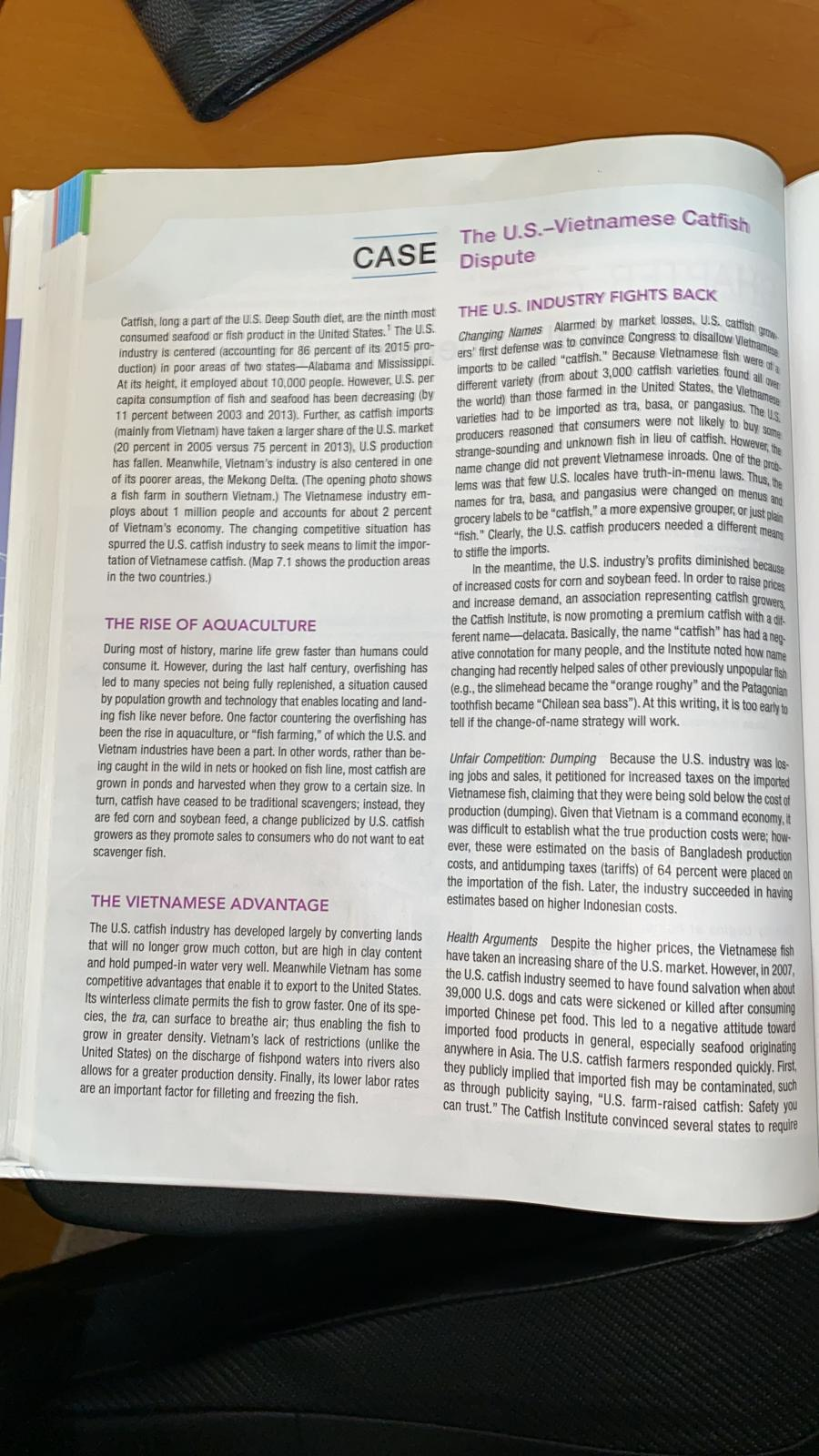
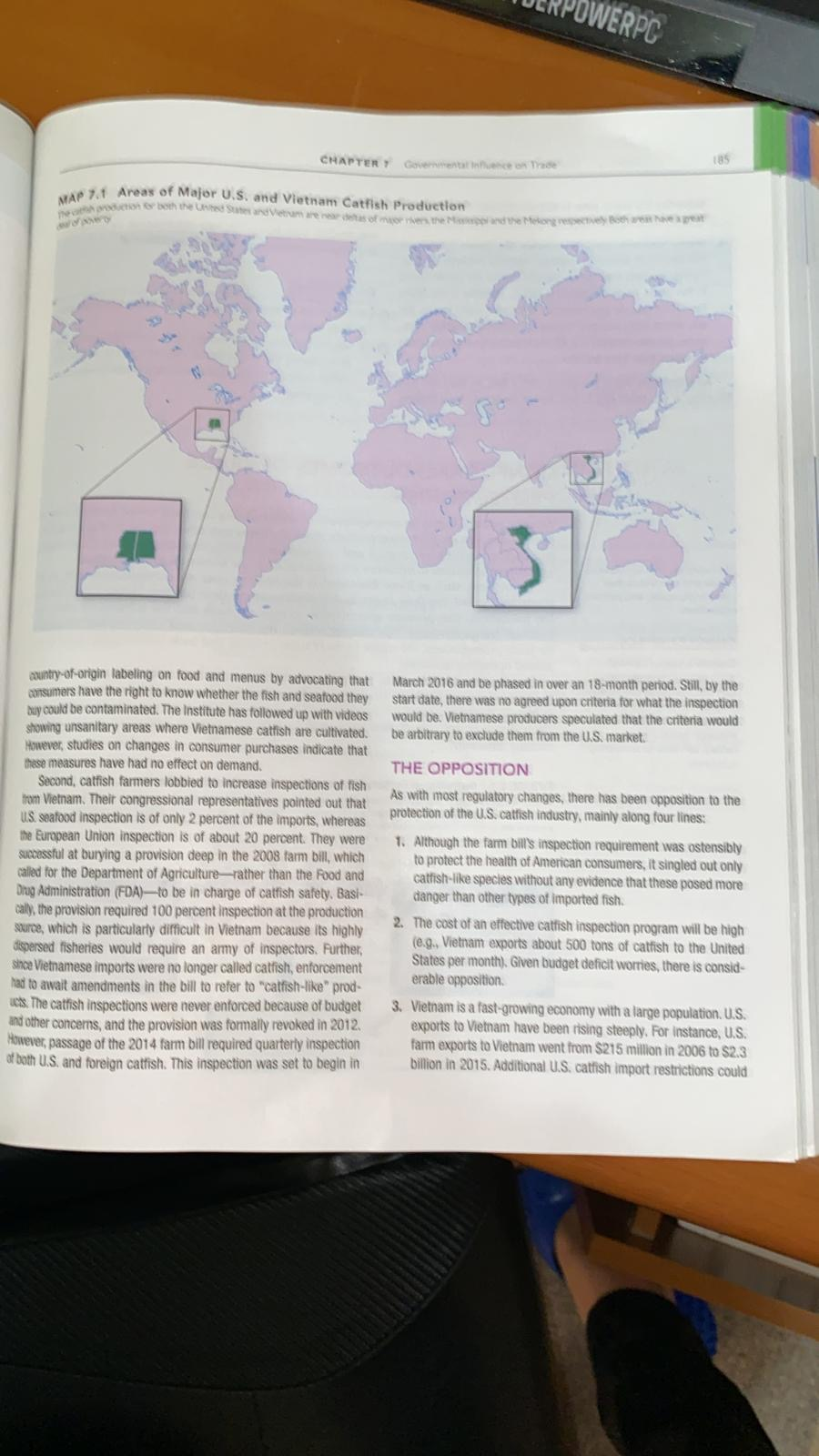
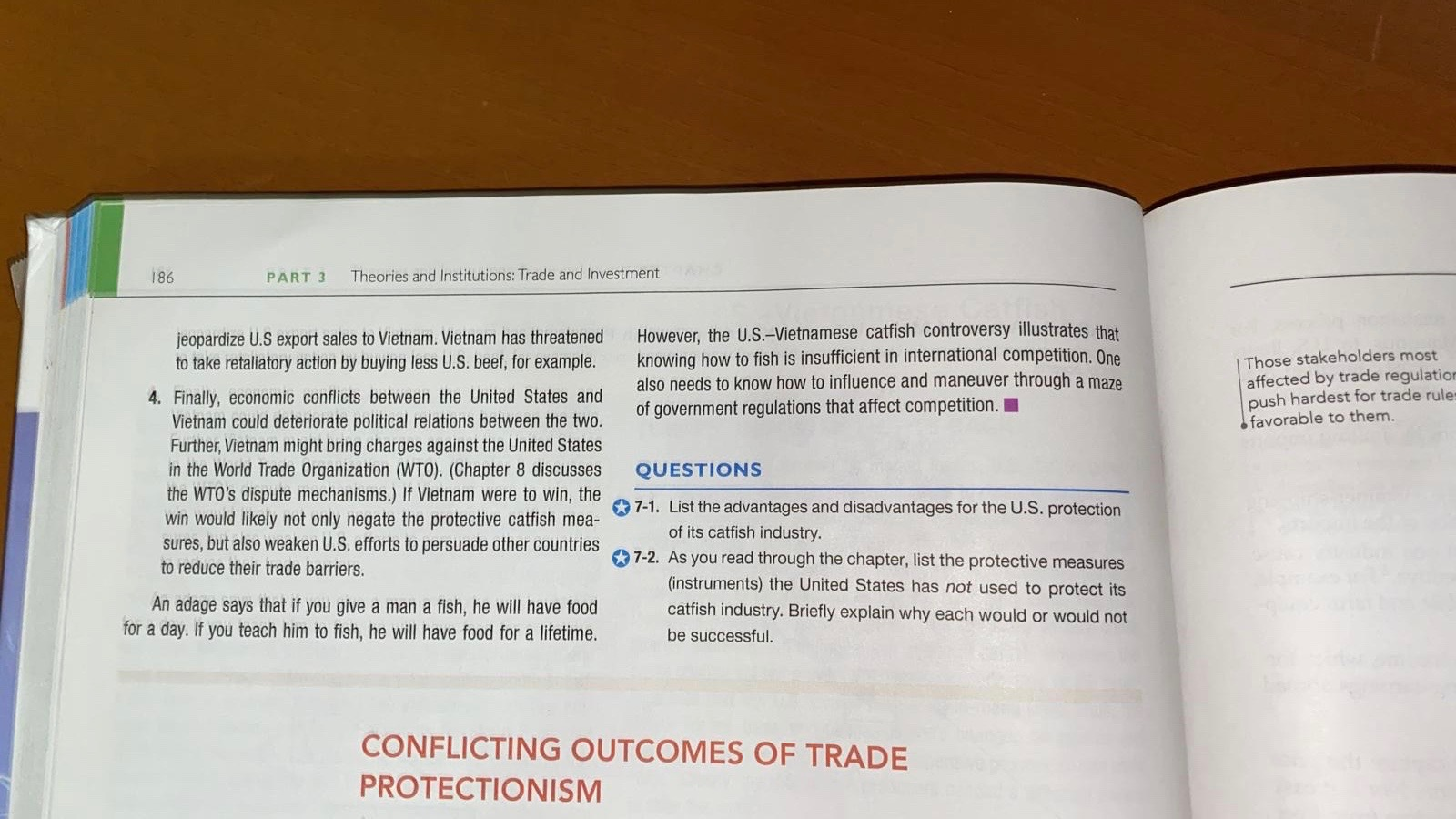
Chapter 7 Case Question (Prescription Drugs - Canada) Should the U.S. legalize the importation of lower cost pharmaceuticals? What could be some of the unintended consequences VI CASE The U.S.-Vietnamese Catfisk Dispute s. catishga disallow. We es ese fish were seties found alle States, the Vietnamese pangasius. The US likely to buy some attish. However, the ds. One of the prin ou laws. Thus, the nged on menus and grouper, or just plain d a different means nished because der to raise prices THE U.S. INDUSTRY FIGHTS BACK THE U.S. INE Catfish, long a part of the US Deep South diet, are the ninth most Names Alarmed by market losses. U.S. consumed seafood or fish product in the United States. The U.S. Changing Names A Industry is centered (accounting for 86 percent of its 2015 pro- ers' first defense was to convince Congress to disallo duction) in poor areas of two states-Alabama and Mississippi. imports to be called "catfish." Because Vietnamese At its height, it employed about 10,000 people. However, U.S. per different variety (from about 3,000 catfish varieties capita consumption of fish and seafood has been decreasing (by the world) than those farmed in the United States. th 11 percent between 2003 and 2013). Further, as catfish imports varieties had to be imported as tra, basa, or pangasi (mainly from Vietnam) have taken a larger share of the U.S. market producers reasoned that consumers were not likely to (20 percent in 2005 versus 75 percent in 2013). U.S production strange-sounding and unknown fish in lieu of catfish has fallen. Meanwhile, Vietnam's industry is also centered in one name change did not prevent Vietnamese inroads. One of its poorer areas, the Mekong Delta. (The opening photo shows lems was that few U.S. locales have truth-in-menu laws a fish farm in southern Vietnam.) The Vietnamese industry em- names for tra, basa, and pangasius were changed on plays about 1 million people and accounts for about 2 percent grocery labels to be "catfish," a more expensive grouper of Vietnam's economy. The changing competitive situation has "fish." Clearly, the U.S. catfish producers needed a differe spurred the U.S. catfish industry to seek means to limit the impor- to stifle the imports. tation of Vietnamese catfish. (Map 7.1 shows the production areas In the meantime, the U.S. Industry's profits diminished her in the two countries.) of increased costs for corn and soybean feed. In order to raisen and increase demand, an association representing catfish gros THE RISE OF AQUACULTURE the Catfish Institute, is now promoting a premium catfish with ferent name-delacata. Basically, the name "catfish" has had a ne During most of history, marine life grew faster than humans could ative connotation for many people, and the Institute noted how name consume it. However, during the last half century, overfishing has changing had recently helped sales of other previously unpopular fish led to many species not being fully replenished, a situation caused (e.g., the slimehead became the "orange roughy" and the Patagonian by population growth and technology that enables locating and land toothfish became "Chilean sea bass"). At this writing, it is too early to ing fish like never before. One factor countering the overfishing has tell if the change-of-name strategy will work. been the rise in aquaculture, or "fish farming," of which the U.S. and Vietnam industries have been a part. In other words, rather than be Unfair Competition: Dumping Because the U.S. Industry was los ing caught in the wild in nets or hooked on fish line, most catfish are grown in ponds and harvested when they grow to a certain size. In ing jobs and sales, it petitioned for increased taxes on the imported turn, catfish have ceased to be traditional scavengers: Instead, they Vietnamese fish, claiming that they were being sold below the cost of are fed corn and soybean feed, a change publicized by U.S. catfish production (dumping). Given that Vietnam is a command economy. It growers as they promote sales to consumers who do not want to eat was difficult to establish what the true production costs were; how- scavenger fish. ever, these were estimated on the basis of Bangladesh production costs, and antidumping taxes (tariffs) of 64 percent were placed on the importation of the fish. Later, the industry succeeded in having THE VIETNAMESE ADVANTAGE estimates based on higher Indonesian costs. The U.S. catfish industry has developed largely by converting lands that will no longer grow much cotton, but are high in clay content Health Arguments Despite the higher prices, the Vietnamese fish and hold pumped-in water very well. Meanwhile Vietnam has some competitive advantages that enable it to export to the United States. Its winterless climate permits the fish to grow faster. One of its spe- cies, the tra, can surface to breathe air, thus enabling the fish to grow in greater density, Vietnam's lack of restrictions (unlike the United States) on the discharge of fishpond waters into rivers also allows for a greater production density. Finally, its lower labor rates are an important factor for filleting and freezing the fish. have taken an increasing share of the U.S. market. However, in 2007 the U.S. catfish industry seemed to have found salvation when about 39,000 U.S. dogs and cats were sickened or killed after consuming imported Chinese pet food. This led to a negative attitude toward Imported food products in general, especially seafood originaung anywhere in Asia. The U.S. catfish farmers responded quickly. First they publicly implied that imported fish may be contaminated, suum as through publicity saying, "U.S. farm-raised catfish: Safety you as through publicity Saving can trust." The Catfish Institute convinced several states to require IDERPOWERPC CHAPTER C h o T MAP . An Areas of Major U.S. and Vietnam Catfish Production both the theme March 2016 and be phased in over an 18-month period. Still, by the start date, there was no agreed upon criteria for what the inspection would be Vietnamese producers speculated that the criteria would be arbitrary to exclude them from the U.S. market THE OPPOSITION As with most regulatory changes, there has been opposition to the protection of the U.S. catfish industry, mainly along four lines: country-of-origin labeling on food and menus by advocating that consumers have the right to know whether the fish and seafood they Duy could be contaminated. The Institute has followed up with videos showing unsanitary areas where Vietnamese catfish are cultivated However, studies on changes in consumer purchases indicate that these measures have had no effect on demand. Second, catfish farmers lobbied to increase inspections of fish trom Vietnam. Their congressional representatives pointed out that US seafood inspection is of only 2 percent of the imports, whereas the European Union inspection is of about 20 percent. They were successful at burying a provision deep in the 2008 farm bill, which called for the Department of Agriculture rather than the Food and Drug Administration (FDA) to be in charge of catfish safely. Basi- cally, the provision required 100 percent inspection at the production source, which is particularly difficult in Vietnam because its highly dispersed fisheries would require an army of inspectors. Further, Shce Vietnamese imports were no longer called catfish, enforcement had to await amendments in the bill to refer to "catfish-like" prod- ucts. The catfish inspections were never enforced because of budget and other concerns, and the provision was formally revoked in 2012. However, passage of the 2014 farm bill required quarterly inspection of both U.S. and foreign catfish. This inspection was set to begin in 1. Although the farm bills inspection requirement was ostensibly to protect the health of American consumers, it singled out only catfish-like species without any evidence that these posed more danger than other types of imported fish. 2. The cost of an effective catfish inspection program will be high (e.g., Vietnam exports about 500 tons of catfish to the United States per month). Given budget deficit worries, there is consid- erable opposition 3. Vietnam is a fast-growing economy with a large population. U.S. exports to Vietnam have been rising steeply. For instance, U.S. farm exports to Vietnam went from $215 million in 2006 to $2.3 billion in 2015. Additional U.S. catfish import restrictions could 186 PART 3 Theories and Institutions: Trade and Investment jeopardize U.S export sales to Vietnam Vietnam has threatened to take retaliatory action by buying less U.S. beef, for example. However, the U.S.- Vietnamese catfish controversy illustrates that knowing how to fish is insufficient in international competition. One also needs to know how to influence and maneuver through a maze of government regulations that affect competition. Those stakeholders most affected by trade regulation push hardest for trade rule I favorable to them. 4. Finally, economic conflicts between the United States and Vietnam could deteriorate political relations between the two. Further, Vietnam might bring charges against the United States in the World Trade Organization (WTO). (Chapter 8 discusses the WTO's dispute mechanisms.) If Vietnam were to win, the win would likely not only negate the protective catfish mea- sures, but also weaken U.S. efforts to persuade other countries to reduce their trade barriers. QUESTIONS 7-1. List the advantages and disadvantages for the U.S. protection of its catfish industry. 7-2. As you read through the chapter, list the protective measures (instruments) the United States has not used to protect its catfish industry. Briefly explain why each would or would not be successful. An adage says that if you give a man a fish, he will have food for a day. If you teach him to fish, he will have food for a lifetime. CONFLICTING OUTCOMES OF TRADE PROTECTIONISM Step by Step Solution
There are 3 Steps involved in it
1 Expert Approved Answer
Step: 1 Unlock

Question Has Been Solved by an Expert!
Get step-by-step solutions from verified subject matter experts
Step: 2 Unlock
Step: 3 Unlock
 Study Help