







Question: Thus far, we have assumed that each value has equal weight, or importance, but that is not always the case. Suppose a stock is expected
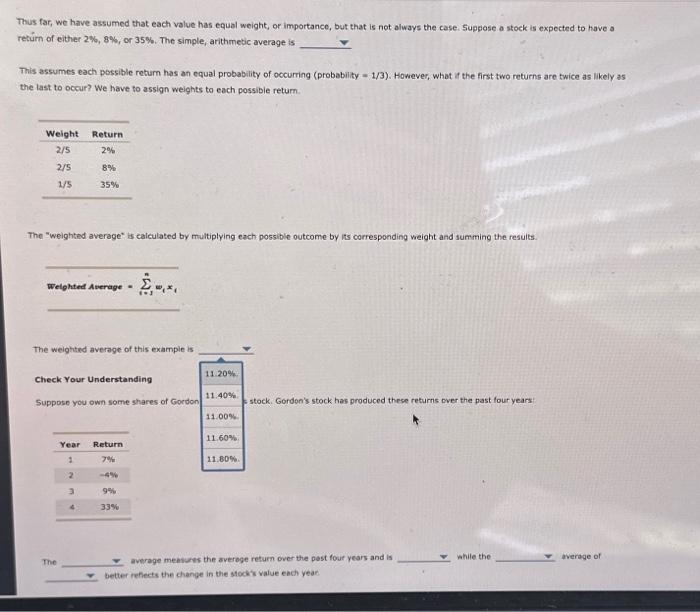
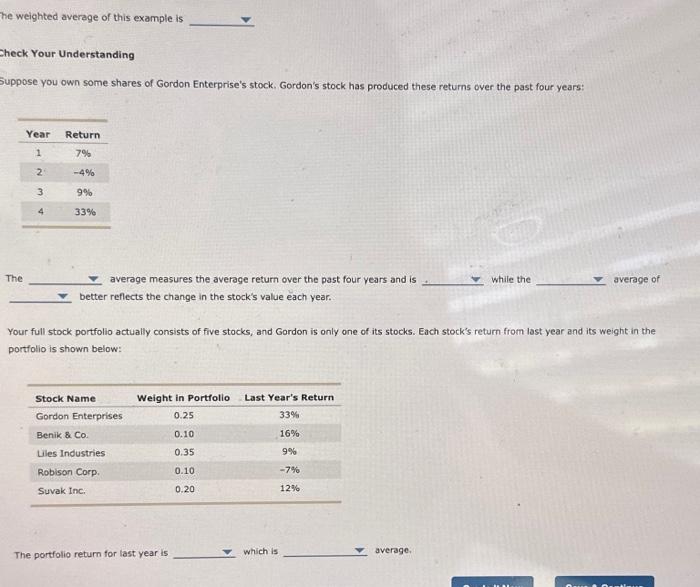
Thus far, we have assumed that each value has equal weight, or importance, but that is not always the case. Suppose a stock is expected to have a return of either \2, or \35. The simple, arithmetic average is This assumes each possible retum has an equal probability of occurring (probability \\( =1 / 3 \\) ). However, what if the first two returns are twice as likely as the last to occur? We have to assign weights to each possible return. The \"weighted average\" is calculated by multiplying each possible outcome by its corresponding weight and summing the results. \\[ \\text { Welghted Average }=\\sum_{i=1}^{n} \\omega_{i} x_{i} \\] The weighted average of this exampie is Check Your Understanding Suppose you own some shares of Gordon \11.20 11.40\\%: stock. Gordon's stock has produced these refurns over the past four years: \11.00 \11.60. \11.60. sible outcome by its corresponding weight and summing the results. The weighted average of this example is Check Your Understanding Suppose you own some shares of Gordon Enterprise's stock. Gordon's stock has produced these returns over the past four years: The average measures the average return over the past four years and is while the average of better reflects the change in the stock's value each year. Your full stock portfolio actually consists of five stocks, and Gordon is only one of its stocks. Each stock's return from last year and its weight in the portfolio is shown below: The portfolio return for last year is which is average. Thus far, we have assumed that each value has equal weight, or importance, but that is not always the case. Suppose a stock is expected to have a return of either \2, or \35. The simple, arithmetic average is This assumes each possible retum has an equal probability of occurring (probability \\( =1 / 3 \\) ). However, what if the first two returns are twice as likely as the last to occur? We have to assign weights to each possible return. The \"weighted average\" is calculated by multiplying each possible outcome by its corresponding weight and summing the results. \\[ \\text { Welghted Average }=\\sum_{i=1}^{n} \\omega_{i} x_{i} \\] The weighted average of this exampie is Check Your Understanding Suppose you own some shares of Gordon \11.20 11.40\\%: stock. Gordon's stock has produced these refurns over the past four years: \11.00 \11.60. \11.60. sible outcome by its corresponding weight and summing the results. The weighted average of this example is Check Your Understanding Suppose you own some shares of Gordon Enterprise's stock. Gordon's stock has produced these returns over the past four years: The average measures the average return over the past four years and is while the average of better reflects the change in the stock's value each year. Your full stock portfolio actually consists of five stocks, and Gordon is only one of its stocks. Each stock's return from last year and its weight in the portfolio is shown below: The portfolio return for last year is which is average
Step by Step Solution
There are 3 Steps involved in it

Get step-by-step solutions from verified subject matter experts
 Study Help