







Question: Trackerservice.js file var events = require(events); var Exercise = require(Exercise); /*trackerService.js Improved Tracker Functionality.In this lab, I've added the ability for the tracker to emit
Trackerservice.js file
var events = require("events");
var Exercise = require("Exercise");
/*trackerService.js
Improved Tracker Functionality.In this lab, I've added the ability for the tracker to emit an event when a new exercise is set. In a fully-featured application we could respond to this event in a variety of ways. For now we are just going to re-
Activities: Walk/Run/Swim
Input: Exercise type
Distance (miles) Weight (lbs) Time (minutes)
Output: Calories Burned
Formula Sources: https://lovandy.com/wellness/physical/calories-burned-by-walking.html AND
https://lovandy.com/wellness/physical/calories-burned-running.html
*/
//requires weight in lbs, Time in minutes, distance in miles //This is yet another way to define the tracker Class.
var tracker = function(exercise, weight, distance, time) {
try{
this.exercise=new Exercise(exercise);
this.weight = Number(weight);
this.distance = Number(distance);
this.time = Number(time);
events.EventEmitter.call(this);
} catch (err){
console.log("Error recieved during service creation");
throw err;
}
//updated to accomodate swimming
this.calculate = function() {
return this.exercise.calculate(this.weight, this.distance, this.time);
};
//speed is consistently calculated for all exercise times (distance/time)
this.calcSpeed = function(){
return this.distance/(this.time/60);//miles per hour
};
this.setExercise = function(exercise){
this.exercise=new Exercise(exercise);
this.emit('exerciseChanged');
};
this.setWeight =function(weight){
this.weight=weight;
this.emit('weightChanged');
};
this.setTime = function(time){
this.time=time;
this.emit('timeChanged', time);
};
this.setDistance = function(distance){
this.distance=distance;
this.emit('distanceChanged', distance);
};
};
tracker.prototype.__proto__=events.EventEmitter.prototype;
module.exports = tracker;
//var test = new tracker("Walking", 200, 4, 45);
//console.log(test.calculate());
Exercise.js File
var walking = function(){
this.calculate = function (weight, distance, time){
return 0.3 * weight * distance;
}
};
//requires weight in lbs, and distance in miles
var running = function(){
this.calculate = function (weight, distance, time){
return 0.63 * weight * distance;
}
};
var swimming = function(){
this.calculate = function (weight, distance, time){
//(6 * Weight in KG * 3.5) / 200; is calories PER MINUTE
kg= weight/2.2;
// console.log("kg " + kg);
// console.log((6 * kg *3.5)/200 * time);
return (((6 * kg *3.5)/200) * time);
}
};
var Exercise = function(type){
if (type.toString().toLowerCase() === "walking"){
this.type = type;
this.calculation = new walking();
} else if (type.toString().toLowerCase() === "running"){
this.type = type;
this.calculation = new running();
} else if (type.toString().toLowerCase() === "swimming"){
this.type=type;
this.calculation = new swimming();
}else {
console.err("Error Exercise Constructor");
throw ({message: "Unknown Exercise. Cannot Create"});
}
}
Exercise.prototype = {
calculate: function(weight, distance, time){
return this.calculation.calculate(weight, distance, time);
}
};
module.exports = Exercise;
Activitytracker.js file
var tracker = require("tracker");
var events = require("events");
var readline = require("readline");
const reader = readline.createInterface({
input: process.stdin,//use std in as this reader's input/readable stream
output: process.stdout // std out as the reader's output/writable stream
});
var response = function(){
reader.question('What actvity did you perform? (Walking/Running/Swimming)', act => {
reader.question('For how long? (in minutes)', time =>{
reader.question('How far? (in miles)', distance => {
reader.question('What is your weight today? (in pounds)', weight =>
{
//Notice that current scope is still able to //capture data provided in previous callbacks.
console.log(act);
var current = new tracker(act.trim(),weight, distance, time);
console.log(`Calories Burned: ${current.calculate()}`);
//"every time you catch the exerciseChanged event, run this function
current.on('exerciseChanged', () => {
console.log("Exercise Changed!");
console.log(`Calories Burned: ${current.calculate()}`);
});
reader.question('Do you want to (s)tart over, (c)hange your current entry, or exit?', answer=>{
var letter = answer.toLowerCase()[0];
switch (letter){
case "s":
response();
//recall this function and start over again //Note that I call the function inside the function, //similar to recursion
break;
case "c":
//change the current activity //Your job: add some code that will allow a user to change any member of the //tracker. Add some cases too. You'll need to add listeners that are listening //for the custom tracker events (provided for you).
reader.question('What is your new activity (Swimming/Walking/Running)', rep=>{
current.setExercise(rep); //setExercise emits the event 'exerciseChanged'
process.exit(0); // see the Exercise module for more info
});
break; //Without break, this falls through and exits BEFORE setExercise completes
default:
console.log("Bye!");
process.exit(0);
}
})
})
})
})
})
}
//current.calculate() //throws error
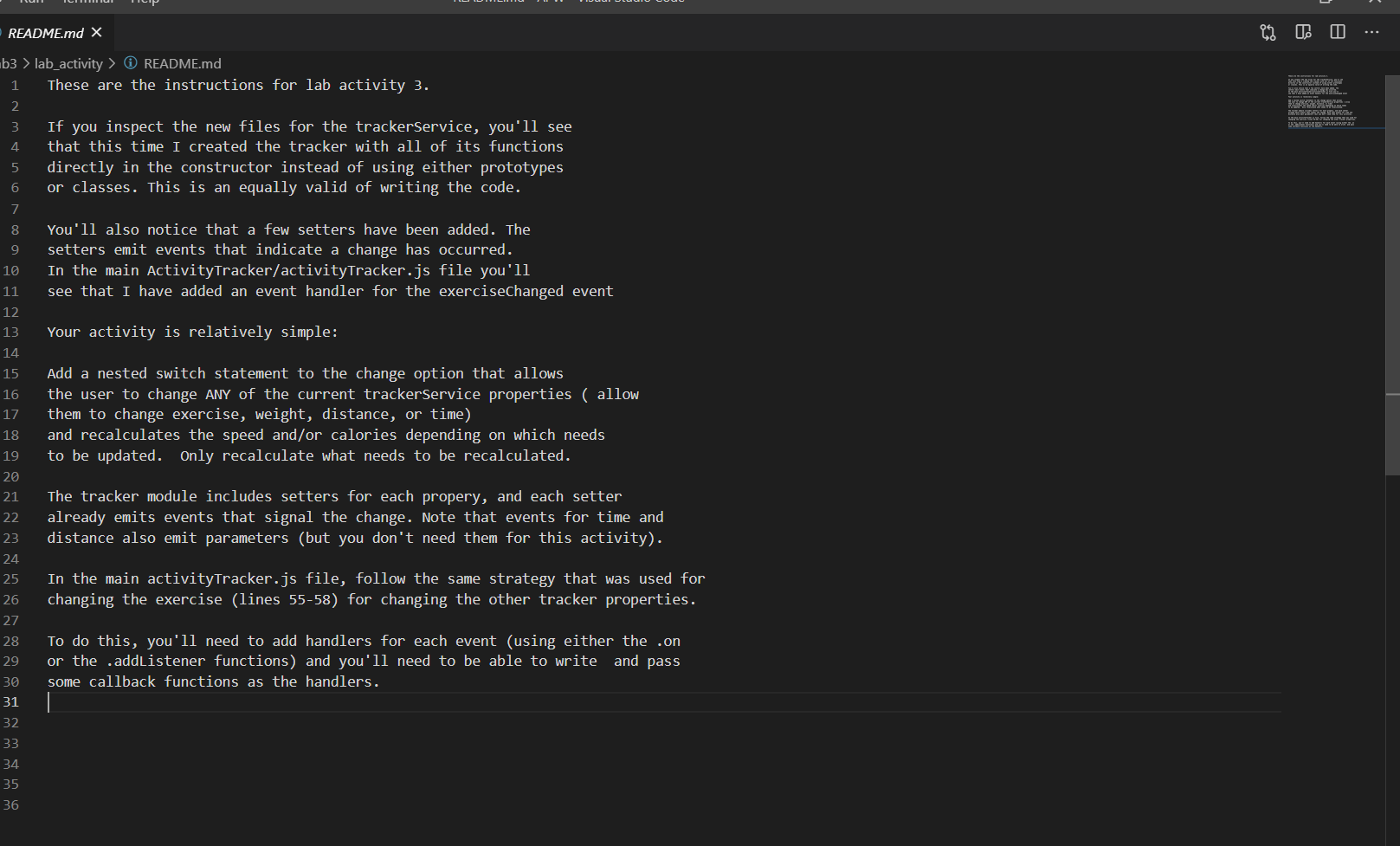
Please follow the instruction of the given image and provide the code.
README.md X es U. I WAWANI EU 6 9 13 b3 > lab_activity > README.md 1 These are the instructions for lab activity 3. 2 3 If you inspect the new files for the trackerservice, you'll see 4. that this time I created the tracker with all of its functions 5 directly in the constructor instead of using either prototypes or classes. This is an equally valid of writing the code. 7 8 You'll also notice that a few setters have been added. The setters emit events that indicate a change has occurred. 10 In the main ActivityTracker/activityTracker.js file you'll 11 see that I have added an event handler for the exerciseChanged event 12 Your activity is relatively simple: 14 15 Add a nested switch statement to the change option that allows 16 the user to change ANY of the current trackerservice properties ( allow 17 them to change exercise, weight, distance, or time) 18 and recalculates the speed and/or calories depending on which needs 19 to be updated. Only recalculate what needs to be recalculated. 20 21 The tracker module includes setters for each propery, and each setter 22 already emits events that signal the change. Note that events for time and 23 distance also emit parameters (but you don't need them for this activity). 24. 25 In the main activityTracker.js file, follow the same strategy that was used for 26 changing the exercise (lines 55-58) for changing the other tracker properties. 27 28 To do this, you'll need to add handlers for each event (using either the .on 29 or the .addlistener functions) and you'll need to be able to write and pass 30 some callback functions as the handlers. 31 32 33 34 35 36 README.md X es U. I WAWANI EU 6 9 13 b3 > lab_activity > README.md 1 These are the instructions for lab activity 3. 2 3 If you inspect the new files for the trackerservice, you'll see 4. that this time I created the tracker with all of its functions 5 directly in the constructor instead of using either prototypes or classes. This is an equally valid of writing the code. 7 8 You'll also notice that a few setters have been added. The setters emit events that indicate a change has occurred. 10 In the main ActivityTracker/activityTracker.js file you'll 11 see that I have added an event handler for the exerciseChanged event 12 Your activity is relatively simple: 14 15 Add a nested switch statement to the change option that allows 16 the user to change ANY of the current trackerservice properties ( allow 17 them to change exercise, weight, distance, or time) 18 and recalculates the speed and/or calories depending on which needs 19 to be updated. Only recalculate what needs to be recalculated. 20 21 The tracker module includes setters for each propery, and each setter 22 already emits events that signal the change. Note that events for time and 23 distance also emit parameters (but you don't need them for this activity). 24. 25 In the main activityTracker.js file, follow the same strategy that was used for 26 changing the exercise (lines 55-58) for changing the other tracker properties. 27 28 To do this, you'll need to add handlers for each event (using either the .on 29 or the .addlistener functions) and you'll need to be able to write and pass 30 some callback functions as the handlers. 31 32 33 34 35 36
Step by Step Solution
There are 3 Steps involved in it

Get step-by-step solutions from verified subject matter experts
 Study Help