







Question: Transport Phenomena The slip condition on a solid surface is usually described by the Navier law, which assumes that the fluid velocity at the solid
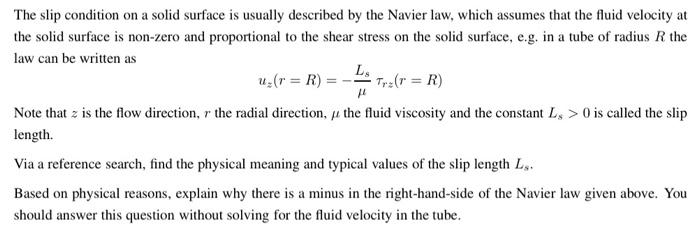
The slip condition on a solid surface is usually described by the Navier law, which assumes that the fluid velocity at the solid surface is non-zero and proportional to the shear stress on the solid surface, e.g. in a tube of radius R the law can be written as L. uz (r=R) Trz (r = R) Note that z is the flow direction, r the radial direction, the fluid viscosity and the constant L. > 0 is called the slip length. Via a reference search, find the physical meaning and typical values of the slip length L.. Based on physical reasons, explain why there is a minus in the right-hand-side of the Navier law given above. You should answer this question without solving for the fluid velocity in the tube
Step by Step Solution
There are 3 Steps involved in it

Get step-by-step solutions from verified subject matter experts
 Study Help