







Question: True False 0 O 1. RETURN = LOSS / ORIGINAL COST O O 2. If Stock X has a higher profit than Stock Y, it
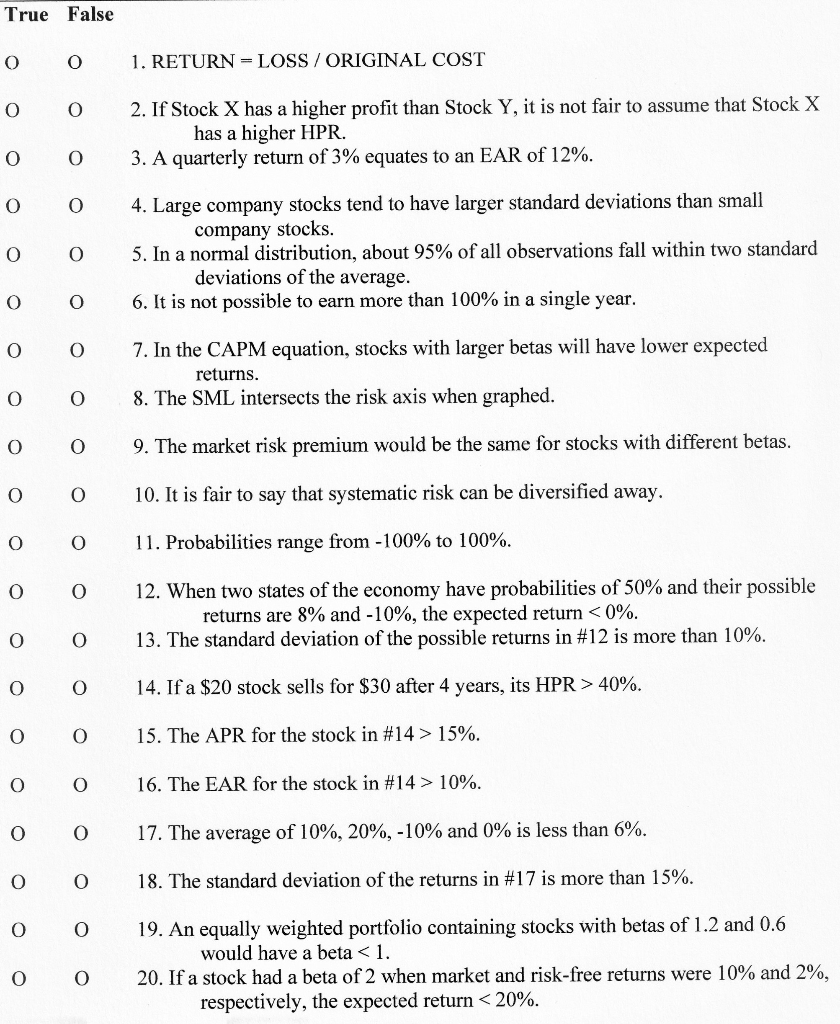
True False 0 O 1. RETURN = LOSS / ORIGINAL COST O O 2. If Stock X has a higher profit than Stock Y, it is not fair to assume that Stock X has a higher HPR. 3. A quarterly return of 3% equates to an EAR of 12%. O 0 0 0 O 0 4. Large company stocks tend to have larger standard deviations than small company stocks. 5. In a normal distribution, about 95% of all observations fall within two standard deviations of the average. 6. It is not possible to earn more than 100% in a single year. 0 O 0 0 7. In the CAPM equation, stocks with larger betas will have lower expected returns. 8. The SML intersects the risk axis when graphed. O O 0 O 9. The market risk premium would be the same for stocks with different betas. O O 10. It is fair to say that systematic risk can be diversified away. 0 O 11. Probabilities range from -100% to 100%. 0 0 12. When two states of the economy have probabilities of 50% and their possible returns are 8% and -10%, the expected return 40%. O 0 15. The APR for the stock in #14 > 15%. O O 16. The EAR for the stock in #14 > 10%. O O 17. The average of 10%, 20%, -10% and 0% is less than 6%. 0 O 18. The standard deviation of the returns in #17 is more than 15%. O o o 19. An equally weighted portfolio containing stocks with betas of 1.2 and 0.6 would have a beta
Step by Step Solution
There are 3 Steps involved in it

Get step-by-step solutions from verified subject matter experts
 Study Help