



Question: True or Flase questions Exam Name TRUE/FALSE. Write 'T if the statement is true and 'F' if the statement is false, 1) Cost allocation data
True or Flase questions
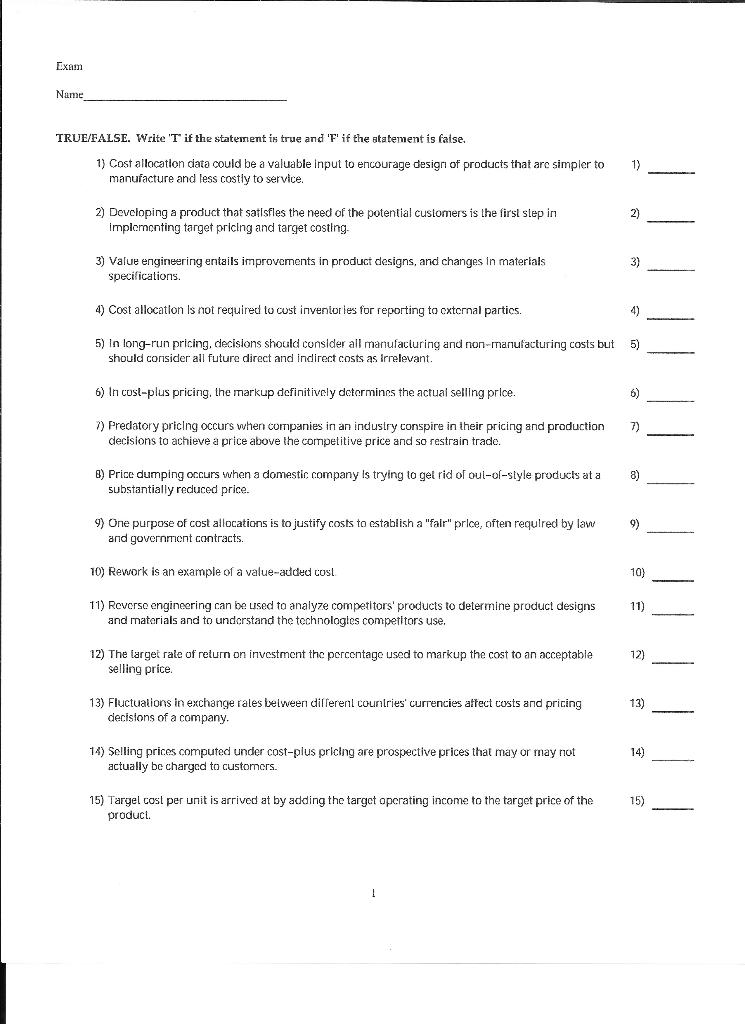
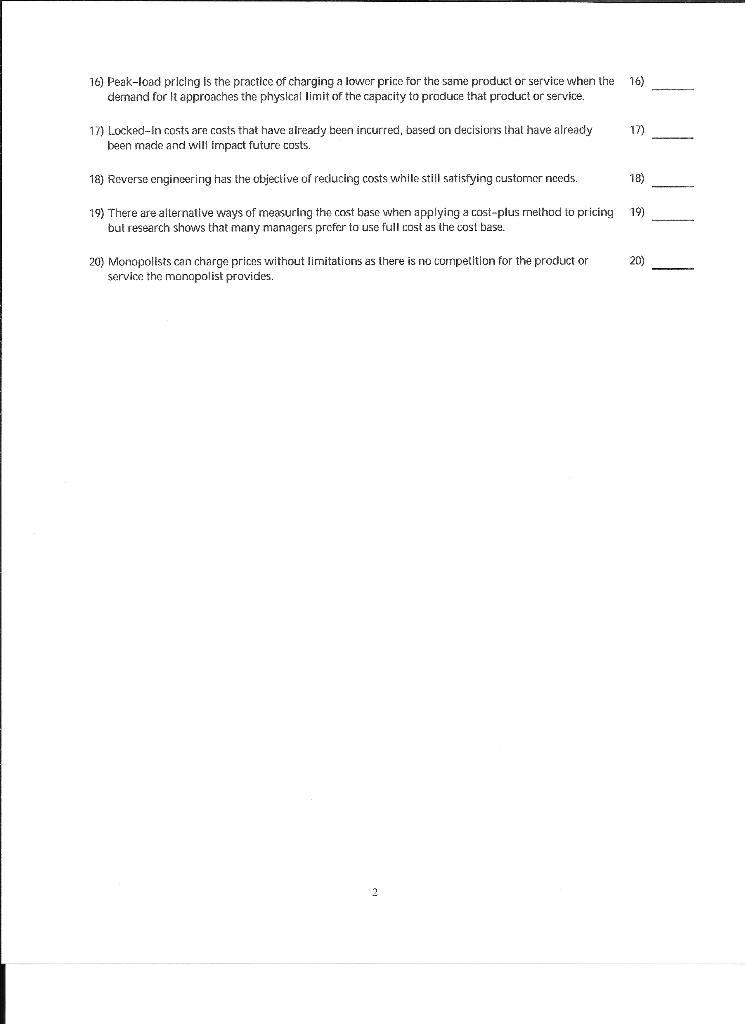
Exam Name TRUE/FALSE. Write 'T if the statement is true and 'F' if the statement is false, 1) Cost allocation data could be a valuable input to encourage design of products that are simpler to manufacture and less costly to service. 1) 2) 2) Developing a product that satisfles the need of the potential customers is the first step in implementing target pricing and target costing- 3) 3) Value engineering entails improvements in product designs, and changes in materials specifications. 4) Cost allocation is not required to cost inventories for reporting to external parties. 4) 5) 5) In long-run pricing, decisions should consider all manufacturing and non-manufacturing costs but should consider all future direct and indirect costs as irrelevant 6) In cost-plus pricing, the markup definitively determines the actual selling price. 6) 7) 7) Predatory pricing occurs when companies in an industry Conspire in their pricing and production decisions to achieve a price above the competitive price and so restrain trade. 8) B) Price dumping occurs when a domestic company is trying to get rid of oul-of-style products at a substantially reduced price. 9) 9) One purpose of cost allocations is to justify costs to establish a "fair" price, often required by law and government contracts. 10) Rework is an example of a value-added cost 10) 11) 11) Rcvcrse engineering can be used to analyze competitors' products to determine product designs and materials and to understand the technologies competitors use. 12) 12) The larget rale of return on investment the percentage used to markup the cost to an acceptable selling price 13) Fluctuations in exchange rales Lelween different countries' currencies affect costs and pricing decisions of a company. 13) 14) 14) Selling prices computed under cost-plus pricing are prospective prices that may or may not actually be charged to customers. 15) 15) Targel cost per unit is arrived at by adding the target operating income to the target price of the product. ! 16) 16) Peak-load pricing is the practice of charging a lower price for the same product or service when the demand for it approaches the physical limit of the capacity to produce that product or service. 17) 17) Locked-In costs are costs that have already been incurred, based on decisions that have already been made and will impact future costs. 18) Reverse engincering has the objective of reducing costs while still satisfying customer needs. 18) 19) 19) There are alternative ways of measuring the cost base when applying a cost-plus method to pricing but research shows that many managers prefer to use full cost as the cost base. 20) 20) Monopolists can charge prices without limitations as there is no competition for the product or service the monopolist provides
Step by Step Solution
There are 3 Steps involved in it

Get step-by-step solutions from verified subject matter experts