



Question: True or False questions Exam Name TRUC/FALSE. Write 'T if the statement is true and 'F' if the statement is false. 1) 1) Acceplable risk
True or False questions
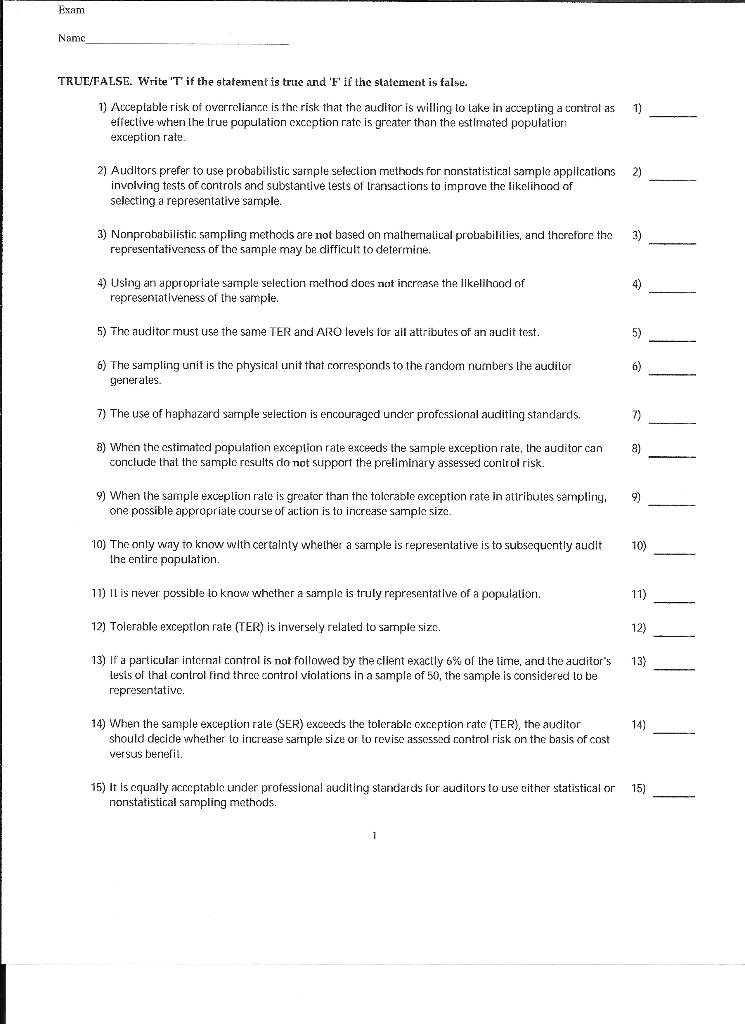
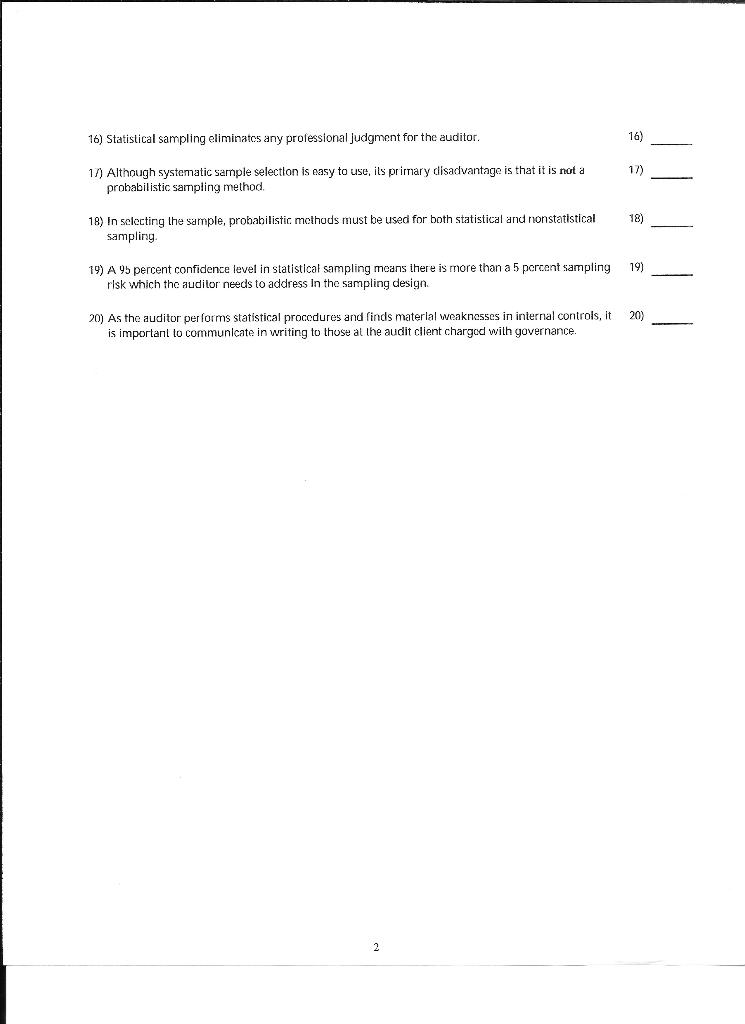
Exam Name TRUC/FALSE. Write 'T if the statement is true and 'F' if the statement is false. 1) 1) Acceplable risk of overreliance is the risk that the auditor is willing to lake in accepting a control as effective when the true population exception rate is greater than the estimated population exception rate. 2) 2) Auditors prefer to use probabilistic sample selection methods for nonstatistical sample applications involving tests of controls and substantive tests of transactions to improve the likelihood of selecting a representative sample. 3) 3) Nonprobabilistic sampling methods are not based on mathematical probabilities, and therefore the representativeness of the sample may be difficult to determine. 4) Using an appropriate sample selection method docs nut increase the likelihood of representativeness of the sample. 4) 5) The auditor must use the same TER and ARO levels for all attributes of an audit test 5) 6) 6) The sampling unit is the physical unit that corresponds to the random nurnbers the auditor generales. 7) The use of haphazard sample selection is encouraged under professional auditing standards. 7) 8) 8) When the estimated population exception rate exceeds the sample exception rate, the auditor can concl sample results not support preliminary assessed control risk. 9) When the sample exceplion rate is greater than the tolerable exception rate in attributes sampling, one possible appropriate course of action is to increase sample size. 10) 10) The only way to know with certainty whether a sample is representative is to subsequently audit the entire population. 11) Il is never possible to know whether a sample is truly representative of a population. 11) 12) Tolerable exception rate (TER) is inversely related to sample size. 12) 13) 13) If a particular internal control is not followed by the client exactly 6% of the lime, and the auditor's lesis of that control find three control violations in a sample of 50, the sample is considered to be representative. 14) 14) When the sample exceplion rale (SER) exceeds the tolerablc exception rate (TER), the auditor should decide whether to increase sample size or to revise assessed control risk on the basis of cost versus benefit 15) It is cqually acceptable under professional auditing standards for auditors to use cither statistical or nonstatistical sampling methods. 15) 16) Statistical sampling eliminates any professional Judgment for the auditor 16) 12) 17) Although systematic sample selection is easy to use, ils primary disadvantage is that it is not a probabilistic sampling method. 18) 18) In selecting the sample, probabilistic methods must be used for both statistical and nonstatistical sampling 19) 19) A 95 percent confidence level in statistical sampling means there is more than a 5 percent sampling risk which the auditor needs to address in the sampling design 20) 20) As the auditor performs statistical procedures and finds material weaknesses in internal controls, it is important to communicate in writing to those at the audit client charged with governance. 2
Step by Step Solution
There are 3 Steps involved in it

Get step-by-step solutions from verified subject matter experts