







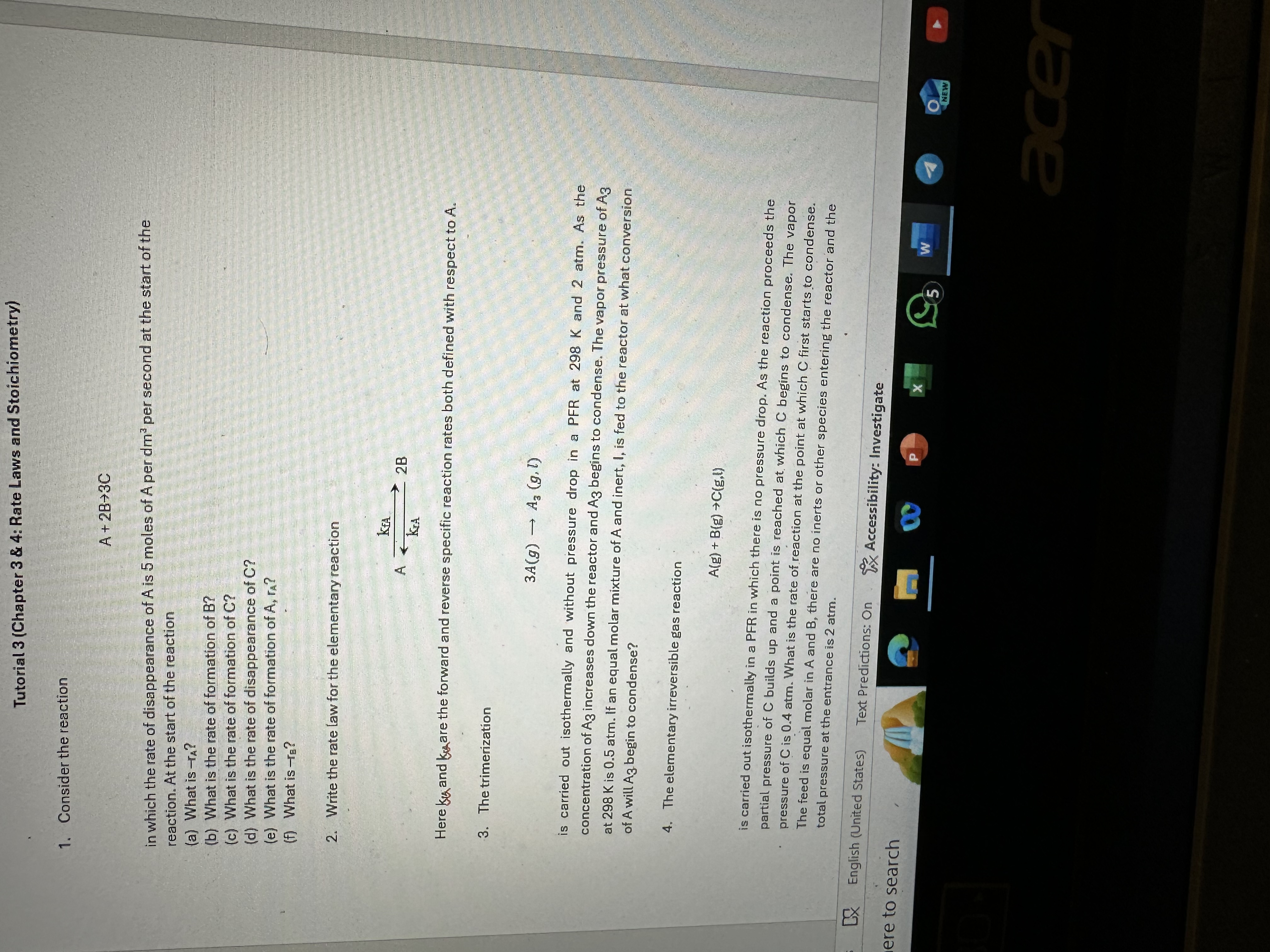
Question: Tutorial 3 ( Chapter 3 & 4 : Rate Laws and Stoichiometry ) Consider the reaction A + 2 B 3 C in which the
Tutorial Chapter & : Rate Laws and Stoichiometry
Consider the reaction
in which the rate of disappearance of is moles of A per per second at the start of the reaction. At the start of the reaction
a What is
b What is the rate of formation of
c What is the rate of formation of
d What is the rate of disappearance of C
e What is the rate of formation of
f What is
Write the rate law for the elementary reaction
Here and are the forward and reverse specific reaction rates both defined with respect to
The trimerization
is carried out isothermally and without pressure drop in a PFR at and atm. As the concentration of increases down the reactor and begins to condense. The vapor pressure of at is atm. If an equal molar mixture of A and inert, I, is fed to the reactor at what conversion of A will begin to condense?
The elementary irreversible gas reaction
is carried out isothermally in a PFR in which there is no pressure drop. As the reaction proceeds the partial pressure of builds up and a point is reached at which begins to condense. The vapor pressure of is atm. What is the rate of reaction at the point at which first starts to condense. The feed is equal molar in A and there are no inerts or other species entering the reactor and the total pressure at the entrance is atm.
English United States
Text Predictions: On
Accessibility: Investigate
Step by Step Solution
There are 3 Steps involved in it
1 Expert Approved Answer
Step: 1 Unlock

Question Has Been Solved by an Expert!
Get step-by-step solutions from verified subject matter experts
Step: 2 Unlock
Step: 3 Unlock
 Study Help